
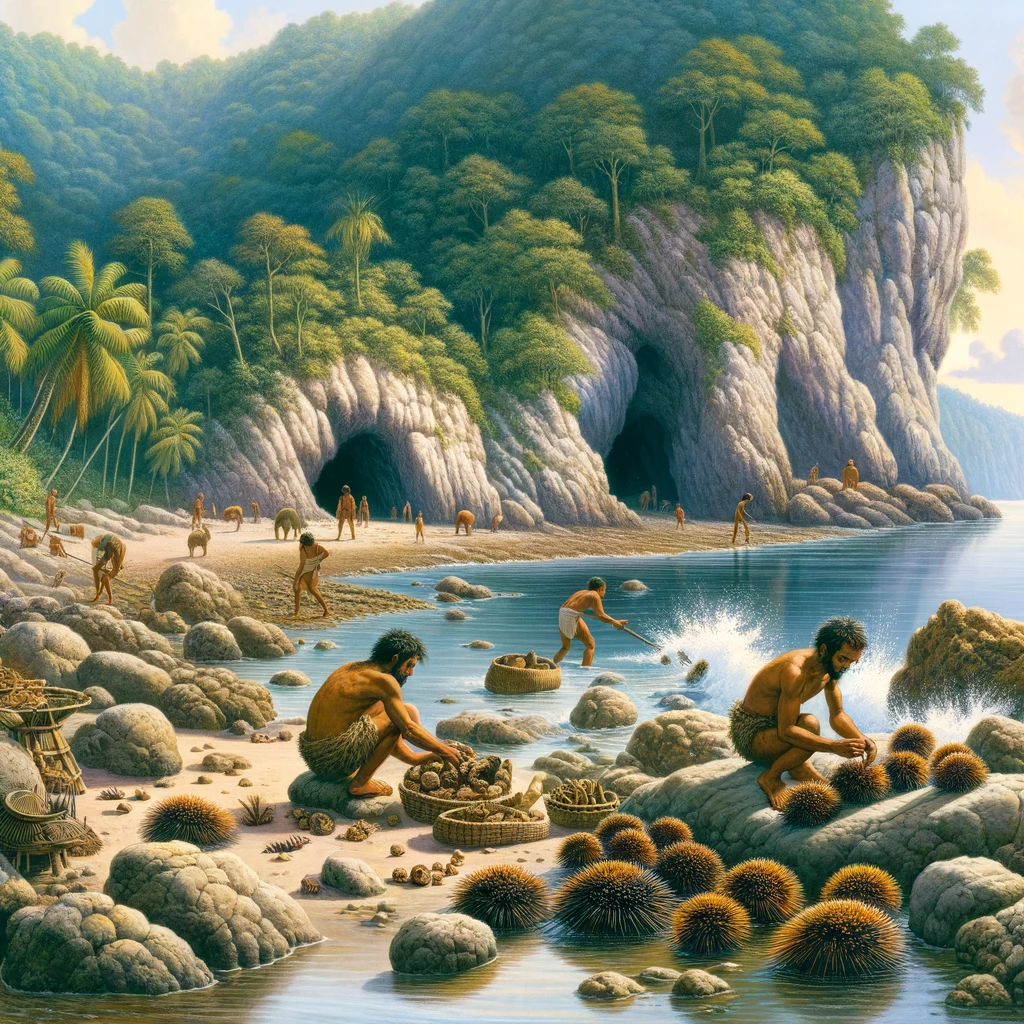
via Journal of Island and Coastal Archaeology, 08 May 2024: The study of Makpan Cave by Kaharudin et al. reveals that sea urchins have been a significant dietary resource for humans since ∼43,000 years ago. Analysis of over 13 kg of sea urchin remains indicates that these marine invertebrates were a staple food during the Late Pleistocene and were consistently exploited throughout various occupation phases, reflecting early human adaptation and resource strategies.
Sea urchins are consumed in many parts of the world today. Human consumption of these marine invertebrates can be traced back to at least the Late Pleistocene in various archaeological sites from Island Southeast Asia. Makpan Cave, on Alor Island in Indonesia, is one of the earliest Wallacean prehistoric sites with an occupation record beginning ∼43,000 years ago. Coastal resources (i.e., shellfish, barnacle, crab, and sea urchin) play a dominant role in the subsistence strategy at this site, with urchins important throughout all occupation phases. In this study, we used three different quantification methods (weight, NISP, and MNI) to analyze the over 13 kg of sea urchin remains recovered from Makpan. Our analysis showed that sea urchins were collected during the initial occupation period, when other coastal resources were sparsely utilized. This indicates that sea urchins were intentionally targeted rather than being the result of subsidiary foraging during shellfish collection. The quantity and consistency of sea urchin exploitation at Makpan indicates that urchin was considered a staple food, especially during the initial phase of occupation. We hypothesize that a focus on sea urchins may have been a key strategy for the colonization of novel environments by the earliest human settlers in the region.
![This week in Southeast Asian Archaeology: Prambanan gets some renewed attention, Phimai Black pottery surfaces at Mun Bon Dam, and I’m taking a short break next week.⠀
⠀
The featured stories look at the new Indonesia–India conservation project at Prambanan, focusing on the temple complex’s ruined perwara shrines, and a striking Late Prehistoric find in northeast Thailand: a remarkably complete Phimai Black vessel discovered as water levels fell at Mun Bon Dam.⠀
⠀
Temples, pottery, reservoirs, and a little scheduled rest. Back again on 27 July.⠀
⠀
Read this week’s newsletter: [link in bio]⠀
⠀
#SoutheastAsianArchaeology #Archaeology #Heritage #Prambanan #Thailand #Indonesia #Cambodia #Vietnam #CulturalHeritage #Substack This week in Southeast Asian Archaeology: Prambanan gets some renewed attention, Phimai Black pottery surfaces at Mun Bon Dam, and I’m taking a short break next week.⠀
⠀
The featured stories look at the new Indonesia–India conservation project at Prambanan, focusing on the temple complex’s ruined perwara shrines, and a striking Late Prehistoric find in northeast Thailand: a remarkably complete Phimai Black vessel discovered as water levels fell at Mun Bon Dam.⠀
⠀
Temples, pottery, reservoirs, and a little scheduled rest. Back again on 27 July.⠀
⠀
Read this week’s newsletter: [link in bio]⠀
⠀
#SoutheastAsianArchaeology #Archaeology #Heritage #Prambanan #Thailand #Indonesia #Cambodia #Vietnam #CulturalHeritage #Substack](https://scontent-sin6-3.cdninstagram.com/v/t51.82787-15/744214042_18361115071209510_2262608560893170251_n.jpg?stp=dst-jpg_e35_tt6&_nc_cat=110&ccb=7-5&_nc_sid=18de74&efg=eyJlZmdfdGFnIjoiRkVFRC5iZXN0X2ltYWdlX3VybGdlbi5DMyJ9&_nc_ohc=xWgcEbcGABIQ7kNvwFx63N6&_nc_oc=Adoe3NBLPcXYeu2Q4WRCzWnJf1ph4tRSl-ndybF0lr1wsJa0WKbjmjX6eHkay-SU5Dk&_nc_zt=23&_nc_ht=scontent-sin6-3.cdninstagram.com&edm=ANo9K5cEAAAA&_nc_gid=dMcRRCmLrU8vIjIWuykhnw&_nc_tpa=Q5bMBQG5vqf4e5fIO0chtZGhHMc0t4iJSvRKIjH0mUwQ4mAL0XnRhUWCa3QyBVw826n_vqBqmRNCfsRP&oh=00_AQDPeFDmCshofY_1cjAQWqyOU02u0lMfxO-CyI0CXLzMFw&oe=6A6490F1)