
• This week on Southeast Asian Archaeology: rare bronze Mahoratuek drums surface in Thailand, gold-glazed terracotta helps redraw Vietnam’s Ho Citadel, and Aceh War “loot” gets a long-overdue digital reckoning.⠀
⠀
https://bit.ly/46lX88H
  • Circuits, Ceramics, and Colonial Archives is out now 🏛️🌊📜 CNY/Tết (Year of the Horse) greetings + this week’s theme: heritage in a hurry—Angkor’s “high risk” Baksei Chamkrong, Sibonga church repairs post-Odette, and Indonesia’s 152-site revitalisation push. Read: https://bit.ly/3Mswq7G
  • Heritage isn’t just awe—it’s upkeep. This week: a historic building floor collapse at Siak Palace, Beng Mealea’s walkway repairs, Ponagar Tower’s arts show paused over losses.⠀
 ⠀
https://bit.ly/4chkwIb⠀
  • Biases, Bones & Burāq — this week’s Southeast Asian Archaeology newsletter is all about how small corrections can change big histories.⠀
⠀
We’ve got four fresh research reads:⠀
 🐟 Neolithic expansion that looks a lot more “rice and fish” once recovery bias is taken seriously⠀
 📜 An illuminated Qur’an section from Java on dluwang (treebark paper), with clues that push it earlier than you might expect⠀
 🐀 Timor-Leste’s giant/large murids, measured in detail to track changing ecologies (and a late crash)⠀
 ⚱️ Ban Non Wat grave size and offerings, mapping a sharp spike—and then easing—of social distinction⠀
⠀
And for a screen break: a small mention of PBS’s Angkor: Hidden Jungle Empire.⠀
⠀
Read the full roundup here: https://bit.ly/45Gh2uN ⠀
 #Archaeology #SoutheastAsia #Heritage #Anthropology #Museums #History
  • This week in Southeast Asian Archaeology: Sulawesi just delivered a headline-grabbing ~67,800-year-old hand-stencil date, Huế’s Imperial Citadel restoration has revealed a trilingual astronomical mural, and Malaysia’s new Guar Kepah Archaeological Gallery opens with the “Penang Woman” at centre stage. Deep time, dynastic science, and fresh public heritage spaces—come catch up on the week’s stories.⠀
⠀
https://bit.ly/3NG7WIg
  • New week, new reads: a “Southwestern Silk Road” model for amber into Han China, the biggest Austroasiatic genomic dataset yet (with Dvaravati/Angkor-era signals), plus rock art methods and fresh motifs from Malaysia and Laos. Molecules, motifs, and migration stories — all in one roundup.

Amber, Ancestry and Arty hands https://bit.ly/3LAK20c
  • New year, new (very full) newsletter From Java Man coming home to Jakarta to Khmer sculptures heading back to Cambodia and a bleak month on the Thai–Cambodian border, catch up on a whole month of Southeast Asian archaeology: https://bit.ly/4syuWJh
  • This week’s Southeast Asian Archaeology newsletter is all about the invisible infrastructure of knowledge — the stuff behind the sites. We look at Cambodia’s push to access the late Emma Bunker’s notebooks as a potential roadmap to looted Khmer art, a Thanh Hóa village communal house where 47 imperial edicts were quietly stashed in bamboo tubes for centuries, and Jingdezhen’s “ceramic gene bank” in China, where millions of sherds and glaze recipes are treated like DNA for porcelain. From roof beams to databases, it’s a reminder that archives, records and lab data shape what we think we know about the past just as much as temples and shipwrecks do. Plus the usual mix of regional news, grants, jobs and heritage politics — link in bio/newsletter below.

https://bit.ly/3XIeV5h
  • Genomes point to a 60,000-year “long chronology” for the first settlers of Sahul, while new DNA links China’s hanging coffins to the modern Bo people. #southeastasianarchaeology
 
Read here: https://bit.ly/4a64D6z
  • Southeast Asia’s past is on tour this week — from Bangkok’s royal treasures in Beijing’s Palace Museum to Cham sculptures in Đà Nẵng, Khmer–Chinese exchanges in Phnom Penh, and 14th-century Temasek sherds greeting commuters in a Singapore MRT station. 

In the latest Southeast Asian Archaeology newsletter, a look at how exhibitions are carrying the region’s history into train platforms, diplomatic halls and hands-on museum workshops, plus what this means for soft power, heritage policy and public archaeology. US readers will also spot a small Thanksgiving note of gratitude to the people and institutions who keep these stories alive.

Read the full issue and subscribe here: https://bit.ly/4oeZz2S 

#SoutheastAsia #Archaeology #Museums #Heritage #Thailand #Cambodia #Vietnam #Singapore #Beijing #PalaceMuseum
Saturday, March 7, 2026
Southeast Asian Archaeology
  • News
  • Resources
  • Countries
    • Southeast Asia
    • Mainland Southeast Asia
      • Cambodia
      • Laos
      • Malaysia
      • Myanmar
      • Thailand
      • Vietnam
    • Island Southeast Asia
      • Brunei
      • Indonesia
      • Malaysia
      • Philippines
      • Singapore
      • Timor Leste
    • Peripheral Southeast Asia
  • Topics
    • Artifact Type
      • Architecture
      • Bones and Burials
      • Ceramics
      • Intangible Cultural Heritage
      • Lithics
      • Megaliths
      • Rock Art
      • Sculpture
    • Field
      • Anthropology
      • Bioarchaeology
      • Epigraphy
      • General Archaeology
      • Metallurgy and Metalworking
      • Paleontology
      • Underwater Archaeology
      • Visual Art
      • Zooarchaeology
    • Other Themes
      • Animism
      • Buddhism
      • Christianity
      • Disaster Risk Management
      • Hinduism
      • Islam
      • Archaeological Tourism in Southeast Asia
  • Visit
    • Virtual Archaeology
    • Unesco World Heritage
  • Jobs
  • Subscribe
  • About
    • About
    • Supporters
    • Terms of Use
    • Privacy Policy
    • Contact
No Result
View All Result
Southeast Asian Archaeology
  • News
  • Resources
  • Countries
    • Southeast Asia
    • Mainland Southeast Asia
      • Cambodia
      • Laos
      • Malaysia
      • Myanmar
      • Thailand
      • Vietnam
    • Island Southeast Asia
      • Brunei
      • Indonesia
      • Malaysia
      • Philippines
      • Singapore
      • Timor Leste
    • Peripheral Southeast Asia
  • Topics
    • Artifact Type
      • Architecture
      • Bones and Burials
      • Ceramics
      • Intangible Cultural Heritage
      • Lithics
      • Megaliths
      • Rock Art
      • Sculpture
    • Field
      • Anthropology
      • Bioarchaeology
      • Epigraphy
      • General Archaeology
      • Metallurgy and Metalworking
      • Paleontology
      • Underwater Archaeology
      • Visual Art
      • Zooarchaeology
    • Other Themes
      • Animism
      • Buddhism
      • Christianity
      • Disaster Risk Management
      • Hinduism
      • Islam
      • Archaeological Tourism in Southeast Asia
  • Visit
    • Virtual Archaeology
    • Unesco World Heritage
  • Jobs
  • Subscribe
  • About
    • About
    • Supporters
    • Terms of Use
    • Privacy Policy
    • Contact
No Result
View All Result
Southeast Asian Archaeology
No Result
View All Result
ADVERTISEMENT

Related Posts

[Paper] Investigating the Risk of Violence During the Neolithic to the Late Iron Age in Northeast Thailand (c. 1400 B.C. – A.D. 800)

31 July 2024
0
42

...

[Paper] Intangible maritime heritage protection in Malaysia: The need for a revision of the National Heritage Act of 2005

26 July 2024
0
31

...

Source Taninai 2024

[Paper] International Coordinating Committee for Angkor (ICC-Angkor): Reflections from Diplomatic Perspectives

24 July 2024
0
26

...

Source: Koad and Deesamutara 2024

[Paper] Examining trade routes through the Thai–Malay Peninsula: A simulation analysis

23 July 2024
0
192

...

Popular This Week

  • Southeast Asian Archaeology from a Rock Art Perspective (with annotations)

    Southeast Asian Archaeology from a Rock Art Perspective (with annotations)

    0 shares
    Share 0 Tweet 0
  • The most influential books on Southeast Asian Archaeology (a crowdsourced list)

    0 shares
    Share 0 Tweet 0
  • Southeast Asian Archaeology memes that will tickle your funny bone and also make you ponder

    68 shares
    Share 68 Tweet 0
  • Negritos or Malays: Who are the original inhabitants of the Philippines?

    2 shares
    Share 2 Tweet 0
  • Explore Southeast Asia through these virtual galleries

    616 shares
    Share 616 Tweet 0
Buy me a coffeeBuy me a coffee

If you found this site useful, you can help support it by buying me a coffee!

[Paper] Staple or delicacy: Sea urchin exploitation over the last 40,000 years at Makpan Cave, Alor Island

10 May 2024
in Indonesia
Tags: Alor (island)foodGua Makpan (site)research papersThe Journal of Island and Coastal Archaeology
0
SHARES
60
VIEWS
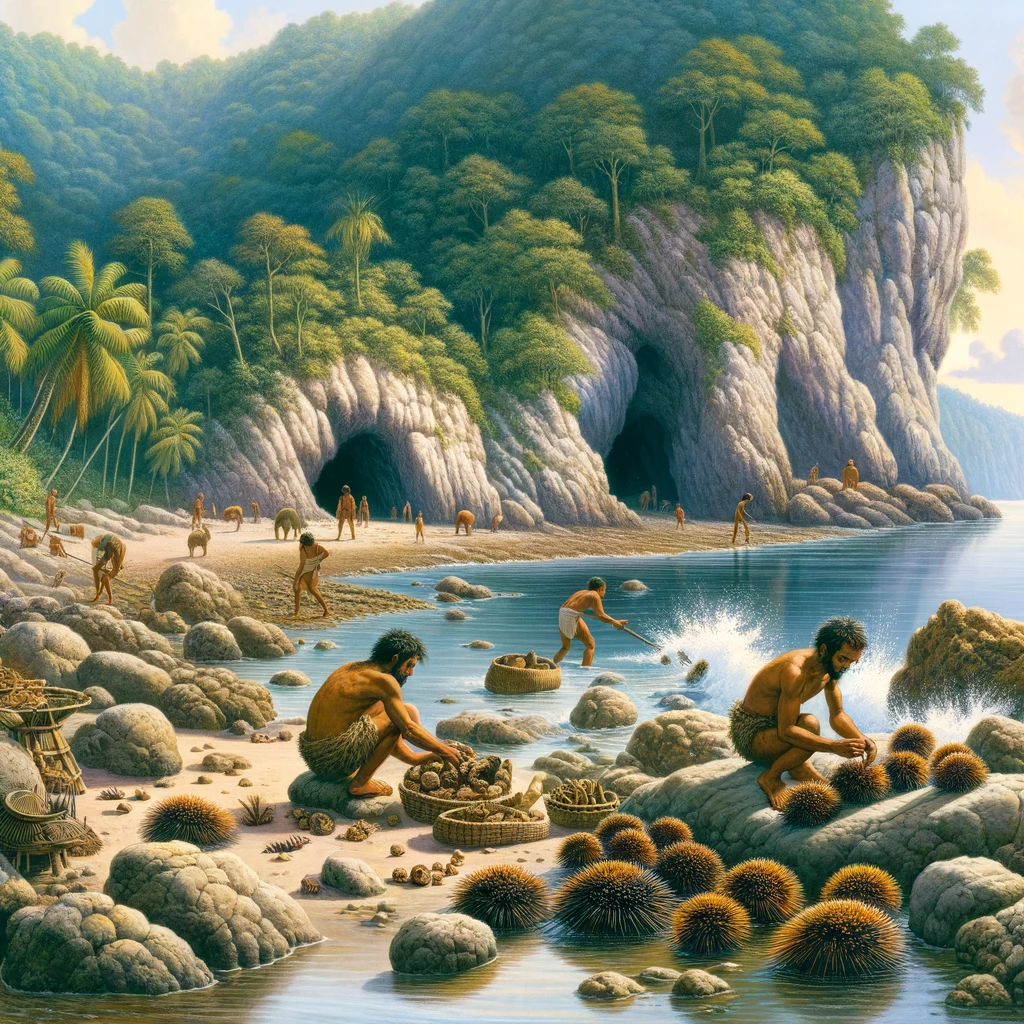
AI generated image

AI generated image

via Journal of Island and Coastal Archaeology, 08 May 2024: The study of Makpan Cave by Kaharudin et al. reveals that sea urchins have been a significant dietary resource for humans since ∼43,000 years ago. Analysis of over 13 kg of sea urchin remains indicates that these marine invertebrates were a staple food during the Late Pleistocene and were consistently exploited throughout various occupation phases, reflecting early human adaptation and resource strategies.

Sea urchins are consumed in many parts of the world today. Human consumption of these marine invertebrates can be traced back to at least the Late Pleistocene in various archaeological sites from Island Southeast Asia. Makpan Cave, on Alor Island in Indonesia, is one of the earliest Wallacean prehistoric sites with an occupation record beginning ∼43,000 years ago. Coastal resources (i.e., shellfish, barnacle, crab, and sea urchin) play a dominant role in the subsistence strategy at this site, with urchins important throughout all occupation phases. In this study, we used three different quantification methods (weight, NISP, and MNI) to analyze the over 13 kg of sea urchin remains recovered from Makpan. Our analysis showed that sea urchins were collected during the initial occupation period, when other coastal resources were sparsely utilized. This indicates that sea urchins were intentionally targeted rather than being the result of subsidiary foraging during shellfish collection. The quantity and consistency of sea urchin exploitation at Makpan indicates that urchin was considered a staple food, especially during the initial phase of occupation. We hypothesize that a focus on sea urchins may have been a key strategy for the colonization of novel environments by the earliest human settlers in the region.

Source: Full article: Staple or delicacy: Sea urchin exploitation over the last 40,000 years at Makpan Cave, Alor Island

Subscribe to the weekly Southeast Asian Archaeology news digest

Latest Books

The following are affiliate links for which I may earn a commission if you click and make a purchase. Click here for more books about Indonesian archaeology.
Sale Patterned Splendour: Textiles Presented on Javanese Metal and Stone Sculptures; Eighth to Fifteenth Century
Patterned Splendour: Textiles Presented on...
Amazon Prime
$30.54
Buy on Amazon
Sale Majapahit: Sculptures from a Forgotten Kingdom
Majapahit: Sculptures from a Forgotten Kingdom
$44.08
Buy on Amazon
Sale Little Species, Big Mystery: The Story of Homo Floresiensis
Little Species, Big Mystery: The Story of Homo...
Amazon Prime
$26.53
Buy on Amazon
Sale Majapahit: Intrigue, Betrayal and War in Indonesia’s Greatest Empire
Majapahit: Intrigue, Betrayal and War in...
Amazon Prime
$15.74
Buy on Amazon
Seaways and Gatekeepers: Trade and State in the Eastern Archipelagos of Southeast Asia, c.1600–c.1906
Seaways and Gatekeepers: Trade and State in the...
Amazon Prime
$46.00
Buy on Amazon
Heroes, Gods and Guardians: Hilts and Keris of Indonesia, Huntington Miller Collection
Heroes, Gods and Guardians: Hilts and Keris of...
Buy on Amazon

Leave a Reply

Your email address will not be published. Required fields are marked *

I agree to the Terms & Conditions and Privacy Policy.

This site uses Akismet to reduce spam. Learn how your comment data is processed.

Southeast Asian Archaeology

© 2019

Navigate Site

  • News
  • Resources
  • Countries
  • Topics
  • Visit
  • Jobs
  • Subscribe
  • About

Follow

Never Miss a Discovery
Subscribe for Exclusive Southeast Asian Archaeology News!

Stay connected with the latest breakthroughs, research, and events from across Southeast Asia’s archaeology scene. Sign up today for exclusive weekly updates, trusted by over 2,000 subscribers.

×
No Result
View All Result
  • News
  • Resources
  • Countries
    • Southeast Asia
    • Mainland Southeast Asia
      • Cambodia
      • Laos
      • Malaysia
      • Myanmar
      • Thailand
      • Vietnam
    • Island Southeast Asia
      • Brunei
      • Indonesia
      • Malaysia
      • Philippines
      • Singapore
      • Timor Leste
    • Peripheral Southeast Asia
  • Topics
    • Artifact Type
      • Architecture
      • Bones and Burials
      • Ceramics
      • Intangible Cultural Heritage
      • Lithics
      • Megaliths
      • Rock Art
      • Sculpture
    • Field
      • Anthropology
      • Bioarchaeology
      • Epigraphy
      • General Archaeology
      • Metallurgy and Metalworking
      • Paleontology
      • Underwater Archaeology
      • Visual Art
      • Zooarchaeology
    • Other Themes
      • Animism
      • Buddhism
      • Christianity
      • Disaster Risk Management
      • Hinduism
      • Islam
      • Archaeological Tourism in Southeast Asia
  • Visit
    • Virtual Archaeology
    • Unesco World Heritage
  • Jobs
  • Subscribe
  • About
    • About
    • Supporters
    • Terms of Use
    • Privacy Policy
    • Contact

© 2019

This website uses cookies. By continuing to use this website you are giving consent to cookies being used. Visit our Privacy and Cookie Policy.