







Forget Angkor. Sure, it’s one of the largest religious monuments in the world, and you gotta admit that with spectacular architecture, sculpture and bas-reliefs there’s no wonder over two million people visited Cambodia last year. But the archaeological sites in Southeast Asian are so much more than the 11th century temple to Vishnu.
With some suggestions from the facebook group, SEAArch gives you the internet tour of five other spectacular archaeological sites in Southeast Asia open to the casual visitor – and three of them are UNESCO World Heritage Sites. So step in and take a look at some of the other great sites Southeast Asia has to offer – in Thailand, Malaysia, Indonesia, Vietnam, and yes, even Singapore!

Note: The names in parentheses denote the nearest airport.
Borobudur
Java, Indonesia (Yogyakarta or Solo)
9th Century
UNESCO World Heritage Site

Creative Commons image by cranrob
Lost to the jungle for over 700 years, this gigantic Buddhist stupa was reclaimed from the jungle in 1814 by Thomas Stamford Raffles, the then-governor of Java. When the locals reported about some ruins on a hill, little that Raffles realise that the entire hill was the archaeological site itself!
Built in the 9th century by the Sailendra Dynasty, this massive pyramid is comprised of four circular terraces on top of six square ones. Estimates say the entire structure was built over a 70-year period, a massive undertaking considering that the monumental stones weigh 100kg each!
Pilgrims would ascend the stupa in a clockwise, circumambulatory route. They would be flanked by reliefs depicting Buddhist teachings: the Jataka tales and the life and wisdom of Buddha. Here, the reliefs tell us as much about daily life in ancient Java as it does of Buddhist teachings. The meditation was as much about the walk as it was the final destination – but it’s still unsure if pilgrims were allowed all the way up or if access were only restricted to the elites and religious. Today, however, it’s a proud symbol of the past – despite most of the population’s conversion to Islam.
For more information about Borobudur:
– The Restoration of Borobudur (World Heritage Series)
– The Lost Temple of Java (History/Journey’s Into the Past) by P. Grabsky
– The Mysteries of Borobudur: Discover Indonesia Series by J. N. Miksic
– Borobudur: Golden Tales of the Buddhas (Periplus Travel Guides) by J. Miksic
– Borobudur by J. L. Nou
– Borobudur (Images of Asia)


My Son Sanctuary
Quang Nam Province, Vietnam (Da Nang)
4th century
UNESCO World Heritage Site

Creative Commons image by Andries3
One of the earliest emergent polities known in Southeast Asia, recorded in Chinese dynastic records, was Champa. An important port in the South Sea, Champa was a crucial stop along the maritime trade route between China and India. More accurately however, Champa was a loose federation of kingdoms that dot the central Vietnamese coast. The name ‘Champa’ came from a 6th century inscription at the My Son Sanctuary.
The sanctuary of My Son represents some of the finest architecture by the Chams. Borrowing heavily from the architectural traditions of India and once thought of as an ‘Indianized’ state, current theories hold that the Cham state emerged locally and later adopted Hindu practices from cultural exchanges with traders to strengthen their positions of rulership.
The complex was originally made up of some 70 towers, but only 25 remain today. In stark contrast to the temples of Angkor, the ruins of My Son seem almost minimalist. They are, however, one of the earliest examples of monumental architecture in Southeast Asia and have existed longer than Angkor as well!
Find our more about Champa in:
– The Art of Champa by J. Hubert
– Early Cultures of Mainland Southeast Asia
– Hindu-Buddhist Art Of Vietnam: Treasures From Champa by E. Guillon
– The Indianized States of Southeast Asia by G. Coedes


Niah Caves
Sarawak, Malaysia (Miri)
40,000 years BP

Creative Commons image by iJER
Archaeological evidence from the Niah caves brings us back 40,000 years ago – to the earliest example of the modern humans in Southeast Asia, from a skull fragment. But even more amazing is that the stratigraphy of Niah shows that the cave has been in use by early humans since that time, judging from the assembly of stone tools, shell ornaments and pottery that traces its occupation from the Pleistocene right up to the metal age.
Among the human remains, the deep skull from the ‘hell’ – named for the unbearable heat conditions during the excavation season – carries an associated radiocarbon date of 40,000 years BP. Neolithic extended burials and later-period secondary jar burials were also found in the massive cave. In addition, rock art bearing the ‘ship of the dead’ motif is associated with a burial area in the cave.
Today, the cave is the highlight of the Niah National Park, a nature-lovers’ stopover. An archaeological museum sits near the entrance of the cave. Niah is approximately two hour’s drive away from the nearest airport city, Miri.
More on the Niah caves and the prehistory of Southeast Asia in:
– Southeast Asia: From Prehistory to History by P. S. Bellwood and I. Glover (Eds)
– Reconstructing human subsistence in the West Mouth (Niah Cave, Sarawak) burial series using stable isotopes of carbon by J. Krigbaum
– The archaeology of foraging and farming at Niah Cave, Sarawak by G. Barker
– Early History (The Encyclopedia of Malaysia) by Nik Hassan Shuhaimi Nik Abdul Rahman (Ed)
– Prehistory of the Indo-Malaysian Archipelago by P. Bellwood


Ban Chiang Archaeological Site
Ban Chiang, Thailand (Udon Thani)
c. 2100 BC
UNESCO World Heritage Site
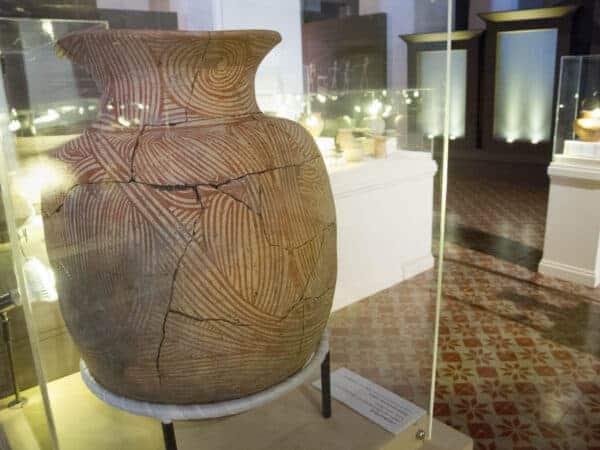
Now that the airport international, the capital of Udon Thani province is certainly more accessible to the world, and about time too – since it’s the gateway to the Ban Chiang archaeological site, one of the earliest sites in Southeast Asia to gain world heritage status.
What Ban Chiang lacks in iconic architecture, it makes up in sheer archaeological significance as a Bronze Age settlement. Over major excavations during the 60s and 70s, the picture of developing metal age technology that emerged challenged previous assumptions of Southeast Asia being a backwater to the civilisations in India and China.
Evidence suggests that a bronze age in Southeast Asia may have arisen as a result of agriculturalists moving into the region from China, or even a local origin for bronze working. Whichever the case may be – the advent of this new technology seems to have affected Southeast Asia in ways that do not conform to the norms seen in the Mediterranean, India and China.
Read about the significance of Ban Chiang and the Southeast Asian Bronze Age in:
– The Bronze Age of Southeast Asia (Cambridge World Archaeology) by C. Higham
– Ban Chiang: Discovery of a Lost Bronze Age by the University Museum of the University of Pennsylvania by J. C. White
– Ban Chiang, a Prehistoric Village Site in Northeast Thailand: The Human Skeletal Remains (Thai Archaeology Monograph Series, 1) by M. Pietrusewsky and M. T. Douglas
– Ban Chiang: Art and prehistory of Northeast Thailand by A. J. Labbei
– Cognition and design production in Ban Chiang painted pottery by P. Van Esterik
– Ban Chiang prehistoric cultures by Y. Chin


Fort Canning Archaeological Site
Singapore (Singapore)
c. 14th century AD
If you’re travelling between anywhere in Asia, chances are you’ll be spending some time transiting in Singapore. And for a country that only has an area of 700 sq. km, space for archaeology is very limited. Which is why the Fort Canning archaeological site is quite special as a window into the island-state’s past.
Don’t be fooled by the colonial period name: Fort Canning Hill was formerly known as Bukit Larangan, Malay for the Forbidden Hill and when the British first landed in Singapore, the locals knew of the hill as a spiritual place where ancient royalty was buried. Early legends of Singapore mentioned the existence of a place called Temasek, presumably a settlement, but it was not until the parts of the hill were excavated in 1984 that the first confirmations of such a settlement existed.
Ceramics, such locally-made earthenware as well as Song Dynasty ceramics and porcelain and celadon provided evidence for the existence of a settlement in the 14th century, while the presence of glass beads and glass slag inferred the presence of a glass recycling facility. Today, one of the open archaeological pits has been converted into a exhibition area where visitors can see the archaeology of Fort Canning as well as the stratigraphic layers that form the site.
Find out more about the archaeology of Singapore in:
– Early Kingdoms of the Indonesian Archipelago and the Malay Peninsula by P. M. Munoz
– Early Singapore 1300s – 1819: Evidence in Maps, Text and Artefacts by J. N. Miksic and C. Low (Eds)
– Cultural Sites of Malaysia, Singapore, and Indonesia by J. Dumarcay and M. Smithies
– Archaeology (A Guide to the collection / National Museum, Singapore) by the National Museum Singapore
– Treasures from the National Museum, Singapore by the National Museum, Singapore


I am not sure what archeologists think of the restoration done in Trowulan archeological site, but its good to see that they really try to preserve and protect the sites, even with limited resources. It is a pity though as its not part of the tourist candi trail.
In contrast, from what i saw 3 years ago…MySon as well as the Cham museum get a lot of tourists but seems to be struggling with restoration and maintenance. Really surprising to see. I did notice that there were 3 related museums there (the on-site one, the nearby one that probably never sees visitors, the Champa museum in Danang with its so few exhibits), so is it a case of spreading resources thin?
Anyway, it is quite understandable for Cambodia, Thailand and Indonesia to have to spread its resources among many many sites. But for Vietnam (and also Malaysia), I really wonder why, especially noting their huge tourism budgets and how the few sites they have can possibly bring in more tourists. Its probably not about availability of funds.