
• What was inside these pottery vessels 3,000 years ago?

In Peninsular Malaysia, researchers have found something unexpected preserved in prehistoric pottery: traces of milk.

A new study analysed 15 pottery fragments from three archaeological cave sites—Gua Cha, Gua Kajang and Gua Harimau—using techniques that can identify microscopic traces of foods absorbed into ceramics.

Among the substances detected were caseins and β-lactoglobulin, proteins found in milk. Their presence provides the earliest direct evidence yet reported for dairy processing in equatorial Mainland Southeast Asia, dating to around 3,000 years ago.

Archaeologists have long struggled to establish when farming and animal domestication became part of life in prehistoric Peninsular Malaysia. Unlike sites further north in Southeast Asia, clear evidence of early livestock management and cultivation has been difficult to find here, partly because animal bones and plant remains are often poorly preserved.

The milk proteins suggest that Neolithic communities were processing dairy products thousands of years ago. This does not necessarily mean they were raising dairy animals locally but it provides an important new piece of evidence for understanding food production and consumption in the region.

The researchers also identified traces of plant and animal foods, suggesting that these vessels were used for a variety of food-processing activities.

Reference
Goh et al. 2026. “Pottery residues provide earliest direct evidence for domestication and dairy processing in equatorial Mainland Southeast Asia.” Journal of Archaeological Science: Reports, 75, 106066.
10.1016/j.jasrep.2026.106066

#SoutheastAsianArchaeology #SEAArch #Archaeology #MalaysiaArchaeology #milk
  • FORTS, FINDS AND FAST BIKES! ⠀
⠀
Archaeology isn
  • This week in Southeast Asian Archaeology:⠀
⠀
💀 What decades of funerary archaeology can tell us about the changing field of bioarchaeology in Indonesia.⠀
⠀
🏛️ Reconstructing the lost palaces of Lý dynasty Đại Việt—and what archaeology at Thăng Long reveals about their architecture.⠀
⠀
🙏 Two devas at Angkor Thom’s Victory Gate get their heads back, complete with an “eye-opening” ceremony.⠀
⠀
🪨 And the Singapore Stone has become Stoney, an absurdly adorable plushie - I want one.⠀
⠀
All that and much more in this week’s Stones, Skeletons and State Rooms.⠀
⠀
#SoutheastAsianArchaeology #Indonesia #Vietnam #Cambodia #Singapore
  • 🏺 CAVES, COMMUNITIES AND CULTURAL MEMORY⠀
⠀
An archaeological site doesn’t stop changing once the excavation ends.⠀
⠀
This week, we look at Ban Chiang through the memories of the people who live there, and at Sri Mahosot, where an ancient landscape remains part of contemporary worship and community identity.⠀
⠀
Also this week:⠀
⠀
🇵🇭 Rescue archaeology at a cave in Romblon⠀
🇮🇩 A possible Kadiri-era site in East Java⠀
🇻🇳 A new forest-and-heritage trail at Mỹ Sơn⠀
🇰🇭 Angkorian Buddhist sculpture⠀
📢 SPAFACON 2027 call for abstracts⠀
💼 New archaeology and heritage jobs⠀
💰 Grants, fellowships and PhD opportunities⠀
⠀
…plus archaeology and heritage stories from across Southeast Asia.⠀
⠀
Caves, Communities and Cultural Memory⠀
Southeast Asian Archaeology Newsletter | 21–27 September 2026⠀
⠀
🔗 Link in bio / southeastasianarchaeology.substack.com⠀
⠀
#Archaeology #SoutheastAsianArchaeology #SoutheastAsia
  • One river in northern Vietnam has yielded a remarkable record of more than 2,000 years of boatbuilding.

From the bed of the Kinh Thầy River at Cầu Bình, researchers documented 23 boat remains, including eight virtually complete logboat hulls and fragments of bows, sterns and planks. Radiocarbon dates place most of them between roughly 700 BCE and 1500 CE. 

Many hulls showed signs of sophisticated work beyond simply hollowing out a tree trunk. The hulls could be widened during manufacture, while wooden thwarts or bulkheads helped maintain their expanded shape. Some boats also carried additional boards along their upper edges, attached through holes with fibre lashings.

Around 2,000 years ago, during the late Đông Sơn and Han periods, several examples reveal another solution: mortise-and-tenon joints locked with wooden dowels. One boat even combined these joints with lashing holes. In later centuries, other Cầu Bình boats were built without this particular system.

This shows that over 2,200 years, boatbuilders used, combined and abandoned different solutions while continuing a long tradition of wooden river craft in the northern Red River Delta.

Reference
Bellwood, Nguyễn, , Lê, Hung, & Calo. 2026. “A 2,200-Year Logboat Sequence (700 BCE–1500 CE) from the Northern Red River Delta, Vietnam.” International Journal of Nautical Archaeology.
DOI: 10.1080/10572414.2026.2717219

#VietnamArchaeology #SoutheastAsianArchaeology #MaritimeArchaeology #NauticalArchaeology #RedRiverDelta
  • 🏺 Palaces, Pots and Porcelain⠀
⠀
Xin Chào! 🇻🇳 It’s a very Vietnam-heavy week in Southeast Asian archaeology: imperial palaces, ceremonial architecture, ancient brick tombs, early tile kilns, Cham heritage and the return of a Đông Sơn bronze drum.⠀
⠀
🔬 New research from Malaysia finds molecular evidence for dairy processing around 3,000 years ago.⠀
⠀
🏺 And in the Philippines, some very unusual earthenware decorated with fragments of Chinese porcelain tells a story about Manila, material culture and the early colonial encounter.⠀
⠀
There’s plenty more from around Southeast Asia in this week’s newsletter.⠀
⠀
Palaces, Pots and Porcelain — read via the link in bio.⠀
⠀
#Archaeology #SoutheastAsianArchaeology #VietnamArchaeology #MalaysiaArchaeology #PhilippineArchaeology
  • A 4.38-metre-long wooden rudder from the west coast of Sumatra is providing a rare glimpse of Southeast Asian seafaring around 1,300 years ago.

The rudder was recovered at the Bongal Site in Central Tapanuli, North Sumatra. Today the site lies inland, but geomorphological research suggests that in the 7th–8th centuries CE it was part of a shallow bay or estuarine environment.

The quarter rudder was carved from a single log and measures 4.38 metres long. Radiocarbon dating of the wood produced a calibrated date of 656–687 CE, making it the earliest securely dated rudder currently known from Southeast Asia.

Researchers also documented hull planks with raised wooden lugs, dowels and surviving palm-fibre ropes. These suggest that parts of these boats were pegged and tied together—a construction method archaeologists call the Southeast Asian lashed-lug tradition. Differences between the surviving planks even suggest that several vessels may have been present. 

Bongal also produced ceramics, glass, beads and coins pointing to connections with much wider exchange networks. The researchers do not argue that the Bongal boats themselves were making long-distance voyages across the Indian Ocean, but propose that locally constructed vessels formed part of a regional maritime network, moving through rivers and along Sumatra’s coast and connecting communities there to broader systems of exchange.

Reference
Mochtar et al. 2026. “Lashed-Lug Boats from the Bongal Site: New Evidence for Early Maritime Networks on the West Coast of Sumatra.” International Journal of Nautical Archaeology.
10.1080/10572414.2026.2714901

#SoutheastAsianArchaeology #Indonesia #Sumatra #MaritimeArchaeology #NauticalArchaeology
  • Betel, Boats and Border Stones is this week’s Southeast Asian Archaeology Newsletter.⠀
⠀
This issue starts with a fascinating new paper on ancient teeth from South Sulawesi, where unusual dental wear may point to the habitual sucking of whole areca nuts by pre-agricultural foragers.⠀
⠀
Then we move from teeth to timbers: lashed-lug boat remains from Bongal on Sumatra’s west coast, including a 7th-century quarter rudder, add new detail to Southeast Asia’s early maritime networks.⠀
⠀
And yes, there are more boats: Phanom Surin in Thailand and the Butuan boat sites in the Philippines both make appearances this week.⠀
⠀
Plus: Preah Vihear, Koh Ker, Prambanan, Đông Sơn drums, repatriation, digital heritage, and more.⠀
⠀
Read the full issue at the link in bio.⠀
⠀
#SoutheastAsianArchaeology #Archaeology #MaritimeArchaeology
  • People in Sulawesi may have been habitually using a neuroactive plant as far back as 25,000–16,000 years ago.

A new study in Science Advances examines two preagricultural foragers from South Sulawesi, Indonesia, separated by thousands of years but sharing an unusual dental pattern: deep, rounded, circumferential wear that does not match ordinary chewing. The researchers argue that the wear formed through repeatedly holding, sucking or gently gnawing a small, hard object in different parts of the mouth. 

Using LC-MS, the team detected arecoline—a characteristic alkaloid of areca, or “betel”, nut—in dental samples from both individuals. One came from Leang Bulu Bettue and dates to 25–16 ka; the other, from Leang Cappalombo 1, is associated with deposits dating to around 7.6–6.3 ka. 

This was probably not betel chewing in the form familiar today. Modern betel quid typically combines processed areca nut with slaked lime and other ingredients. To test whether a simpler practice was plausible, the researchers soaked intact areca nuts and applied the resulting solutions to cells expressing human receptors. The experiments showed that intact nuts could release physiologically active arecoline without slaked lime. Combined with the dental wear, chemical residues and experiments support the authors’ interpretation that these foragers habitually sucked whole areca nuts.

For now, the sample is just two individuals, and psuggestions that the nuts were used for stimulation, pain relief or medicinal purposes remain hypotheses. What the study does show is that habitual neuroactive plant use may reach far deeper into the hunter-gatherer past than the archaeological record had previously demonstrated. 

Reference
Brumm et al. 2026. “Betel nut sucking is the earliest recorded evidence for the habitual use of a neuroactive plant drug.” Science Advances.
10.1126/sciadv.aei1901

#SoutheastAsianArchaeology #Sulawesi #IndonesiaArchaeology #Prehistory #BetelNut
  • Twenty-two small beads can preserve the traces of a much larger world of movement and exchange.

A new archaeometric study examines beads excavated in 2023 at Khok Phithak, within the ancient city of Khu Bua in Ratchaburi, central Thailand. Khu Bua was an important urban centre associated with the Dvaravatī cultural sphere, enclosed by earthen ramparts and moats and situated within the Mae Klong river system. 

The researchers analysed 21 glass beads and one chalcedony/agate bead, combining microscopic observations with VP-SEM-EDS, LA-ICP-MS and micro-Raman spectroscopy. Manufacturing traces—including axial colour streaks and elongated bubbles—indicate that most of the glass beads were made by drawing glass into tubes or canes before cutting them into individual beads. 

Their chemistry indicates that nineteen beads belong to the m-Na-Al-1 glass subgroup, consistent with glassmaking traditions documented in South Asia, particularly the wider technological sphere of southern India and Sri Lanka. Together with their manufacturing technique, the authors associate these beads with the large-scale Indo-Pacific beadmaking tradition. 

However, one blue bead, B014, is made from plant-ash soda–lime glass with a broad western Asian affinity—although the study cannot identify a specific production centre. Another remarkable bead, B007, appears to have been wound from recycled iron-smelting slag, suggesting an entirely different production history.

Rather than evidence for primary glassmaking at Khu Bua itself, the authors interpret the assemblage as reflecting an inland centre of consumption and possibly redistribution, connected through maritime and riverine networks to much wider systems of Indian Ocean exchange. 

Reference
Risteka et al. 2026. “Production Technology and Provenance of Dvaravatī Glass Beads from Khu Bua, Central Thailand: An Archaeometric Study.” Heritage 9, 347.
10.3390/heritage9090347

#SoutheastAsianArchaeology #ThailandArchaeology #Dvaravati #KhuBua #ancienttrade
Wednesday, October 21, 2026
Southeast Asian Archaeology
  • News
  • Resources
  • Countries
    • Southeast Asia
    • Mainland Southeast Asia
      • Cambodia
      • Laos
      • Malaysia
      • Myanmar
      • Thailand
      • Vietnam
    • Island Southeast Asia
      • Brunei
      • Indonesia
      • Malaysia
      • Philippines
      • Singapore
      • Timor Leste
    • Peripheral Southeast Asia
  • Topics
    • Artifact Type
      • Architecture
      • Bones and Burials
      • Ceramics
      • Intangible Cultural Heritage
      • Lithics
      • Megaliths
      • Rock Art
      • Sculpture
    • Field
      • Anthropology
      • Bioarchaeology
      • Epigraphy
      • General Archaeology
      • Metallurgy and Metalworking
      • Paleontology
      • Underwater Archaeology
      • Visual Art
      • Zooarchaeology
    • Other Themes
      • Animism
      • Buddhism
      • Christianity
      • Disaster Risk Management
      • Hinduism
      • Islam
      • Archaeological Tourism in Southeast Asia
  • Visit
    • Virtual Archaeology
    • Unesco World Heritage
  • Jobs
  • Subscribe
  • About
    • About
    • Supporters
    • Terms of Use
    • Privacy Policy
    • Contact
No Result
View All Result
Southeast Asian Archaeology
No Result
View All Result
ADVERTISEMENT

Related Posts

Source: Vietnam Net 20240608

Vintage Photos Capture Early 20th Century Vietnamese Culture

11 June 2024
0
113

...

Source: Harvard Gazette 20240529

Archivist Highlights Philippine Heritage at Peabody

30 May 2024
0
21

...

Did the Ming Reach America Before Columbus

Did the Ming Reach America Before Columbus

30 January 2024
0
202

...

Source: Canilao 2023

[Paper] Systematic archaeological aerial survey using Consumer Off-the-Shelf Remotely Piloted Aerial System: Methods note in the Philippine setting

10 January 2024
0
40

...

Popular This Week

  • Southeast Asian Archaeology from a Rock Art Perspective (with annotations)

    Southeast Asian Archaeology from a Rock Art Perspective (with annotations)

    0 shares
    Share 0 Tweet 0
  • The most influential books on Southeast Asian Archaeology (a crowdsourced list)

    0 shares
    Share 0 Tweet 0
  • Southeast Asian Archaeology memes that will tickle your funny bone and also make you ponder

    68 shares
    Share 68 Tweet 0
  • Negritos or Malays: Who are the original inhabitants of the Philippines?

    2 shares
    Share 2 Tweet 0
  • Explore Southeast Asia through these virtual galleries

    616 shares
    Share 616 Tweet 0
Buy me a coffeeBuy me a coffee

If you found this site useful, you can help support it by buying me a coffee!

Pole photography for archaeology – Part 4: Evaluations and Tips

26 November 2009
in Featured, Personal
Tags: aerial archaeologygeneral archaeologymaps and mappingNotes from the Fieldphotography
0
SHARES
144
VIEWS
Pole photography for archaeology – Part 3: Parts List

I end off my series on using a pole camera for archaeology (check out Parts 1: The Problem, 2: Field Test and 3: Parts list) with some pole photography tips and evaluative notes about the system I made. I also have some ideas for things I might want to try out for later, and the cost of the whole setup.
My pole photography setup using a Canon G11 and a carbon fibre pole

Initial Requirements
In my first post, I wrote that I needed to be able to take “high-quality photographs from a stable, elevated platform that could reach heights of 35 feet. This system had to be portable, operable by one person, and cost much less than what I spent on the scaffold.” For most part, the polecam did everything I required of it. High-quality photos (specifically, shooting in raw was an important requirement for me) is not an issue with prosumer class compacts these days, although I would one day like to have a system that I can set a DSLR up on. I couldn’t reach 35′ or 45′ feet – the maximum elevation that I could go is 30′ but I should note that height is the upper limit a normal person can handle. People with small frames might not be able to extend it this high or control the pole effectively. There are configurations that extend further, to 45’ or even 66’ – but at this height you’re going to need to mount the pole on a vehicle for stability, with a hydraulic system to extend and collapse the pole.

At the current configuration, the pole is approximately 6 feet long and weighs about 11lbs (5 kg) when fully collapsed. The length of the pole was a bit of an issue for me because it was a little cumbersome to stuff into a car; that said, I did manage to stuff it into a Kancil with minimum inconvenience. With a carry case or a shoulder strap, the pole could also be comfortably carried around in wide open spaces. In urban areas, I had to do a Gandalf impression and carry it like a walking staff (You shall not… pass!). Setting up was easy enough for one person, but something I didn’t really factor in was the amount of physical strength needed to operate the pole. Repeated collapsing and extending the pole, along with keeping the pole in balance when extended, requires a lot of upper body strength, especially when holding the pole is at maximum length. After three hours, I was positively tired and couldn’t extend the pole past 15 feet. I also managed to get some skin crushed between the telescoping sections – ouch! – and a righteous muscle ache the next day. I think two people would be able to operate the pole comfortably for a day, and a medium-to-large sized person could probably handle it alone. Hobbits would have a problem getting the camera to the top of the pole in the first place.
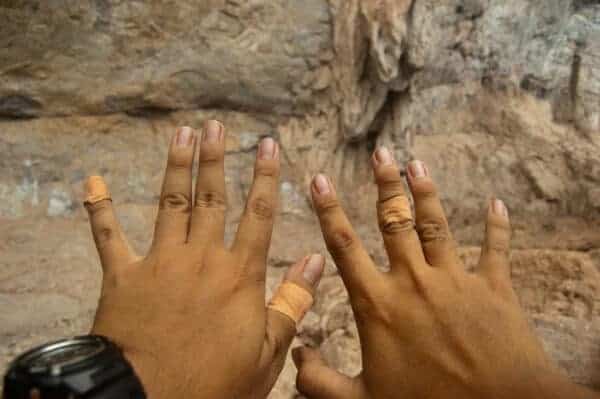
Scratches on my fingers from using the polecam

Future options
I’ve already mentioned that I wasn’t with the relatively narrow field of view at its widest setting (24 mm) and a wide-angle lens might be able to solve this. Another consideration was the video monitor – if you’ve noticed, I didn’t have any space of the pole to place the monitor, and most cases I propped in in the ground in front of me. It’s a bit of a strain to look down at the monitor to aim, especially on bright days, so perhaps I will find some way to mount the monitor to the pole to improve visibility. Maybe another creative use of a gorillapod? Finally, I might want to look into getting a tripod for the pole, perhaps adapting a large survey tripod to add some stability to the whole rig and take the stress out of balancing the pole. Of course, adding an additional tripod would also mean adding an extra load to the overall carry weight.

Total cost
I’ve had a couple of questions over how much this entire project cost me. My budget was US$1800. The breakdown for the items laid on in the parts list is as follows:
Hastings Hotstick + GPS Antenna mount + Carry Case: US$491
3/8″-1/4″ adapter: US$12
Gorillapod: US$6 (cheap imitation from a local camera equipment store)
Wireless remote: US$33
Fasteners: under US$5
Baby monitor (Video camera and monitor): US$250
Canon G11: US$500
Shipping and Handling (A little higher for me, since I’m based in Malaysia): US$300
Total: US$1600 (approx)
At time of writing this, this was the first time I actually sat down to count all the numbers together. I’m pleasantly surprised that I was under budget. I had expected to hit US$2,000.

Further Reading
The idea for a polecam is not a novel one, and I based my designs on a number of good suggestions out there on the web. For starters, check out the Pole Aerial Photography group on Flickr for great examples of shots, as well as a forum full of information for starters and practitioners. The West Lothian Archaeology Group was a helpful introduction to pole and kite aerial photography. Finally, this post from a real estate blog also provided great information about how to assemble a polecam from scratch.

I hope you enjoyed this series of pole photography tips and it’s given you an idea of its potential. My requirements were quite specific- to take pictures of cliff paintings, but I eventually also used it to take plans of excavation pits. If you make a polecam of your own, send some of your shots to me so that I can share it on this site!

Subscribe to the weekly Southeast Asian Archaeology news digest

Latest Books

The following are affiliate links for which I may earn a commission if you click and make a purchase. Click here for more books about Southeast Asian archaeology.
Sale Malay Silver and Gold: Courtly Splendour from Indonesia, Malaysia, Singapore, Brunei and Thailand
Malay Silver and Gold: Courtly Splendour from...
Amazon Prime
$38.54
Buy on Amazon
Sale The Oxford Guide to the Malayo-Polynesian Languages of Southeast Asia (Oxford Guides to the World's Languages)
The Oxford Guide to the Malayo-Polynesian...
Amazon Prime
$165.87
Buy on Amazon
Sale Majapahit: Sculptures from a Forgotten Kingdom
Majapahit: Sculptures from a Forgotten Kingdom
$44.08
Buy on Amazon
Sale Majapahit: Intrigue, Betrayal and War in Indonesia’s Greatest Empire
Majapahit: Intrigue, Betrayal and War in...
Amazon Prime
$15.74
Buy on Amazon
Sale The Story of Southeast Asia
The Story of Southeast Asia
$24.11
Buy on Amazon
Buddhist Landscapes: Art and Archaeology of the Khorat Plateau, 7th to 11th Centuries
Buddhist Landscapes: Art and Archaeology of the...
Amazon Prime
$56.00
Buy on Amazon

Leave a Reply

Your email address will not be published. Required fields are marked *

I agree to the Terms & Conditions and Privacy Policy.

This site uses Akismet to reduce spam. Learn how your comment data is processed.

Southeast Asian Archaeology

© 2019

Navigate Site

  • News
  • Resources
  • Countries
  • Topics
  • Visit
  • Jobs
  • Subscribe
  • About

Follow

Never Miss a Discovery
Subscribe for Exclusive Southeast Asian Archaeology News!

Stay connected with the latest breakthroughs, research, and events from across Southeast Asia’s archaeology scene. Sign up today for exclusive weekly updates, trusted by over 2,000 subscribers.

×
No Result
View All Result
  • News
  • Resources
  • Countries
    • Southeast Asia
    • Mainland Southeast Asia
      • Cambodia
      • Laos
      • Malaysia
      • Myanmar
      • Thailand
      • Vietnam
    • Island Southeast Asia
      • Brunei
      • Indonesia
      • Malaysia
      • Philippines
      • Singapore
      • Timor Leste
    • Peripheral Southeast Asia
  • Topics
    • Artifact Type
      • Architecture
      • Bones and Burials
      • Ceramics
      • Intangible Cultural Heritage
      • Lithics
      • Megaliths
      • Rock Art
      • Sculpture
    • Field
      • Anthropology
      • Bioarchaeology
      • Epigraphy
      • General Archaeology
      • Metallurgy and Metalworking
      • Paleontology
      • Underwater Archaeology
      • Visual Art
      • Zooarchaeology
    • Other Themes
      • Animism
      • Buddhism
      • Christianity
      • Disaster Risk Management
      • Hinduism
      • Islam
      • Archaeological Tourism in Southeast Asia
  • Visit
    • Virtual Archaeology
    • Unesco World Heritage
  • Jobs
  • Subscribe
  • About
    • About
    • Supporters
    • Terms of Use
    • Privacy Policy
    • Contact

© 2019

This website uses cookies. By continuing to use this website you are giving consent to cookies being used. Visit our Privacy and Cookie Policy.