
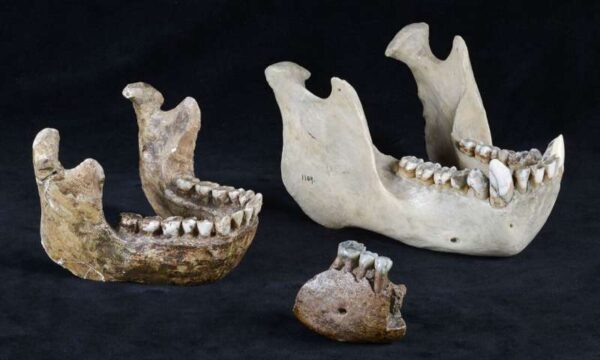
via Phys.org, 09 April 2019: Another ancient hominid species was discovered in Indonesia earlier this month, described in another paper in Nature – ‘Evidence for increased hominid diversity in the Early to Middle Pleistocene of Indonesia‘.
Together with an international team, Senckenberg scientists were able to document an additional fossil ape species in the Senckenberg hominid collection. The new species had already been described in 1950 as Meganthropus palaeojavanicus by Gustav Heinrich Ralph von Koenigswald, the founder of Senckenberg’s paleoanthropological department, but at the time it was interpreted as a prehistoric human. Examinations of the anatomical dental structures now reveal that approximately one million years ago at least three additional species of hominids shared the habitat of Homo erectus on Java. The study is published today in the scientific journal Nature Ecology & Evolution.
More than 200 fossil teeth and jaw fragments have been discovered on the Indonesian island of Java to date. The majority of these hominid remains can be attributed to the extinct species Homo erectus, the first early human discovered outside of Europe. It is known that Homo erectus lived on Java during the time of the Pleistocene, approximately one million years ago, in the company of the ancestors of the modern-day Orangutans,” explains PD Dr. Ottmar Kullmer of the Senckenberg Research Institute in Frankfurt, and he continues, “We were now able to show that yet another species of ape existed there at the same time.”
Source: Studies of fossil teeth reveal another Pleistocene ape species from Southeast Asia
![This week in Southeast Asian Archaeology: Prambanan gets some renewed attention, Phimai Black pottery surfaces at Mun Bon Dam, and I’m taking a short break next week.⠀
⠀
The featured stories look at the new Indonesia–India conservation project at Prambanan, focusing on the temple complex’s ruined perwara shrines, and a striking Late Prehistoric find in northeast Thailand: a remarkably complete Phimai Black vessel discovered as water levels fell at Mun Bon Dam.⠀
⠀
Temples, pottery, reservoirs, and a little scheduled rest. Back again on 27 July.⠀
⠀
Read this week’s newsletter: [link in bio]⠀
⠀
#SoutheastAsianArchaeology #Archaeology #Heritage #Prambanan #Thailand #Indonesia #Cambodia #Vietnam #CulturalHeritage #Substack This week in Southeast Asian Archaeology: Prambanan gets some renewed attention, Phimai Black pottery surfaces at Mun Bon Dam, and I’m taking a short break next week.⠀
⠀
The featured stories look at the new Indonesia–India conservation project at Prambanan, focusing on the temple complex’s ruined perwara shrines, and a striking Late Prehistoric find in northeast Thailand: a remarkably complete Phimai Black vessel discovered as water levels fell at Mun Bon Dam.⠀
⠀
Temples, pottery, reservoirs, and a little scheduled rest. Back again on 27 July.⠀
⠀
Read this week’s newsletter: [link in bio]⠀
⠀
#SoutheastAsianArchaeology #Archaeology #Heritage #Prambanan #Thailand #Indonesia #Cambodia #Vietnam #CulturalHeritage #Substack](https://scontent-sin6-3.cdninstagram.com/v/t51.82787-15/744214042_18361115071209510_2262608560893170251_n.jpg?stp=dst-jpg_e35_tt6&_nc_cat=110&ccb=7-5&_nc_sid=18de74&efg=eyJlZmdfdGFnIjoiRkVFRC5iZXN0X2ltYWdlX3VybGdlbi5DMyJ9&_nc_ohc=xWgcEbcGABIQ7kNvwFx63N6&_nc_oc=Adoe3NBLPcXYeu2Q4WRCzWnJf1ph4tRSl-ndybF0lr1wsJa0WKbjmjX6eHkay-SU5Dk&_nc_zt=23&_nc_ht=scontent-sin6-3.cdninstagram.com&edm=ANo9K5cEAAAA&_nc_gid=dMcRRCmLrU8vIjIWuykhnw&_nc_tpa=Q5bMBQG5vqf4e5fIO0chtZGhHMc0t4iJSvRKIjH0mUwQ4mAL0XnRhUWCa3QyBVw826n_vqBqmRNCfsRP&oh=00_AQDPeFDmCshofY_1cjAQWqyOU02u0lMfxO-CyI0CXLzMFw&oe=6A6490F1)