
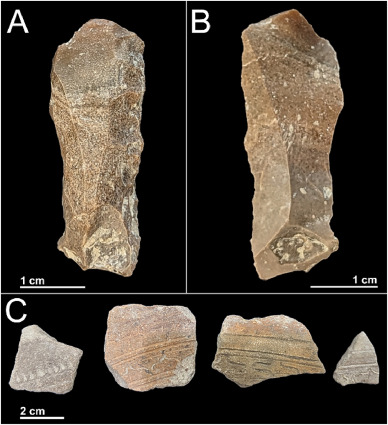
via Quaternary Science Reviews, 18 August 2024: Evidence from the Tanimbar Islands shows human occupation dating back 42,000 years, highlighting early maritime technology and exploitation of land and marine resources. The discovery includes macropod remains, suggesting possible back migration from Sahul to Wallacea, and emphasizes Tanimbar’s role in early human migration from Sunda to Sahul.
Tanimbar is one of the main island groups in Wallacea included in Birdsell’s early human migration routes from Sunda to Sahul, situated at the easternmost end of south Wallacea on Birdsell’s Route 2A. Despite its geographic significance, the island group has not undergone thorough archaeological investigation. Here, we present the first evidence of Pleistocene human occupation in the Tanimbar Islands, dating back approximately 42,000 years, representing one of the oldest ages for human occupation in Wallacea. This finding aligns with records from islands in the west of Wallacea, suggesting rapid human movement through the region. The successful colonization of Tanimbar, like other islands in southern Wallacea, required advanced maritime technology. However, unlike other islands on Route 2A, the early occupants on Tanimbar had access to medium-sized terrestrial mammals, specifically macropods, which are now locally extinct. The faunal remains from the initial colonization period suggest exploitation of both terrestrial and marine resources. This early settlement of the Tanimbar’s potentially enabled exploration of surrounding islands, supported by possible evidence of the movement of lithic raw materials and potentially the introduction of macropods from Sahul.
See also:
![This week in Southeast Asian Archaeology: Prambanan gets some renewed attention, Phimai Black pottery surfaces at Mun Bon Dam, and I’m taking a short break next week.⠀
⠀
The featured stories look at the new Indonesia–India conservation project at Prambanan, focusing on the temple complex’s ruined perwara shrines, and a striking Late Prehistoric find in northeast Thailand: a remarkably complete Phimai Black vessel discovered as water levels fell at Mun Bon Dam.⠀
⠀
Temples, pottery, reservoirs, and a little scheduled rest. Back again on 27 July.⠀
⠀
Read this week’s newsletter: [link in bio]⠀
⠀
#SoutheastAsianArchaeology #Archaeology #Heritage #Prambanan #Thailand #Indonesia #Cambodia #Vietnam #CulturalHeritage #Substack This week in Southeast Asian Archaeology: Prambanan gets some renewed attention, Phimai Black pottery surfaces at Mun Bon Dam, and I’m taking a short break next week.⠀
⠀
The featured stories look at the new Indonesia–India conservation project at Prambanan, focusing on the temple complex’s ruined perwara shrines, and a striking Late Prehistoric find in northeast Thailand: a remarkably complete Phimai Black vessel discovered as water levels fell at Mun Bon Dam.⠀
⠀
Temples, pottery, reservoirs, and a little scheduled rest. Back again on 27 July.⠀
⠀
Read this week’s newsletter: [link in bio]⠀
⠀
#SoutheastAsianArchaeology #Archaeology #Heritage #Prambanan #Thailand #Indonesia #Cambodia #Vietnam #CulturalHeritage #Substack](https://scontent-sin6-3.cdninstagram.com/v/t51.82787-15/744214042_18361115071209510_2262608560893170251_n.jpg?stp=dst-jpg_e35_tt6&_nc_cat=110&ccb=7-5&_nc_sid=18de74&efg=eyJlZmdfdGFnIjoiRkVFRC5iZXN0X2ltYWdlX3VybGdlbi5DMyJ9&_nc_ohc=efvF5aVfY5EQ7kNvwHCwB5Y&_nc_oc=Adrhygfs4_3OVhjr2Rgbgpm8FmeWkE2yymjBA2vziLdP9JGysLT5sw8HvP0DyoT9ok0&_nc_zt=23&_nc_ht=scontent-sin6-3.cdninstagram.com&edm=ANo9K5cEAAAA&_nc_gid=E2a971KxU5zWh5nw04VahQ&_nc_tpa=Q5bMBQG3isXxBQ6X2iiWSZMjLP-e67HFOBtkU91-gQ-AKbsKRt5f8E-T4V3vusgBi5f3KhWHhujQj78B&oh=00_AQDe-6UC5alsUH9NnC76ElPMhHOuQqr5Md7rQWU22phWgQ&oe=6A65E271)


