
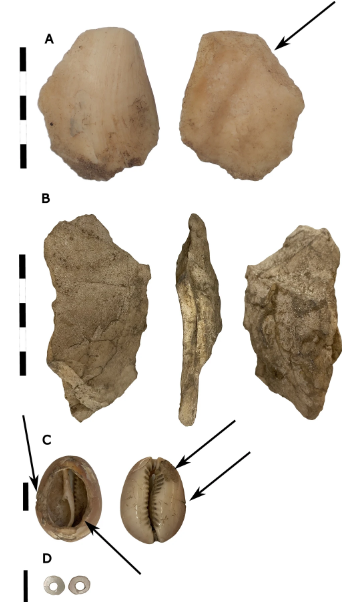
via Scientific Reports, 02 January 2024: Paper by Hawkins et al. on recent archaeological investigations at Ratu Mali 2 cave on Kisar Island that have uncovered the earliest known human burials in the region, dating back to 15.5–14.7 ka. These findings provide unique insights into maritime adaptations, extensive exchange networks, and early mortuary practices of Pleistocene humans in insular environments. The presence of obsidian and shellfish in graves and the dietary evidence from stable isotope analyses highlight sophisticated marine adaptations and the symbolic treatment of the dead.
The insular region of Wallacea has become a focal point for studying Pleistocene human ecological and cultural adaptations in island environments, however, little is understood about early burial traditions during the Pleistocene. Here we investigate maritime interactions and burial practices at Ratu Mali 2, an elevated coastal cave site on the small island of Kisar in the Lesser Sunda Islands of eastern Indonesia dated to 15,500–3700 cal. BP. This multidisciplinary study demonstrates extreme marine dietary adaptations, engagement with an extensive exchange network across open seas, and early mortuary practices. A flexed male and a female, interred in a single grave with abundant shellfish and obsidian at Ratu Mali 2 by 14.7 ka are the oldest known human burials in Wallacea with established funerary rites. These findings highlight the impressive flexibility of our species in marginal environments and provide insight into the earliest known ritualised treatment of the dead in Wallacea.
Source: Earliest known funerary rites in Wallacea after the last glacial maximum | Scientific Reports
![This week in Southeast Asian Archaeology: Prambanan gets some renewed attention, Phimai Black pottery surfaces at Mun Bon Dam, and I’m taking a short break next week.⠀
⠀
The featured stories look at the new Indonesia–India conservation project at Prambanan, focusing on the temple complex’s ruined perwara shrines, and a striking Late Prehistoric find in northeast Thailand: a remarkably complete Phimai Black vessel discovered as water levels fell at Mun Bon Dam.⠀
⠀
Temples, pottery, reservoirs, and a little scheduled rest. Back again on 27 July.⠀
⠀
Read this week’s newsletter: [link in bio]⠀
⠀
#SoutheastAsianArchaeology #Archaeology #Heritage #Prambanan #Thailand #Indonesia #Cambodia #Vietnam #CulturalHeritage #Substack This week in Southeast Asian Archaeology: Prambanan gets some renewed attention, Phimai Black pottery surfaces at Mun Bon Dam, and I’m taking a short break next week.⠀
⠀
The featured stories look at the new Indonesia–India conservation project at Prambanan, focusing on the temple complex’s ruined perwara shrines, and a striking Late Prehistoric find in northeast Thailand: a remarkably complete Phimai Black vessel discovered as water levels fell at Mun Bon Dam.⠀
⠀
Temples, pottery, reservoirs, and a little scheduled rest. Back again on 27 July.⠀
⠀
Read this week’s newsletter: [link in bio]⠀
⠀
#SoutheastAsianArchaeology #Archaeology #Heritage #Prambanan #Thailand #Indonesia #Cambodia #Vietnam #CulturalHeritage #Substack](https://scontent-sin6-3.cdninstagram.com/v/t51.82787-15/744214042_18361115071209510_2262608560893170251_n.jpg?stp=dst-jpg_e35_tt6&_nc_cat=110&ccb=7-5&_nc_sid=18de74&efg=eyJlZmdfdGFnIjoiRkVFRC5iZXN0X2ltYWdlX3VybGdlbi5DMyJ9&_nc_ohc=efvF5aVfY5EQ7kNvwHCwB5Y&_nc_oc=Adrhygfs4_3OVhjr2Rgbgpm8FmeWkE2yymjBA2vziLdP9JGysLT5sw8HvP0DyoT9ok0&_nc_zt=23&_nc_ht=scontent-sin6-3.cdninstagram.com&edm=ANo9K5cEAAAA&_nc_gid=E2a971KxU5zWh5nw04VahQ&_nc_tpa=Q5bMBQG3isXxBQ6X2iiWSZMjLP-e67HFOBtkU91-gQ-AKbsKRt5f8E-T4V3vusgBi5f3KhWHhujQj78B&oh=00_AQDe-6UC5alsUH9NnC76ElPMhHOuQqr5Md7rQWU22phWgQ&oe=6A65E271)


