
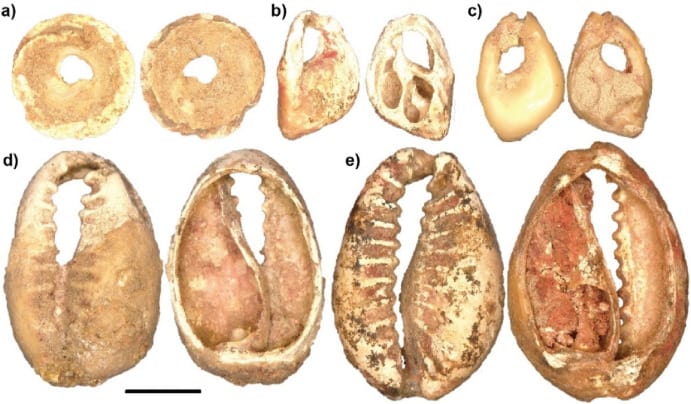
via Journal of Archaeological Science, 26 August 2023: Paper by Maloney et al. analyzes a 16,700-year sequence of marine shell beads from Liang Jon in East Kalimantan, Borneo, using wear patterns to reconstruct socioeconomic roles and revealing shifts in human occupation and material usage across 11,000 years.
Cultural objects composed of composite materials with differing physical properties are often differentially preserved in archaeological records favouring those materials less susceptible to taphonomic processes. Using microscopically observed wear patterns to decipher a model of socioeconomic roles for composite beaded objects, this study examines the rich marine shell bead assemblage excavated from Liang Jon in East Kalimantan, Borneo. Assessment of this 16,700-year sequence provides a unique context for discussing collection, transport, manufacture, and use of marine shell beads; spanning the biogeographical change associated with sea level rise 11,700 years ago creating the island of Borneo. Quantifying differences in bead wear patterning and distribution has revealed changes across 11,000 years of human occupation—detail seldom exposed in Island South East Asian archaeology. Results demonstrate marine species belonging to the families Nassariidae and Cypraeidae were targeted for the manufacture of beads. Whole shells and removed dorsa indicate some onsite manufacture occurred, while patterns of wear and residues including pigments, suggest most beads originated from different varieties of composite objects brought to the site and maintained in different contexts of daily life. Our model reveals a novel picture of Holocene social complexity broadly associated with dated rock art, providing a unique link between parts of the rich archaeological record at the Liang Jon, circumventing popular modes of ethnographic analogy less appropriate for this region.
![This week in Southeast Asian Archaeology: Prambanan gets some renewed attention, Phimai Black pottery surfaces at Mun Bon Dam, and I’m taking a short break next week.⠀
⠀
The featured stories look at the new Indonesia–India conservation project at Prambanan, focusing on the temple complex’s ruined perwara shrines, and a striking Late Prehistoric find in northeast Thailand: a remarkably complete Phimai Black vessel discovered as water levels fell at Mun Bon Dam.⠀
⠀
Temples, pottery, reservoirs, and a little scheduled rest. Back again on 27 July.⠀
⠀
Read this week’s newsletter: [link in bio]⠀
⠀
#SoutheastAsianArchaeology #Archaeology #Heritage #Prambanan #Thailand #Indonesia #Cambodia #Vietnam #CulturalHeritage #Substack This week in Southeast Asian Archaeology: Prambanan gets some renewed attention, Phimai Black pottery surfaces at Mun Bon Dam, and I’m taking a short break next week.⠀
⠀
The featured stories look at the new Indonesia–India conservation project at Prambanan, focusing on the temple complex’s ruined perwara shrines, and a striking Late Prehistoric find in northeast Thailand: a remarkably complete Phimai Black vessel discovered as water levels fell at Mun Bon Dam.⠀
⠀
Temples, pottery, reservoirs, and a little scheduled rest. Back again on 27 July.⠀
⠀
Read this week’s newsletter: [link in bio]⠀
⠀
#SoutheastAsianArchaeology #Archaeology #Heritage #Prambanan #Thailand #Indonesia #Cambodia #Vietnam #CulturalHeritage #Substack](https://scontent-sin6-3.cdninstagram.com/v/t51.82787-15/744214042_18361115071209510_2262608560893170251_n.jpg?stp=dst-jpg_e35_tt6&_nc_cat=110&ccb=7-5&_nc_sid=18de74&efg=eyJlZmdfdGFnIjoiRkVFRC5iZXN0X2ltYWdlX3VybGdlbi5DMyJ9&_nc_ohc=xWgcEbcGABIQ7kNvwFx63N6&_nc_oc=Adoe3NBLPcXYeu2Q4WRCzWnJf1ph4tRSl-ndybF0lr1wsJa0WKbjmjX6eHkay-SU5Dk&_nc_zt=23&_nc_ht=scontent-sin6-3.cdninstagram.com&edm=ANo9K5cEAAAA&_nc_gid=dMcRRCmLrU8vIjIWuykhnw&_nc_tpa=Q5bMBQG5vqf4e5fIO0chtZGhHMc0t4iJSvRKIjH0mUwQ4mAL0XnRhUWCa3QyBVw826n_vqBqmRNCfsRP&oh=00_AQDPeFDmCshofY_1cjAQWqyOU02u0lMfxO-CyI0CXLzMFw&oe=6A6490F1)