
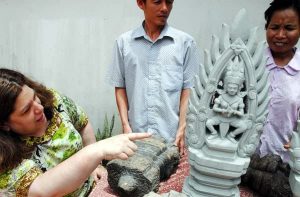
The World Monuments Fund unveils four statues, locally produced and designed as a result of research, and hopes to see them installed on the roof of Angkor Wat’s East Gallery, after approval from public consultation.
A monumental undertaking in Angkor Wat
Phnom Penh Post, 11 June 2012
New Cambodia Art Planned for an Old Empire
VOA, 11 June 2012
With that in mind, the New York-based WMF has pulled out all the stops for the production of four statues, the first of their type in perhaps 800 years, which will adorn the roof top of the East Gallery, home to the Sea of the Churning Milk – a bas relief of battling gods and demons symbolising immortality.
Each carving stands little more than 30 centimetres tall, each with an apsara – a traditional Khmer symbol – at the centre surrounded by a lotus, and each with its own personality.
“This would have been unthinkable 20 years ago,” Ackerman said. “To have this done 20 years ago would have risked accusations of trying to falsify what this was like all those centuries ago.”
Nineteen fragments were collected from the statues that originally sat atop the gallery. Scientists determined the original stone contained a high clay content, making it heavy when wet. Fresh grey-blue sandstone was dug from nearby Bangmealea, a quarry similar to those used in Angkorian times.
Full story here.
![This week in Southeast Asian Archaeology: Prambanan gets some renewed attention, Phimai Black pottery surfaces at Mun Bon Dam, and I’m taking a short break next week.⠀
⠀
The featured stories look at the new Indonesia–India conservation project at Prambanan, focusing on the temple complex’s ruined perwara shrines, and a striking Late Prehistoric find in northeast Thailand: a remarkably complete Phimai Black vessel discovered as water levels fell at Mun Bon Dam.⠀
⠀
Temples, pottery, reservoirs, and a little scheduled rest. Back again on 27 July.⠀
⠀
Read this week’s newsletter: [link in bio]⠀
⠀
#SoutheastAsianArchaeology #Archaeology #Heritage #Prambanan #Thailand #Indonesia #Cambodia #Vietnam #CulturalHeritage #Substack This week in Southeast Asian Archaeology: Prambanan gets some renewed attention, Phimai Black pottery surfaces at Mun Bon Dam, and I’m taking a short break next week.⠀
⠀
The featured stories look at the new Indonesia–India conservation project at Prambanan, focusing on the temple complex’s ruined perwara shrines, and a striking Late Prehistoric find in northeast Thailand: a remarkably complete Phimai Black vessel discovered as water levels fell at Mun Bon Dam.⠀
⠀
Temples, pottery, reservoirs, and a little scheduled rest. Back again on 27 July.⠀
⠀
Read this week’s newsletter: [link in bio]⠀
⠀
#SoutheastAsianArchaeology #Archaeology #Heritage #Prambanan #Thailand #Indonesia #Cambodia #Vietnam #CulturalHeritage #Substack](https://scontent-sin6-3.cdninstagram.com/v/t51.82787-15/744214042_18361115071209510_2262608560893170251_n.jpg?stp=dst-jpg_e35_tt6&_nc_cat=110&ccb=7-5&_nc_sid=18de74&efg=eyJlZmdfdGFnIjoiRkVFRC5iZXN0X2ltYWdlX3VybGdlbi5DMyJ9&_nc_ohc=xWgcEbcGABIQ7kNvwFx63N6&_nc_oc=Adoe3NBLPcXYeu2Q4WRCzWnJf1ph4tRSl-ndybF0lr1wsJa0WKbjmjX6eHkay-SU5Dk&_nc_zt=23&_nc_ht=scontent-sin6-3.cdninstagram.com&edm=ANo9K5cEAAAA&_nc_gid=dMcRRCmLrU8vIjIWuykhnw&_nc_tpa=Q5bMBQG5vqf4e5fIO0chtZGhHMc0t4iJSvRKIjH0mUwQ4mAL0XnRhUWCa3QyBVw826n_vqBqmRNCfsRP&oh=00_AQDPeFDmCshofY_1cjAQWqyOU02u0lMfxO-CyI0CXLzMFw&oe=6A6490F1)