
• This week on Southeast Asian Archaeology: rare bronze Mahoratuek drums surface in Thailand, gold-glazed terracotta helps redraw Vietnam’s Ho Citadel, and Aceh War “loot” gets a long-overdue digital reckoning.⠀
⠀
https://bit.ly/46lX88H
  • Circuits, Ceramics, and Colonial Archives is out now 🏛️🌊📜 CNY/Tết (Year of the Horse) greetings + this week’s theme: heritage in a hurry—Angkor’s “high risk” Baksei Chamkrong, Sibonga church repairs post-Odette, and Indonesia’s 152-site revitalisation push. Read: https://bit.ly/3Mswq7G
  • Heritage isn’t just awe—it’s upkeep. This week: a historic building floor collapse at Siak Palace, Beng Mealea’s walkway repairs, Ponagar Tower’s arts show paused over losses.⠀
 ⠀
https://bit.ly/4chkwIb⠀
  • Biases, Bones & Burāq — this week’s Southeast Asian Archaeology newsletter is all about how small corrections can change big histories.⠀
⠀
We’ve got four fresh research reads:⠀
 🐟 Neolithic expansion that looks a lot more “rice and fish” once recovery bias is taken seriously⠀
 📜 An illuminated Qur’an section from Java on dluwang (treebark paper), with clues that push it earlier than you might expect⠀
 🐀 Timor-Leste’s giant/large murids, measured in detail to track changing ecologies (and a late crash)⠀
 ⚱️ Ban Non Wat grave size and offerings, mapping a sharp spike—and then easing—of social distinction⠀
⠀
And for a screen break: a small mention of PBS’s Angkor: Hidden Jungle Empire.⠀
⠀
Read the full roundup here: https://bit.ly/45Gh2uN ⠀
 #Archaeology #SoutheastAsia #Heritage #Anthropology #Museums #History
  • This week in Southeast Asian Archaeology: Sulawesi just delivered a headline-grabbing ~67,800-year-old hand-stencil date, Huế’s Imperial Citadel restoration has revealed a trilingual astronomical mural, and Malaysia’s new Guar Kepah Archaeological Gallery opens with the “Penang Woman” at centre stage. Deep time, dynastic science, and fresh public heritage spaces—come catch up on the week’s stories.⠀
⠀
https://bit.ly/3NG7WIg
  • New week, new reads: a “Southwestern Silk Road” model for amber into Han China, the biggest Austroasiatic genomic dataset yet (with Dvaravati/Angkor-era signals), plus rock art methods and fresh motifs from Malaysia and Laos. Molecules, motifs, and migration stories — all in one roundup.

Amber, Ancestry and Arty hands https://bit.ly/3LAK20c
  • New year, new (very full) newsletter From Java Man coming home to Jakarta to Khmer sculptures heading back to Cambodia and a bleak month on the Thai–Cambodian border, catch up on a whole month of Southeast Asian archaeology: https://bit.ly/4syuWJh
  • This week’s Southeast Asian Archaeology newsletter is all about the invisible infrastructure of knowledge — the stuff behind the sites. We look at Cambodia’s push to access the late Emma Bunker’s notebooks as a potential roadmap to looted Khmer art, a Thanh Hóa village communal house where 47 imperial edicts were quietly stashed in bamboo tubes for centuries, and Jingdezhen’s “ceramic gene bank” in China, where millions of sherds and glaze recipes are treated like DNA for porcelain. From roof beams to databases, it’s a reminder that archives, records and lab data shape what we think we know about the past just as much as temples and shipwrecks do. Plus the usual mix of regional news, grants, jobs and heritage politics — link in bio/newsletter below.

https://bit.ly/3XIeV5h
  • Genomes point to a 60,000-year “long chronology” for the first settlers of Sahul, while new DNA links China’s hanging coffins to the modern Bo people. #southeastasianarchaeology
 
Read here: https://bit.ly/4a64D6z
  • Southeast Asia’s past is on tour this week — from Bangkok’s royal treasures in Beijing’s Palace Museum to Cham sculptures in Đà Nẵng, Khmer–Chinese exchanges in Phnom Penh, and 14th-century Temasek sherds greeting commuters in a Singapore MRT station. 

In the latest Southeast Asian Archaeology newsletter, a look at how exhibitions are carrying the region’s history into train platforms, diplomatic halls and hands-on museum workshops, plus what this means for soft power, heritage policy and public archaeology. US readers will also spot a small Thanksgiving note of gratitude to the people and institutions who keep these stories alive.

Read the full issue and subscribe here: https://bit.ly/4oeZz2S 

#SoutheastAsia #Archaeology #Museums #Heritage #Thailand #Cambodia #Vietnam #Singapore #Beijing #PalaceMuseum
Saturday, March 7, 2026
Southeast Asian Archaeology
  • News
  • Resources
  • Countries
    • Southeast Asia
    • Mainland Southeast Asia
      • Cambodia
      • Laos
      • Malaysia
      • Myanmar
      • Thailand
      • Vietnam
    • Island Southeast Asia
      • Brunei
      • Indonesia
      • Malaysia
      • Philippines
      • Singapore
      • Timor Leste
    • Peripheral Southeast Asia
  • Topics
    • Artifact Type
      • Architecture
      • Bones and Burials
      • Ceramics
      • Intangible Cultural Heritage
      • Lithics
      • Megaliths
      • Rock Art
      • Sculpture
    • Field
      • Anthropology
      • Bioarchaeology
      • Epigraphy
      • General Archaeology
      • Metallurgy and Metalworking
      • Paleontology
      • Underwater Archaeology
      • Visual Art
      • Zooarchaeology
    • Other Themes
      • Animism
      • Buddhism
      • Christianity
      • Disaster Risk Management
      • Hinduism
      • Islam
      • Archaeological Tourism in Southeast Asia
  • Visit
    • Virtual Archaeology
    • Unesco World Heritage
  • Jobs
  • Subscribe
  • About
    • About
    • Supporters
    • Terms of Use
    • Privacy Policy
    • Contact
No Result
View All Result
Southeast Asian Archaeology
  • News
  • Resources
  • Countries
    • Southeast Asia
    • Mainland Southeast Asia
      • Cambodia
      • Laos
      • Malaysia
      • Myanmar
      • Thailand
      • Vietnam
    • Island Southeast Asia
      • Brunei
      • Indonesia
      • Malaysia
      • Philippines
      • Singapore
      • Timor Leste
    • Peripheral Southeast Asia
  • Topics
    • Artifact Type
      • Architecture
      • Bones and Burials
      • Ceramics
      • Intangible Cultural Heritage
      • Lithics
      • Megaliths
      • Rock Art
      • Sculpture
    • Field
      • Anthropology
      • Bioarchaeology
      • Epigraphy
      • General Archaeology
      • Metallurgy and Metalworking
      • Paleontology
      • Underwater Archaeology
      • Visual Art
      • Zooarchaeology
    • Other Themes
      • Animism
      • Buddhism
      • Christianity
      • Disaster Risk Management
      • Hinduism
      • Islam
      • Archaeological Tourism in Southeast Asia
  • Visit
    • Virtual Archaeology
    • Unesco World Heritage
  • Jobs
  • Subscribe
  • About
    • About
    • Supporters
    • Terms of Use
    • Privacy Policy
    • Contact
No Result
View All Result
Southeast Asian Archaeology
No Result
View All Result
ADVERTISEMENT

Related Posts

Source: Vietnam Net 20240608

Vintage Photos Capture Early 20th Century Vietnamese Culture

11 June 2024
0
61

...

Source: Harvard Gazette 20240529

Archivist Highlights Philippine Heritage at Peabody

30 May 2024
0
18

...

Did the Ming Reach America Before Columbus

Did the Ming Reach America Before Columbus

30 January 2024
0
140

...

Source: Canilao 2023

[Paper] Systematic archaeological aerial survey using Consumer Off-the-Shelf Remotely Piloted Aerial System: Methods note in the Philippine setting

10 January 2024
0
36

...

Popular This Week

  • Southeast Asian Archaeology from a Rock Art Perspective (with annotations)

    Southeast Asian Archaeology from a Rock Art Perspective (with annotations)

    0 shares
    Share 0 Tweet 0
  • The most influential books on Southeast Asian Archaeology (a crowdsourced list)

    0 shares
    Share 0 Tweet 0
  • Southeast Asian Archaeology memes that will tickle your funny bone and also make you ponder

    68 shares
    Share 68 Tweet 0
  • Negritos or Malays: Who are the original inhabitants of the Philippines?

    2 shares
    Share 2 Tweet 0
  • Explore Southeast Asia through these virtual galleries

    616 shares
    Share 616 Tweet 0
Buy me a coffeeBuy me a coffee

If you found this site useful, you can help support it by buying me a coffee!

Pole photography for archaeology – Part 3: Parts List

25 November 2009
in Featured, Personal
Tags: aerial archaeologygeneral archaeologymaps and mappingNotes from the Fieldphotography
0
SHARES
104
VIEWS

You’ve seen the polecam in action in the last post, in this post we’ll take a closer look at the polecam rig, the parts I used and the factors I considered for each part. Hopefully this information will be useful if you need some ideas about how to make a pole camera setup.


1. A Pole
Well, you can’t do pole photography without a pole! The pole I used was a telescopic fibreglass pole by Hastings. The pole extends to 30′, and has a collapsed length of 66″. The pole weighs about 11lbs (5kg) which is not too unmanageable, especially if you attach a strap to the body and haul it over your shoulder. I even managed to carry it onto a city bus and also in to a Perodua Kancil, one of the smallest cars in Malaysia. The individual sections of the pole has little pegs that lock in place, which was one of the main reasons I got it, but on hindsight that might not have been such a good thing (you’ll see why in my next post). The other appeal for the Hastings Hotstick was the customisable heads that can turn at 30-degree angles. This allows me to tilt the camera 90 degrees to take portrait shots, as well as angle the heads to take the overhead aerial shots. The other poles I considered was the wonderpole (no head), this telescopic antenna mast (too long when collapsed), an a giant Manfrotto tripod (at 24′ it was too short for my requirements, a little heavy at 24lbs, but it had a built in tripod which would have been really useful).

2. Camera
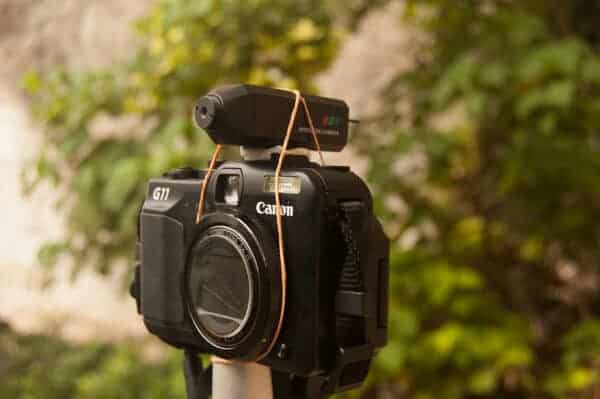
The other important component of the polecam of course is the camera – in this case, a Canon G11. The G11 is a prosumer compact camera that has many of the functions of a DSLR. What I was really looking for was the ability to shoot in raw (as in raw data recorded by the camera’s sensor, opposed to the JPEGs that are pre-compressed). I also appreciated greatly this model’s articulating LCD screen which in some cases stood in for an external video monitor. The movable screen was really handy especially because it was hard to move the entire camera when it was being tethered to the end of a 6-foot pole. The downside of this camera for me was the not-wide-enough angle of the lens; compared to other cameras of its class, it was relatively more heavy (13 ounces). Other cameras you might want to consider using for your polecam is the Lumix LX3 by Panasonic, which is about half the weight and apparently a favourite among pole aerial photographers, or the Pentax Optio which has the advantage of being both light and waterproof, and also the Nikon Coolpix P6000, that at 28mm is even less wide than the G11, but has the advantage of inbuilt GPS.
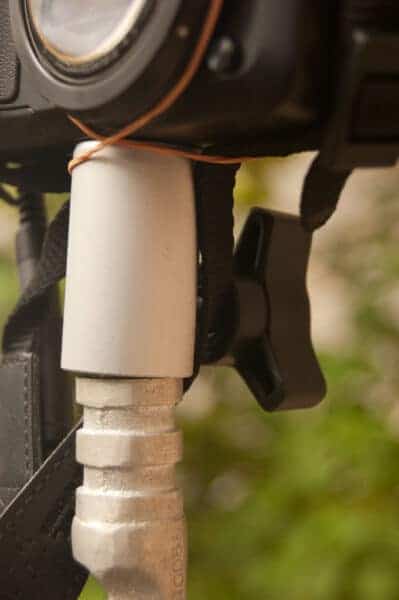
The camera was attached to the pole in two parts – first, I used the GPS antenna attachment for the hastings pole, which had a 5/8″ head. I the connected this attachment to the camera using this 5/8″ to 1/4″ adapter.

3. Wireless Remote
The wireless remote was a little more tricky, because the usual infra-red remotes only have a range of five metres or 15′. For a period I was toying around with the idea of a really long USB cable, but the maximum effective distance a cable can carry a signal is also about 5 metres. Fortunately, there are quite a few third-party radio-frequency wireless remotes out there, with far longer ranges than the IR ones. This remote that I used has a range of 80m – more than adequate for my 10m requirement – and can be attached to the camera’s hotshoe or another 1/4″ screw thread.

4. Video monitor
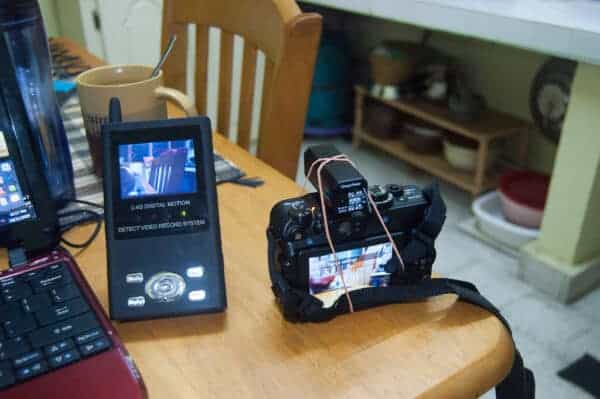
I guess the video camera and monitor is strictly optional – if you didn’t mind adjusting the camera, raising the pole, shooting, collapsing and rechecking the shot every time. I think given enough practice, it would be possible to use the pole without a visual aid. I didn’t have this luxury, so I found a baby monitor and wireless camera from an electronics store. The camera was about the size of my finger and had a narrower frame of view than the camera; so if I could see it on the monitor, I could definitely capture it on the camera. There were still a couple of drawbacks with this system; if I used the camera zoom, the accuracy of the video feed was less effective so the video cam was only good for the wide shots. The second drawback – a major one – was the battery life of the camera itself – it only lasted half an hour! With that amount of time, you might be able to get one or two different locations, maybe three if you’re experienced. I might consider powering the camera directly with batteries, but this would add extra weight onto the rig, which would make it harder to control at the higher elevations.
5. Fasteners
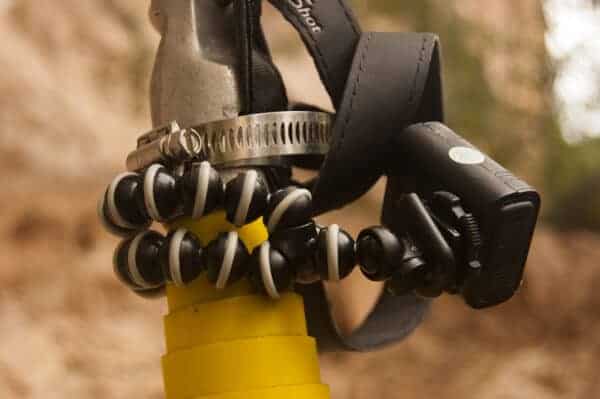
Finally, the glue that holds everything together – or making sure that your thousand-dollar investment doesn’t fall off and shatter to pieces! I used a number of small gadgets to fasten the entire rig to the main pole, all of which I got from the hardware store. You probably would have noticed that the video camera was attached to the main camera using nothing but blu-tack and rubber bands. I was quite surprised that it held as well as it did, but it was pretty steady throughout the whole field test. Because the hotshoe space was used up by the video camera, the receiver for the wireless remote was attached to the side of the pole using a small gorillapod and then wired to the camera. Finally, the wire and the camera strap were fastened onto the pole using a ring clamp. The ring clamp acted as an insurance policy just in case the 5/8″-1/4″ adapter ever got dislodged. In reality, nothing in the rig ever came apart during the field test, although the adapter had to be tightened every now and then.
And that’s how I assembled my polecam. In the next post, the last of the series, I end off with some evaluative notes about the operation of the polecam, how it measured up against my requirements and show off my bleeding fingers. =D

Subscribe to the weekly Southeast Asian Archaeology news digest

Latest Books

The following are affiliate links for which I may earn a commission if you click and make a purchase. Click here for more books about Southeast Asian archaeology.
Sale Malay Silver and Gold: Courtly Splendour from Indonesia, Malaysia, Singapore, Brunei and Thailand
Malay Silver and Gold: Courtly Splendour from...
Amazon Prime
$38.54
Buy on Amazon
Sale The Oxford Guide to the Malayo-Polynesian Languages of Southeast Asia (Oxford Guides to the World's Languages)
The Oxford Guide to the Malayo-Polynesian...
Amazon Prime
$165.87
Buy on Amazon
Sale Majapahit: Sculptures from a Forgotten Kingdom
Majapahit: Sculptures from a Forgotten Kingdom
$44.08
Buy on Amazon
Sale Majapahit: Intrigue, Betrayal and War in Indonesia’s Greatest Empire
Majapahit: Intrigue, Betrayal and War in...
Amazon Prime
$15.74
Buy on Amazon
Sale The Story of Southeast Asia
The Story of Southeast Asia
$24.11
Buy on Amazon
Buddhist Landscapes: Art and Archaeology of the Khorat Plateau, 7th to 11th Centuries
Buddhist Landscapes: Art and Archaeology of the...
Amazon Prime
$56.00
Buy on Amazon

Comments 5

  1. Ann says:
    16 years ago

    LMAO on the Gorillapod. This is the best use of it I’ve seen up to now! Good solution with the babycam though, will suggest that to my kite-flying friend.

    Ann

  2. Andrew says:
    16 years ago

    Very Nice. I do a fair amount of clambering up tree’s to get aerial shots.

    I could save a lot of twig bashing using that device.

    What was the total cost (exclusive of the digicam)

  3. noelbynature says:
    16 years ago

    Thanks. I have a cost breakdown in my fourth and final post, coming up in about an hour’s time!

  4. noelbynature says:
    16 years ago

    Thanks Jonah! Merry Christmas and Happy New Year to you too!

  5. Jim says:
    16 years ago

    Hey,

    Just ran across this and thought folks may be interested in this:

    http://lightroomers.com/the-polester/871/

    Good luck above and beyond!

    Jim

Leave a Reply

Your email address will not be published. Required fields are marked *

I agree to the Terms & Conditions and Privacy Policy.

This site uses Akismet to reduce spam. Learn how your comment data is processed.

Southeast Asian Archaeology

© 2019

Navigate Site

  • News
  • Resources
  • Countries
  • Topics
  • Visit
  • Jobs
  • Subscribe
  • About

Follow

Never Miss a Discovery
Subscribe for Exclusive Southeast Asian Archaeology News!

Stay connected with the latest breakthroughs, research, and events from across Southeast Asia’s archaeology scene. Sign up today for exclusive weekly updates, trusted by over 2,000 subscribers.

×
No Result
View All Result
  • News
  • Resources
  • Countries
    • Southeast Asia
    • Mainland Southeast Asia
      • Cambodia
      • Laos
      • Malaysia
      • Myanmar
      • Thailand
      • Vietnam
    • Island Southeast Asia
      • Brunei
      • Indonesia
      • Malaysia
      • Philippines
      • Singapore
      • Timor Leste
    • Peripheral Southeast Asia
  • Topics
    • Artifact Type
      • Architecture
      • Bones and Burials
      • Ceramics
      • Intangible Cultural Heritage
      • Lithics
      • Megaliths
      • Rock Art
      • Sculpture
    • Field
      • Anthropology
      • Bioarchaeology
      • Epigraphy
      • General Archaeology
      • Metallurgy and Metalworking
      • Paleontology
      • Underwater Archaeology
      • Visual Art
      • Zooarchaeology
    • Other Themes
      • Animism
      • Buddhism
      • Christianity
      • Disaster Risk Management
      • Hinduism
      • Islam
      • Archaeological Tourism in Southeast Asia
  • Visit
    • Virtual Archaeology
    • Unesco World Heritage
  • Jobs
  • Subscribe
  • About
    • About
    • Supporters
    • Terms of Use
    • Privacy Policy
    • Contact

© 2019

This website uses cookies. By continuing to use this website you are giving consent to cookies being used. Visit our Privacy and Cookie Policy.