







Over the weekend, I made a trip to nearby Karimun Island, some 30 km west of Singapore in search of an ancient stone inscription.
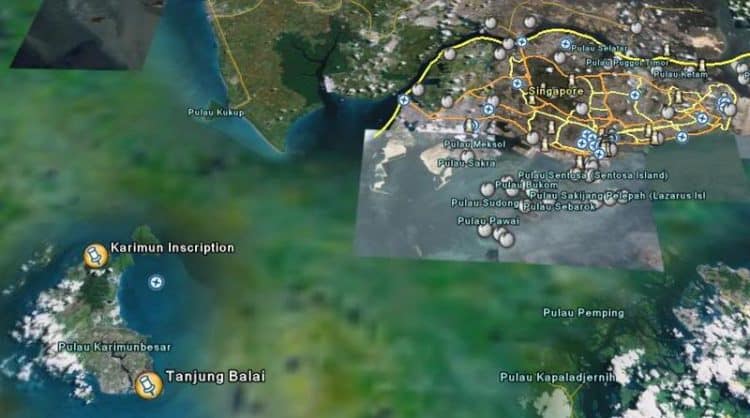
The island of Karimun Besar (Greater Karimun) is a croissant-shaped island resting at the end of the Melaka strait – a great strategic position because from the north shore one can see Sumatra at the left and the Malay Peninsula in the right. In fact, the British once considered setting up base there because of its location – but Raffles opted instead for Singapore with the romantic notion of resurrecting the civilization (Temasek) that was mentioned in the Malay Annals.
I read about the inscription a long time ago, and was recently reminded by it when I attended a short course on the archaeology of Singapore. Dr. John Miksic, the course conductor, mentioned the Karimun inscription and inspired me to take a trip down to look for it. Finding the inscription was the tricky part, however. Dr Miksic mentioned visiting the place almost 20 years ago, so I was working with 20-year-old information. The only lead I had was that it must have laid on the north shore of the island, possibly by a beach. Locating the stone was also compounded by the fact that Karimun of late was mired in some tension over importing granite to Singapore – and that the granite quarry was also in the north side of the island.
So I was rather fortunate to have met with Tres, one of the taxi drivers who aggressively touted visitors to Karimun. For something like S$30, Tres would drive my party of three up to the northern Pasir Panjang beach. When he found out that we were looking for the stone inscription, he told us that he knew where it was and offered to drive us directly there.
It was a good thing he did – as it turns out the inscription was, as feared, inside the grounds of the granite quarry. We had to pass through two security checkpoints, as well as surrender our cameras at the second checkpoint where we continued on foot. Our guide was good to his word when he led us to a shed 100 metres away from the security post – the stone inscription was carved on the side of a large granite hill, in an area of about 3 metres by 3 metres. At a distance, trucks rumbled carrying workers and granite. The area around the inscription was fairly untouched and protected – a small wall, fence and roof were erected over the inscription, and the presence of incense offerings also indicated that the place was venerated as a shrine. There was even a government notice that indicated the inscription was protected.

(Yes, I snuck my phone camera in.) I think the current worshippers at the shrine are Sikhs, judging from the images placed at the shrine. This is quite strange, considering that the inscription was probably written by a Buddhist author:

According to Dr. Miksic, the inscription is written in Devanegari script and dates to the 9th or 10th century AD. It reads, “These are the footsteps of the illustrious Gautama the Mahayana Buddhist who possessed a round instrument.” Which was why I found it strange that it has become a site of Sikh veneration. Dr. Miksic also noted that the characters that formed the word “round instrument” are unique – they are not found in any other Indian inscription anywhere in the world. When I got home, I merged the two photos in photoshop-cleanup for better clarity:

What about the footprints that our illustrious Gautama left behind? At first, I thought it was the rounded depressions on the side of the hill beside the shrine. But Tres our guide came to the rescue again, pointing us to the footprint at the foot of the hill, 20 feet away.

The footprint was carved in the rock, but was partly covered by sand which was also wet. As a result, we couldn’t see if there were carvings at the bottom, but we managed to scoop out enough water to see the outline of the foot. Maybe the task for the next time I visit?
Related Books:
The article on Malaysia in Southeast Asia: From Prehistory to History by I. Glover and P. S. Bellwood (Eds)



Glad to read that you found the inscription. Seems that luck was on your side, finding a taxi driver who could take you right to the site. Do you know how old the inscriptions are?
It’s worrying that the inscriptions are now located inside a quarry. How far away are they blasting? Let’s hope they don’t get destroyed.
Ah, i forgot to mention the age of the script! According to Dr Miksic, they date to about 9th to 10th century. Yes, I was really lucky to have met up with Tres, the taxi driver. I might employ him again if I visit there again – there are a couple of other sites he pointed out that might be ointerest,one being “Kubor Badang”, or the grave of Badang who I assume is the grace of the legendary strongman named in the Malay Annals. The site itself seems fairly safe – it looks like it’s become a shrine now that is still in use. There is a fair amount of traffic in front of the site – I think the blasting takes place deeper inside from where I was at.
i am taking a tri[p to karimun today could you please sms or email me directions to the stone please! i am an artist and would like to see the inscriptions.
apparently the quarry site closed down. just got back from yesterday in karimun
Hi Charles!
I was wondering about your expedition. Did you even manage to see the inscription then? It was very near the entrance.
no i didn’t make it to that quarry . next time!
Oh, thanks so much for the information. Actually now Im trying to do research on Buddhist inscriptions in Indonesia.
Hi, I have been bringing Students and Teachers from Singapore to Karimun Island since 1998. Information that I got from the people and the ministry of Tourism is totally different from what is mention about the inscription. There is no issues for bringing in Cameras for photo taking, we just need to ensure the Security Guards that we will only be taking photos of the inscription and not the Granite Quarry. Furthermore, the Sikhs claim that the writings are in Sanskrit and that’s the reason they visit the site often…. !