


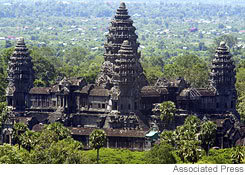
The Wall Street Journal’s Leslie Hook writes about the history and architecture of the fabulous Cambodian temple, Angkor Wat. You can read SEAArch’s Adventures in Angkor series on Angkor Wat as well.
Cambodian History Writ Large At Angkor Wat
Wall Street Journal, 25 January 2008
One of the largest religious structures in the world, and the only religious monument to appear on a national flag, Angkor Wat has become synonymous with Cambodia at its most powerful — when it was the seat of the Khmer Empire, stretching from the South China Sea to the Bay of Bengal. The monumental scale of the temple has the same effect on visitors today as when it was first built. Angkor Wat has but a single approach: a wide stone causeway more than a third of a mile long (that’s as long as six football fields end-to-end). The entry walkway crosses a moat 600 feet wide (my guide assures me it used to be filled with crocodiles) and ends at a wall and gates leading into the center of the compound. The central compound covers about 400 acres and once supported a town of about 100,000 people.
Read the full story here.
Read more about Angkor Wat in:
– Angkor Cities and Temples by C. Jaques
– Angkor Wat: Time, Space, and Kingship by E. Mannikka
– Angkor: Cambodia’s Wondrous Khmer Temples, Fifth Edition by D. Rooney and P. Danford
– Angkor Wat and cultural ties with India by K. M. Srivastava
– Apsarases at Angkor Wat, in Indian context by K. M. Srivastava
– Khmer Mythology: Secrets Of Angkor Wat by V. Roveda
– Of Gods, Kings and Men: The Reliefs of Angkor Wat