• This week on Southeast Asian Archaeology: rare bronze Mahoratuek drums surface in Thailand, gold-glazed terracotta helps redraw Vietnam’s Ho Citadel, and Aceh War “loot” gets a long-overdue digital reckoning.⠀
⠀
https://bit.ly/46lX88H
  • Circuits, Ceramics, and Colonial Archives is out now 🏛️🌊📜 CNY/Tết (Year of the Horse) greetings + this week’s theme: heritage in a hurry—Angkor’s “high risk” Baksei Chamkrong, Sibonga church repairs post-Odette, and Indonesia’s 152-site revitalisation push. Read: https://bit.ly/3Mswq7G
  • Heritage isn’t just awe—it’s upkeep. This week: a historic building floor collapse at Siak Palace, Beng Mealea’s walkway repairs, Ponagar Tower’s arts show paused over losses.⠀
 ⠀
https://bit.ly/4chkwIb⠀
  • Biases, Bones & Burāq — this week’s Southeast Asian Archaeology newsletter is all about how small corrections can change big histories.⠀
⠀
We’ve got four fresh research reads:⠀
 🐟 Neolithic expansion that looks a lot more “rice and fish” once recovery bias is taken seriously⠀
 📜 An illuminated Qur’an section from Java on dluwang (treebark paper), with clues that push it earlier than you might expect⠀
 🐀 Timor-Leste’s giant/large murids, measured in detail to track changing ecologies (and a late crash)⠀
 ⚱️ Ban Non Wat grave size and offerings, mapping a sharp spike—and then easing—of social distinction⠀
⠀
And for a screen break: a small mention of PBS’s Angkor: Hidden Jungle Empire.⠀
⠀
Read the full roundup here: https://bit.ly/45Gh2uN ⠀
 #Archaeology #SoutheastAsia #Heritage #Anthropology #Museums #History
  • This week in Southeast Asian Archaeology: Sulawesi just delivered a headline-grabbing ~67,800-year-old hand-stencil date, Huế’s Imperial Citadel restoration has revealed a trilingual astronomical mural, and Malaysia’s new Guar Kepah Archaeological Gallery opens with the “Penang Woman” at centre stage. Deep time, dynastic science, and fresh public heritage spaces—come catch up on the week’s stories.⠀
⠀
https://bit.ly/3NG7WIg
  • New week, new reads: a “Southwestern Silk Road” model for amber into Han China, the biggest Austroasiatic genomic dataset yet (with Dvaravati/Angkor-era signals), plus rock art methods and fresh motifs from Malaysia and Laos. Molecules, motifs, and migration stories — all in one roundup.

Amber, Ancestry and Arty hands https://bit.ly/3LAK20c
  • New year, new (very full) newsletter From Java Man coming home to Jakarta to Khmer sculptures heading back to Cambodia and a bleak month on the Thai–Cambodian border, catch up on a whole month of Southeast Asian archaeology: https://bit.ly/4syuWJh
  • This week’s Southeast Asian Archaeology newsletter is all about the invisible infrastructure of knowledge — the stuff behind the sites. We look at Cambodia’s push to access the late Emma Bunker’s notebooks as a potential roadmap to looted Khmer art, a Thanh Hóa village communal house where 47 imperial edicts were quietly stashed in bamboo tubes for centuries, and Jingdezhen’s “ceramic gene bank” in China, where millions of sherds and glaze recipes are treated like DNA for porcelain. From roof beams to databases, it’s a reminder that archives, records and lab data shape what we think we know about the past just as much as temples and shipwrecks do. Plus the usual mix of regional news, grants, jobs and heritage politics — link in bio/newsletter below.

https://bit.ly/3XIeV5h
  • Genomes point to a 60,000-year “long chronology” for the first settlers of Sahul, while new DNA links China’s hanging coffins to the modern Bo people. #southeastasianarchaeology
 
Read here: https://bit.ly/4a64D6z
  • Southeast Asia’s past is on tour this week — from Bangkok’s royal treasures in Beijing’s Palace Museum to Cham sculptures in Đà Nẵng, Khmer–Chinese exchanges in Phnom Penh, and 14th-century Temasek sherds greeting commuters in a Singapore MRT station. 

In the latest Southeast Asian Archaeology newsletter, a look at how exhibitions are carrying the region’s history into train platforms, diplomatic halls and hands-on museum workshops, plus what this means for soft power, heritage policy and public archaeology. US readers will also spot a small Thanksgiving note of gratitude to the people and institutions who keep these stories alive.

Read the full issue and subscribe here: https://bit.ly/4oeZz2S 

#SoutheastAsia #Archaeology #Museums #Heritage #Thailand #Cambodia #Vietnam #Singapore #Beijing #PalaceMuseum
Saturday, March 7, 2026
Southeast Asian Archaeology
  • News
  • Resources
  • Countries
    • Southeast Asia
    • Mainland Southeast Asia
      • Cambodia
      • Laos
      • Malaysia
      • Myanmar
      • Thailand
      • Vietnam
    • Island Southeast Asia
      • Brunei
      • Indonesia
      • Malaysia
      • Philippines
      • Singapore
      • Timor Leste
    • Peripheral Southeast Asia
  • Topics
    • Artifact Type
      • Architecture
      • Bones and Burials
      • Ceramics
      • Intangible Cultural Heritage
      • Lithics
      • Megaliths
      • Rock Art
      • Sculpture
    • Field
      • Anthropology
      • Bioarchaeology
      • Epigraphy
      • General Archaeology
      • Metallurgy and Metalworking
      • Paleontology
      • Underwater Archaeology
      • Visual Art
      • Zooarchaeology
    • Other Themes
      • Animism
      • Buddhism
      • Christianity
      • Disaster Risk Management
      • Hinduism
      • Islam
      • Archaeological Tourism in Southeast Asia
  • Visit
    • Virtual Archaeology
    • Unesco World Heritage
  • Jobs
  • Subscribe
  • About
    • About
    • Supporters
    • Terms of Use
    • Privacy Policy
    • Contact
No Result
View All Result
Southeast Asian Archaeology
  • News
  • Resources
  • Countries
    • Southeast Asia
    • Mainland Southeast Asia
      • Cambodia
      • Laos
      • Malaysia
      • Myanmar
      • Thailand
      • Vietnam
    • Island Southeast Asia
      • Brunei
      • Indonesia
      • Malaysia
      • Philippines
      • Singapore
      • Timor Leste
    • Peripheral Southeast Asia
  • Topics
    • Artifact Type
      • Architecture
      • Bones and Burials
      • Ceramics
      • Intangible Cultural Heritage
      • Lithics
      • Megaliths
      • Rock Art
      • Sculpture
    • Field
      • Anthropology
      • Bioarchaeology
      • Epigraphy
      • General Archaeology
      • Metallurgy and Metalworking
      • Paleontology
      • Underwater Archaeology
      • Visual Art
      • Zooarchaeology
    • Other Themes
      • Animism
      • Buddhism
      • Christianity
      • Disaster Risk Management
      • Hinduism
      • Islam
      • Archaeological Tourism in Southeast Asia
  • Visit
    • Virtual Archaeology
    • Unesco World Heritage
  • Jobs
  • Subscribe
  • About
    • About
    • Supporters
    • Terms of Use
    • Privacy Policy
    • Contact
No Result
View All Result
Southeast Asian Archaeology
No Result
View All Result
ADVERTISEMENT

Related Posts

Source: Bangkok Post 20240801

Southeast Asia’s Ruins: The Case for Minimal Restoration

1 August 2024
0
64

...

Source: Ministry of Information Myanmar 20240730

Reviving Bagan’s Ancient Lakes: Ongoing Restoration and Donation Appeal

1 August 2024
0
22

...

[Talk] The Ancient Town of Si Thep in Thailand: A Crossroads of Indianization

[Talk] The Ancient Town of Si Thep in Thailand: A Crossroads of Indianization

31 July 2024
0
68

...

Source: Phnom Penh Post/The Star 20240729

Restoration Underway at Angkor Thom’s South Gate After Storm Damage

30 July 2024
0
59

...

Popular This Week

  • Southeast Asian Archaeology from a Rock Art Perspective (with annotations)

    Southeast Asian Archaeology from a Rock Art Perspective (with annotations)

    0 shares
    Share 0 Tweet 0
  • The most influential books on Southeast Asian Archaeology (a crowdsourced list)

    0 shares
    Share 0 Tweet 0
  • Southeast Asian Archaeology memes that will tickle your funny bone and also make you ponder

    68 shares
    Share 68 Tweet 0
  • Negritos or Malays: Who are the original inhabitants of the Philippines?

    2 shares
    Share 2 Tweet 0
  • Explore Southeast Asia through these virtual galleries

    616 shares
    Share 616 Tweet 0
Buy me a coffeeBuy me a coffee

If you found this site useful, you can help support it by buying me a coffee!

[Webinar] Recent Research in Myanmar: Bagan sculpture and art

26 January 2022
in Burma (Myanmar)
Tags: Bagan (kingdom)Bagan (site)MetallurgysculptureSEAMEO SPAFAtalks / presentationswebinar
0
SHARES
59
VIEWS
SPAFA SESH 20220128

SPAFA SESH 20220128

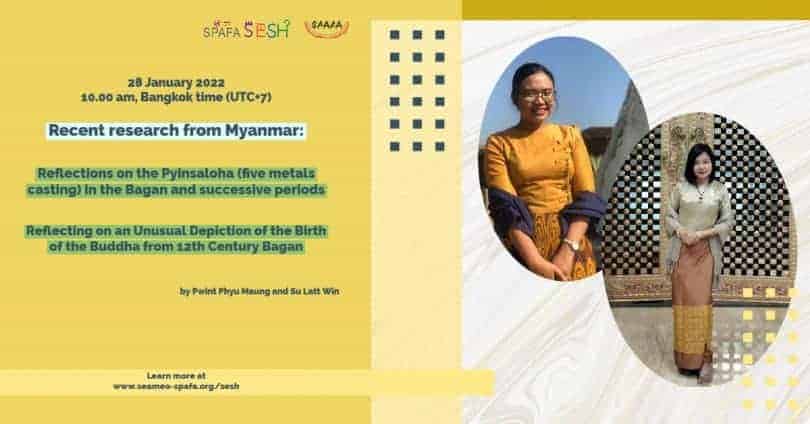
On Friday, I will be hosting a SPAFA SESH with two colleagues from Myanmar talking about Bagan Sculpture and Art. 10.30 am Bangkok time, join on Facebook Live or Zoom

Reflections on the Pyinsaloha (five metals casting) in the Bagan and successive periods
Speaker: Pwint Phyu Maung

Images of the Buddha from Myanmar, date to the 2nd century CE. In early periods, terracotta and earthenware are mostly found. However, since the early Bagan period (11th-13th CE), images developed of stone, bronze and stucco. Subsequently, a combination of metals alloys called Pyinsaloha came to be used. The tradition of casting Pyinsaloha started in India, especially in Southern India. Pyinsaloha or Pincaloha means a statue made of five metal alloys. In Sanskrit, Pyinsa means five and Loha means metal, in this case gold, silver, copper, zinc and iron. Moreover, there are also combinations called Triloha (three metals), Sattaloha (seven metals) and Navaloha (nine metals). Initially, bronze (lead+copper+tin) can also be defined as Triloha with a metal alloy used for image casting. Later on, according to religious concepts and to make it more precious, gold and silver were combined and became Pyinsaloha. In Hinduism, worshipping the Pyinsaloha murtis brings auspiciousness, prosperity, a peaceful mind and especially a balanced life. On one hand, worshiping the Pyincaloha murtis originated in Hinduism, In India, Nataraja (dancing Shiva) was favoured for Pyincaloha. On the other hand, in Buddhism, Pyincaloha is rarely found as a Buddha image and other parts of religious monuments. However, in common with Hinduism, the concept and tradition of casting Pyinsaloha image in Buddhism are seen as bringing prosperity and a better life. The paper highlights how the tradition of Pyinsaloha spread to successive periods and how the casting of religious parts changed from the Bagan Period to the present.

Reflecting on an Unusual Depiction of the Birth of the Buddha from 12th Century Bagan
Speaker: Su Latt Win
While murals depicting the Birth of the Buddha at Bagan (9th to 13th century CE) are seen at various temples, sculptural depictures are rare. This paper describes an unusual, perhaps unique sculpture of this scene, reflecting on its place at Bagan. The finely sculpted stone nativity scene of the Birth of the Buddha in the Bagan Archaeological Museum is one of eleven stone steles depicting the Eight Scenes of the Buddha’s life from the 12th century Myinkaba Kubyauk Nge temple. Although all nativity scenes are similar, this stele is a remarkable example of the narrative art of Bagan. The Buddha’s art nativity scene is not like an ordinary human delivery. Here Queen Maya stands on the right side of her sister under the Sal tree. Similar to other depictions, the baby sits cross-legged and emerges from her right hip, where rows of Brahmas, Indra and humans are kneeling and uplifting the child. But in this relief, a small seated Buddha in Bhumisparsa Mudra is shown on the head of Maya, possibly the only one in Bagan. The sculpture recalls the form of Avalokitesvara with the figure of Amitabha in the crown, here to presage that Queen Maya’s child will become the Buddha. The paper compares the image, its iconography and style, to others and considers reasons for this depiction produced in 12th century CE Bagan.

Su Latt Win is an alumni SOAS and Alphawood scholar in 2015-2016. She works at the Zaykabar private museum in Myanmar where her responsibilities are in the registration of museum objects, and writing the catalogue for the museum. She is interested in the collection and curation of Buddhist art in the Museum.

Source: SPAFA SESH – Seameo Spafa

Subscribe for Southeast Asian Archaeology news updates

Latest Books

The following are affiliate links for which I may earn a commission if you click and make a purchase. Click here for more books about Myanmar archaeology.
Sale Relics and Relic Worship in the Early Buddhism: India, Afghanistan, Sri Lanka and Burma (British Museum Research Publications)
Relics and Relic Worship in the Early Buddhism:...
$41.01
Buy on Amazon
Sale The Buried Spitfires of Burma: A ‘Fake’ History
The Buried Spitfires of Burma: A ‘Fake’...
$16.13
Buy on Amazon
Sale Textiles in Burman Culture
Textiles in Burman Culture
$64.73
Buy on Amazon
Sale Unseen Burma: Early Photography 1862-1962
Unseen Burma: Early Photography 1862-1962
Amazon Prime
$28.71
Buy on Amazon
Sale Sri Ksetra Museum Collection Inventory (Beyond Boundaries, 7)
Sri Ksetra Museum Collection Inventory (Beyond...
$129.00
Buy on Amazon
Wider Bagan: Ancient and Living Buddhist Traditions
Wider Bagan: Ancient and Living Buddhist...
Amazon Prime
$60.00
Buy on Amazon

Leave a Reply

Your email address will not be published. Required fields are marked *

I agree to the Terms & Conditions and Privacy Policy.

This site uses Akismet to reduce spam. Learn how your comment data is processed.

Next Post
Source: Khmer Times 20220117

Preah Vihear National Authority and Royal University of Fine Arts agree on cooperation

Southeast Asian Archaeology

© 2019

Navigate Site

  • News
  • Resources
  • Countries
  • Topics
  • Visit
  • Jobs
  • Subscribe
  • About

Follow

Never Miss a Discovery
Subscribe for Exclusive Southeast Asian Archaeology News!

Stay connected with the latest breakthroughs, research, and events from across Southeast Asia’s archaeology scene. Sign up today for exclusive weekly updates, trusted by over 2,000 subscribers.

×
No Result
View All Result
  • News
  • Resources
  • Countries
    • Southeast Asia
    • Mainland Southeast Asia
      • Cambodia
      • Laos
      • Malaysia
      • Myanmar
      • Thailand
      • Vietnam
    • Island Southeast Asia
      • Brunei
      • Indonesia
      • Malaysia
      • Philippines
      • Singapore
      • Timor Leste
    • Peripheral Southeast Asia
  • Topics
    • Artifact Type
      • Architecture
      • Bones and Burials
      • Ceramics
      • Intangible Cultural Heritage
      • Lithics
      • Megaliths
      • Rock Art
      • Sculpture
    • Field
      • Anthropology
      • Bioarchaeology
      • Epigraphy
      • General Archaeology
      • Metallurgy and Metalworking
      • Paleontology
      • Underwater Archaeology
      • Visual Art
      • Zooarchaeology
    • Other Themes
      • Animism
      • Buddhism
      • Christianity
      • Disaster Risk Management
      • Hinduism
      • Islam
      • Archaeological Tourism in Southeast Asia
  • Visit
    • Virtual Archaeology
    • Unesco World Heritage
  • Jobs
  • Subscribe
  • About
    • About
    • Supporters
    • Terms of Use
    • Privacy Policy
    • Contact

© 2019

This website uses cookies. By continuing to use this website you are giving consent to cookies being used. Visit our Privacy and Cookie Policy.