
• This week on Southeast Asian Archaeology: rare bronze Mahoratuek drums surface in Thailand, gold-glazed terracotta helps redraw Vietnam’s Ho Citadel, and Aceh War “loot” gets a long-overdue digital reckoning.⠀
⠀
https://bit.ly/46lX88H
  • Circuits, Ceramics, and Colonial Archives is out now 🏛️🌊📜 CNY/Tết (Year of the Horse) greetings + this week’s theme: heritage in a hurry—Angkor’s “high risk” Baksei Chamkrong, Sibonga church repairs post-Odette, and Indonesia’s 152-site revitalisation push. Read: https://bit.ly/3Mswq7G
  • Heritage isn’t just awe—it’s upkeep. This week: a historic building floor collapse at Siak Palace, Beng Mealea’s walkway repairs, Ponagar Tower’s arts show paused over losses.⠀
 ⠀
https://bit.ly/4chkwIb⠀
  • Biases, Bones & Burāq — this week’s Southeast Asian Archaeology newsletter is all about how small corrections can change big histories.⠀
⠀
We’ve got four fresh research reads:⠀
 🐟 Neolithic expansion that looks a lot more “rice and fish” once recovery bias is taken seriously⠀
 📜 An illuminated Qur’an section from Java on dluwang (treebark paper), with clues that push it earlier than you might expect⠀
 🐀 Timor-Leste’s giant/large murids, measured in detail to track changing ecologies (and a late crash)⠀
 ⚱️ Ban Non Wat grave size and offerings, mapping a sharp spike—and then easing—of social distinction⠀
⠀
And for a screen break: a small mention of PBS’s Angkor: Hidden Jungle Empire.⠀
⠀
Read the full roundup here: https://bit.ly/45Gh2uN ⠀
 #Archaeology #SoutheastAsia #Heritage #Anthropology #Museums #History
  • This week in Southeast Asian Archaeology: Sulawesi just delivered a headline-grabbing ~67,800-year-old hand-stencil date, Huế’s Imperial Citadel restoration has revealed a trilingual astronomical mural, and Malaysia’s new Guar Kepah Archaeological Gallery opens with the “Penang Woman” at centre stage. Deep time, dynastic science, and fresh public heritage spaces—come catch up on the week’s stories.⠀
⠀
https://bit.ly/3NG7WIg
  • New week, new reads: a “Southwestern Silk Road” model for amber into Han China, the biggest Austroasiatic genomic dataset yet (with Dvaravati/Angkor-era signals), plus rock art methods and fresh motifs from Malaysia and Laos. Molecules, motifs, and migration stories — all in one roundup.

Amber, Ancestry and Arty hands https://bit.ly/3LAK20c
  • New year, new (very full) newsletter From Java Man coming home to Jakarta to Khmer sculptures heading back to Cambodia and a bleak month on the Thai–Cambodian border, catch up on a whole month of Southeast Asian archaeology: https://bit.ly/4syuWJh
  • This week’s Southeast Asian Archaeology newsletter is all about the invisible infrastructure of knowledge — the stuff behind the sites. We look at Cambodia’s push to access the late Emma Bunker’s notebooks as a potential roadmap to looted Khmer art, a Thanh Hóa village communal house where 47 imperial edicts were quietly stashed in bamboo tubes for centuries, and Jingdezhen’s “ceramic gene bank” in China, where millions of sherds and glaze recipes are treated like DNA for porcelain. From roof beams to databases, it’s a reminder that archives, records and lab data shape what we think we know about the past just as much as temples and shipwrecks do. Plus the usual mix of regional news, grants, jobs and heritage politics — link in bio/newsletter below.

https://bit.ly/3XIeV5h
  • Genomes point to a 60,000-year “long chronology” for the first settlers of Sahul, while new DNA links China’s hanging coffins to the modern Bo people. #southeastasianarchaeology
 
Read here: https://bit.ly/4a64D6z
  • Southeast Asia’s past is on tour this week — from Bangkok’s royal treasures in Beijing’s Palace Museum to Cham sculptures in Đà Nẵng, Khmer–Chinese exchanges in Phnom Penh, and 14th-century Temasek sherds greeting commuters in a Singapore MRT station. 

In the latest Southeast Asian Archaeology newsletter, a look at how exhibitions are carrying the region’s history into train platforms, diplomatic halls and hands-on museum workshops, plus what this means for soft power, heritage policy and public archaeology. US readers will also spot a small Thanksgiving note of gratitude to the people and institutions who keep these stories alive.

Read the full issue and subscribe here: https://bit.ly/4oeZz2S 

#SoutheastAsia #Archaeology #Museums #Heritage #Thailand #Cambodia #Vietnam #Singapore #Beijing #PalaceMuseum
Saturday, March 7, 2026
Southeast Asian Archaeology
  • News
  • Resources
  • Countries
    • Southeast Asia
    • Mainland Southeast Asia
      • Cambodia
      • Laos
      • Malaysia
      • Myanmar
      • Thailand
      • Vietnam
    • Island Southeast Asia
      • Brunei
      • Indonesia
      • Malaysia
      • Philippines
      • Singapore
      • Timor Leste
    • Peripheral Southeast Asia
  • Topics
    • Artifact Type
      • Architecture
      • Bones and Burials
      • Ceramics
      • Intangible Cultural Heritage
      • Lithics
      • Megaliths
      • Rock Art
      • Sculpture
    • Field
      • Anthropology
      • Bioarchaeology
      • Epigraphy
      • General Archaeology
      • Metallurgy and Metalworking
      • Paleontology
      • Underwater Archaeology
      • Visual Art
      • Zooarchaeology
    • Other Themes
      • Animism
      • Buddhism
      • Christianity
      • Disaster Risk Management
      • Hinduism
      • Islam
      • Archaeological Tourism in Southeast Asia
  • Visit
    • Virtual Archaeology
    • Unesco World Heritage
  • Jobs
  • Subscribe
  • About
    • About
    • Supporters
    • Terms of Use
    • Privacy Policy
    • Contact
No Result
View All Result
Southeast Asian Archaeology
  • News
  • Resources
  • Countries
    • Southeast Asia
    • Mainland Southeast Asia
      • Cambodia
      • Laos
      • Malaysia
      • Myanmar
      • Thailand
      • Vietnam
    • Island Southeast Asia
      • Brunei
      • Indonesia
      • Malaysia
      • Philippines
      • Singapore
      • Timor Leste
    • Peripheral Southeast Asia
  • Topics
    • Artifact Type
      • Architecture
      • Bones and Burials
      • Ceramics
      • Intangible Cultural Heritage
      • Lithics
      • Megaliths
      • Rock Art
      • Sculpture
    • Field
      • Anthropology
      • Bioarchaeology
      • Epigraphy
      • General Archaeology
      • Metallurgy and Metalworking
      • Paleontology
      • Underwater Archaeology
      • Visual Art
      • Zooarchaeology
    • Other Themes
      • Animism
      • Buddhism
      • Christianity
      • Disaster Risk Management
      • Hinduism
      • Islam
      • Archaeological Tourism in Southeast Asia
  • Visit
    • Virtual Archaeology
    • Unesco World Heritage
  • Jobs
  • Subscribe
  • About
    • About
    • Supporters
    • Terms of Use
    • Privacy Policy
    • Contact
No Result
View All Result
Southeast Asian Archaeology
No Result
View All Result
ADVERTISEMENT

Related Posts

[Paper] Investigating the Risk of Violence During the Neolithic to the Late Iron Age in Northeast Thailand (c. 1400 B.C. – A.D. 800)

31 July 2024
0
42

...

[Paper] Intangible maritime heritage protection in Malaysia: The need for a revision of the National Heritage Act of 2005

26 July 2024
0
31

...

Source Taninai 2024

[Paper] International Coordinating Committee for Angkor (ICC-Angkor): Reflections from Diplomatic Perspectives

24 July 2024
0
26

...

Source: Koad and Deesamutara 2024

[Paper] Examining trade routes through the Thai–Malay Peninsula: A simulation analysis

23 July 2024
0
192

...

Popular This Week

  • Southeast Asian Archaeology from a Rock Art Perspective (with annotations)

    Southeast Asian Archaeology from a Rock Art Perspective (with annotations)

    0 shares
    Share 0 Tweet 0
  • The most influential books on Southeast Asian Archaeology (a crowdsourced list)

    0 shares
    Share 0 Tweet 0
  • Southeast Asian Archaeology memes that will tickle your funny bone and also make you ponder

    68 shares
    Share 68 Tweet 0
  • Negritos or Malays: Who are the original inhabitants of the Philippines?

    2 shares
    Share 2 Tweet 0
  • Explore Southeast Asia through these virtual galleries

    616 shares
    Share 616 Tweet 0
Buy me a coffeeBuy me a coffee

If you found this site useful, you can help support it by buying me a coffee!

[Paper] Early ground axe technology in Wallacea: The first excavations on Obi Island

21 August 2020
in Indonesia
Tags: Austronesian (peoples)axebeadslithicsNorth Maluku (province)Obi (island)obsidianPleistocenePLOS One (journal)prehistoryresearch papersSue O'Connor (person)
6
SHARES
1.5k
VIEWS
Edge ground stone tools from Obi Island. Source: Shipton et al. PloSOne/ANU

Edge ground stone tools from Obi Island. Source: Shipton et al. PloSOne/ANU

via PLoSOne: A new Open Access paper by Shipton et al. about the archaeology of Obi Island in northern Maluku, revealing prehistoric habitation between 18,000-10,000 years ago.

The first excavations on Obi Island, north-east Wallacea, reveal three phases of occupation beginning in the terminal Pleistocene. Ground shell artefacts appear at the end of the terminal Pleistocene, the earliest examples in Wallacea. In the subsequent early Holocene occupation phase, ground stone axe flakes appear, which are again the earliest examples in Wallacea. Ground axes were likely instrumental to subsistence in Obi’s dense tropical forest. From ~8000 BP there was a hiatus lasting several millennia, perhaps because increased precipitation and forest density made the sites inhospitable. The site was reoccupied in the Metal Age, with this third phase including quadrangular ground stone artefacts, as well as pottery and pigs; reflecting Austronesian influences. Greater connectivity at this time is also indicated by an Oliva shell bead tradition that occurs in southern Wallacea and an exotic obsidian artefact. The emergence of ground axes on Obi is an independent example of a broader pattern of intensification at the Pleistocene-Holocene transition in Wallacea and New Guinea, evincing human innovation in response to rapid environmental change.

Source: Early ground axe technology in Wallacea: The first excavations on Obi Island

See also:

  • Stone tools from a remote cave reveal how island-hopping humans made a living in the jungle millennia ago | The Conversation, 20 August 2020

Stone tools from a remote cave reveal how island-hopping humans made a living in the jungle millennia ago

ANU, Author provided
Shimona Kealy, Australian National University and Sue O’Connor, Australian National University

Prehistoric axes and beads found in caves on a remote Indonesian island suggest this was a crucial staging post for seafaring people who lived in this region as the last ice age was coming to an end.

Our discoveries, published today in PLOS ONE, suggest humans arrived on the tropical island of Obi at least 18,000 years ago, successfully making a living there for at least the next 10,000 years.

It also provides the first direct archaeological evidence to support the idea these islands were crucial for humans’ island-hopping migration through this region millennia ago.

In early April 2019, we and our colleagues in Indonesia became the first archaeologists to explore Obi, in Indonesia’s Maluku Utara province.

We found the oldest example from east Indonesia of edge-ground axes, made by grinding a piece of stone to a sharp blade against a rough material such as sandstone. These were likely used for clearing the forest and making dugout canoes.
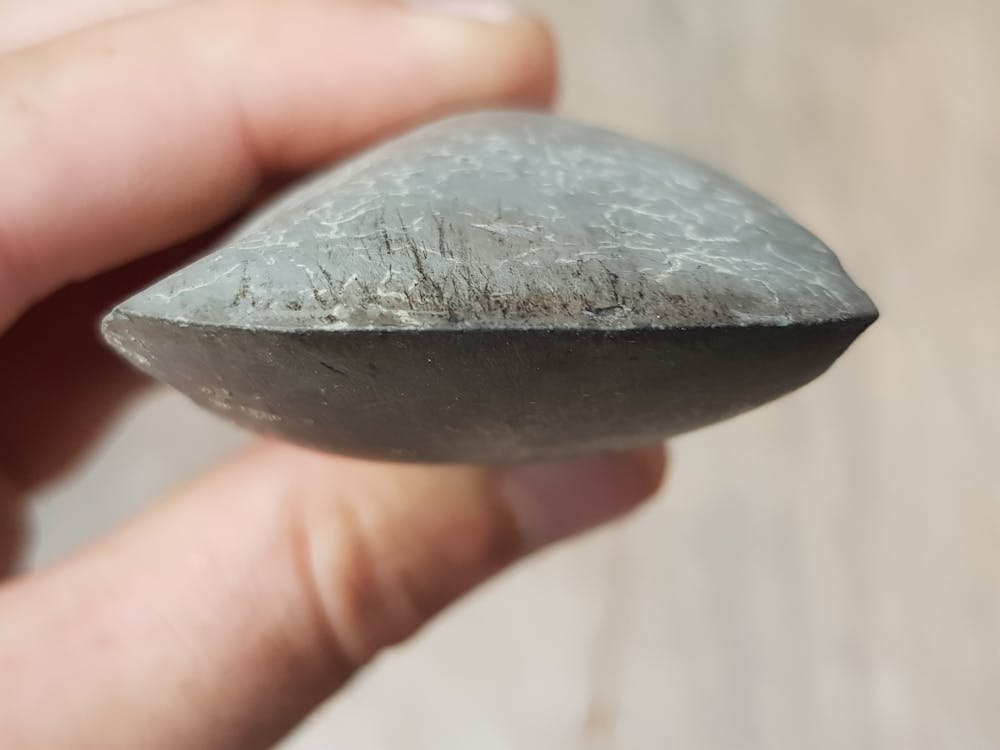
Hand holding a prehistoric stone axe
Stone axes were vital tools for clearing forest and making canoes. ANU, Author provided

Our discoveries suggest the prehistoric people who lived on Obi were adept on both land and sea, hunting in the dense rainforest, foraging by the sea, and possibly even making canoes for voyaging between islands.

Our research is part of a project to learn more about how people first dispersed from mainland Asia, through the Indonesian archipelago and into Sahul, the prehistoric continent that once connected Australia and New Guinea.

An island stepping-stone

Recent models by CABAH researchers identified the collection of small islands in northeast Indonesia – and Obi in particular – as the most likely “stepping-stones” used by humans on their very first journey east towards northern Sahul (modern-day New Guinea), about 65,000-50,000 years ago.
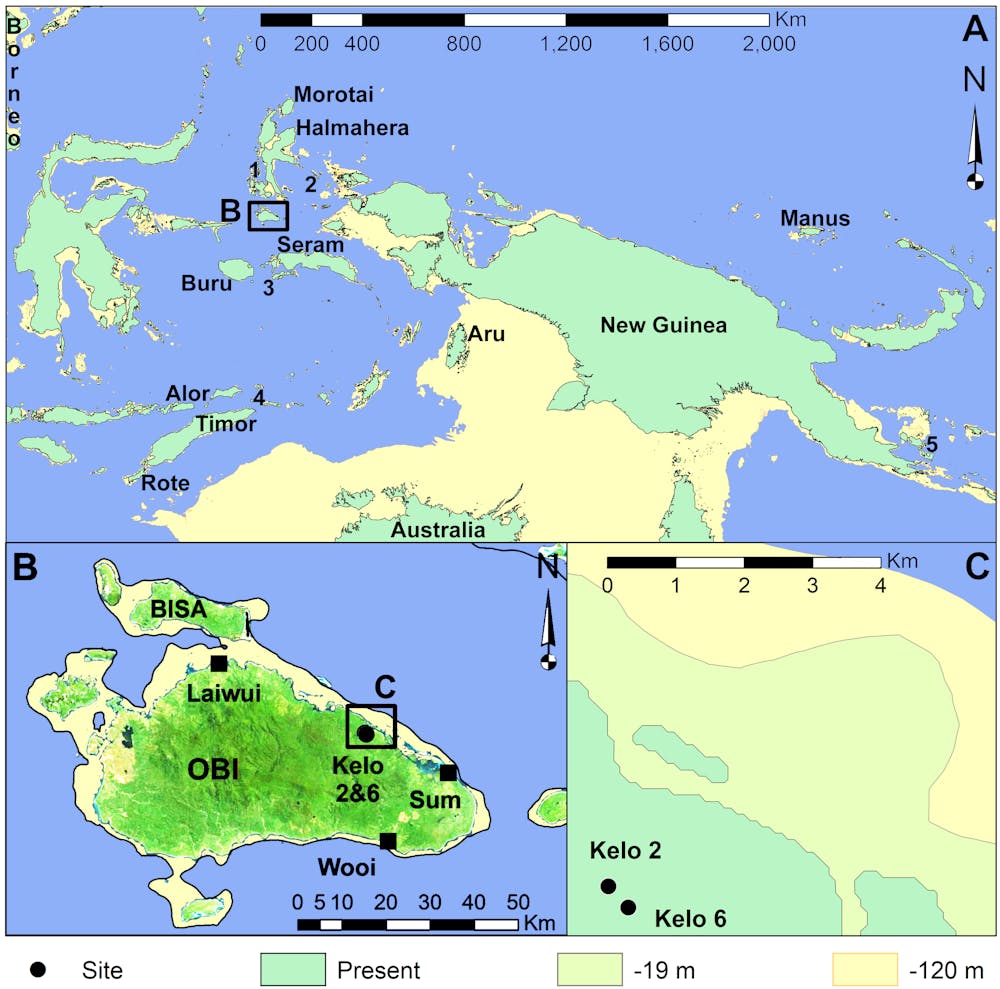
Map of Obi and surrounding islands
Map of the region showing the location of Obi island and the sites excavated by the team, and the previous geography of the region when sea levels were lower.

Migrating through this region, which is named Wallacea after the explorer and naturalist Alfred Russel Wallace, would have required multiple sea crossings. This enormous archipelago thus has a unique significance in human history, as the region where people first set out on deliberate long sea voyages.

Our earlier research suggested the northern Wallacean islands, including Obi, would have offered the easiest migration route. But to back this theory, we need archaeological evidence for humans living in this remote area in the ancient past. So we travelled to Obi to look for cave sites that might reveal evidence of early occupation.


Read more: Island-hopping study shows the most likely route the first people took to Australia


Tools and treasure

We found two rock shelter sites, just inland from the village of Kelo on Obi’s northern coast, that were suitable for excavation. With the permission and help of the local people of Kelo, we dug a small test excavation in each shelter.

We found numberous artefacts including fragments of edge-ground axes, some dating to about 14,000 years ago. The earliest ground axes at Kelo were made using clam shells. Axes made from shells have also been found elsewhere in this region from roughly the same time, including on the nearby island of Gebe to the northeast. Traditionally, they were used by people in the region for the construction of dugout canoes. It is highly likely that Obi’s axes were also used for making canoes, thus allowing these early peoples to maintain connections between communities on neighbouring islands.
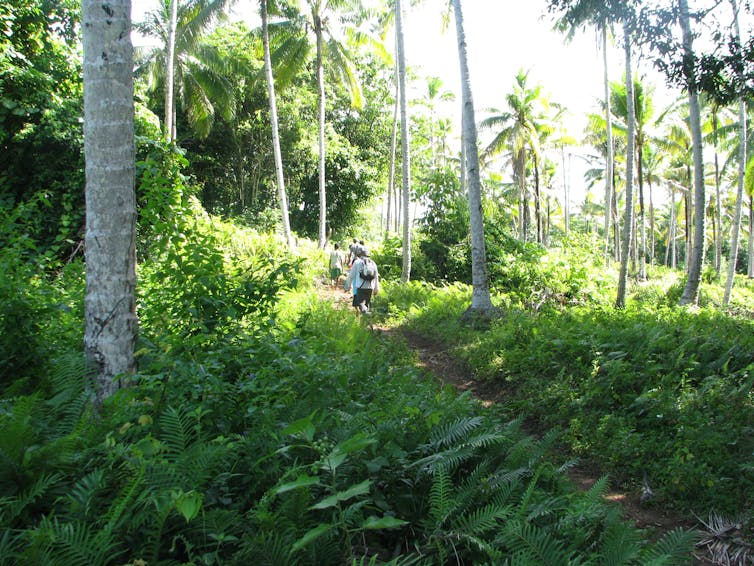
People walking among coconut trees
The research team treks through coconut groves on Obi. ANU, Author provided

The oldest cultural layers from the Kelo 6 site, containing a combination of shell and stone tool flakes, provided us with the earliest record for human occupation on Obi, dating back around 18,000 years. At this time the climate was drier and colder the today, and the island’s dense rainforests would likely have been much less impenetrable than they are now. Sea levels were about 120 metres lower, meaning Obi was a much larger island, encompassing what is today the separate island of Bisa, as well as several other small islands nearby.

Roughly 11,700 years ago, as the most recent ice age ended, the climate became significantly warmer and wetter, no doubt making Obi’s jungle much thicker. It is perhaps no coincidence this is the time we see the first evidence of axes made from stone rather than sea shells, likely in response to their increased, heavy-duty use for clearing and modification of the increasingly dense rainforest. While stone takes about twice as long to grind into an axe compared to shell, the harder material also keeps its sharp edge for longer as well.
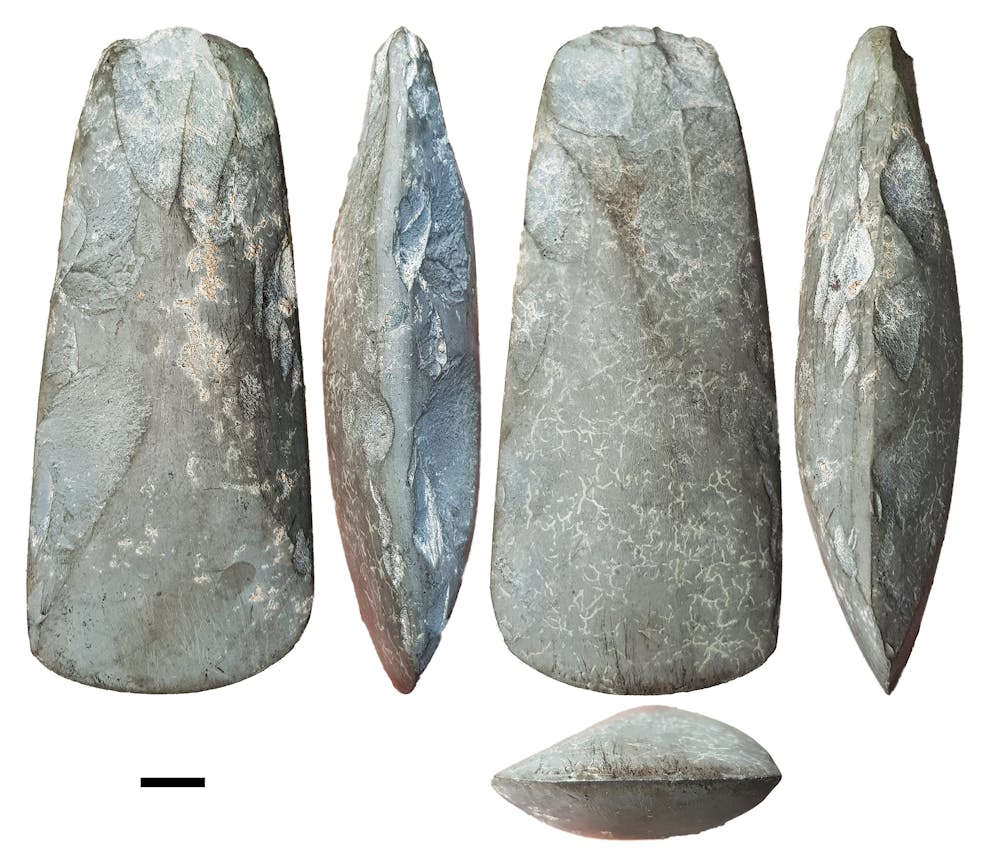
Various views of stone axes
Stone axes found on the ground near Kelo village. Scale bar represents 1cm. Shipton et al. 2020

Judging by the bones we found in the Kelo caves, people living there mainly hunted the Rothschild’s cuscus, a possum-like animal that still lives on Obi today. As the forest grew more dense, people probably used axes to clear patches of forest and make hunting easier.

Again, it’s probably no coincidence axes made of volcanic stone – which would have stayed sharp for longer, and are known to have been used for this purpose in New Guinea – first appearing in the archaeological record at around the time the climate was changing.

We also found obsidian, which must have been brought over from another island as there is no known source on Obi, and particular types of shell beads in the Kelo caves, similar to those previously found on islands in southern Wallacea. This again supports the idea that Obi islanders routinely travelled to other islands.
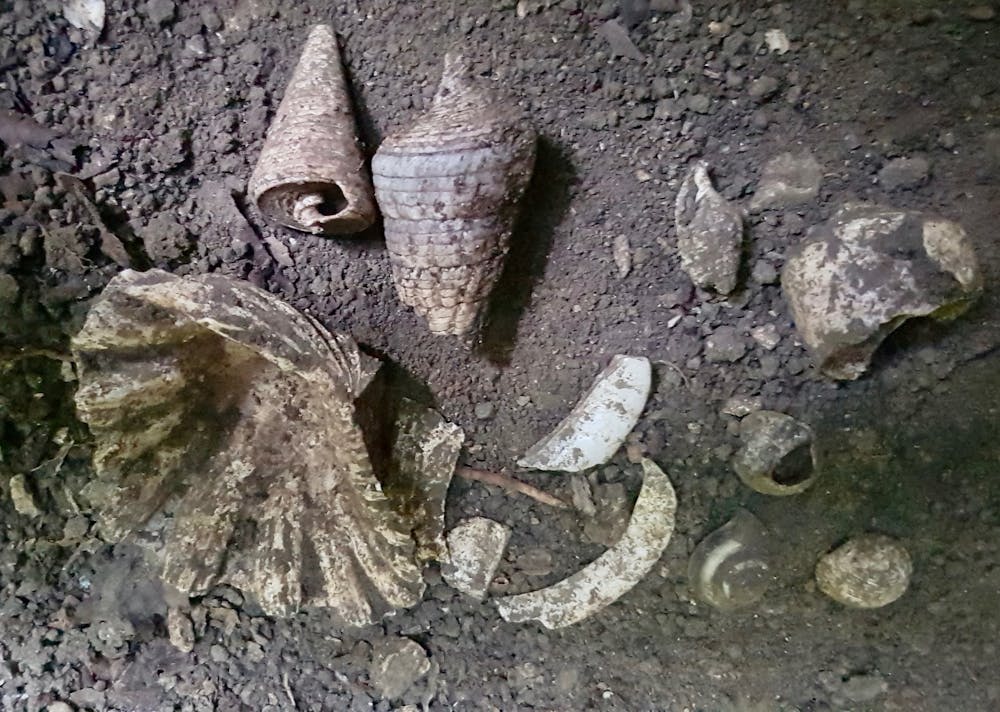
Selection of ancient sea shell pieces
Sea shell fragments on the cave floor. ANU, Author provided

Moving out, or moving on?

Our excavations suggest people successfully lived at the Kelo caves for about 10,000 years. But then, about 8,000 years ago, both sites were abandoned.

Did the residents leave Obi completely, or move elsewhere on the island? Perhaps the jungle had grown so thick human axes (even stone ones!) were no longer a match for the dense undergrowth. Perhaps people simply moved to the coast and became mainly fishers rather than hunters.


Read more: An incredible journey: the first people to arrive in Australia came in large numbers, and on purpose


Whatever the reason, we have no evidence for use of the Kelo shelters after this time, until about 1,000 years ago, when they were reoccupied by people who had pottery and metal items. It seems likely, in view of Obi’s location in the middle of the Maluku “Spice Islands”, this final phase of occupation saw the Kelo shelters used by people involved in the historic spice trade.

We will hopefully find the answers to some of these questions when we return to Obi next year, COVID permitting, to excavate some coastal caves.The Conversation

Shimona Kealy, Postdoctoral Researcher, College of Asia & the Pacific, Australian National University and Sue O’Connor, Distinguished Professor, School of Culture, History & Language, Australian National University

This article is republished from The Conversation under a Creative Commons license. Read the original article.

Subscribe to the weekly Southeast Asian Archaeology news digest

Latest Books

The following are affiliate links for which I may earn a commission if you click and make a purchase. Click here for more books about Indonesian archaeology.
Sale Patterned Splendour: Textiles Presented on Javanese Metal and Stone Sculptures; Eighth to Fifteenth Century
Patterned Splendour: Textiles Presented on...
Amazon Prime
$30.54
Buy on Amazon
Sale Majapahit: Sculptures from a Forgotten Kingdom
Majapahit: Sculptures from a Forgotten Kingdom
$44.08
Buy on Amazon
Sale Little Species, Big Mystery: The Story of Homo Floresiensis
Little Species, Big Mystery: The Story of Homo...
Amazon Prime
$26.53
Buy on Amazon
Sale Majapahit: Intrigue, Betrayal and War in Indonesia’s Greatest Empire
Majapahit: Intrigue, Betrayal and War in...
Amazon Prime
$15.74
Buy on Amazon
Seaways and Gatekeepers: Trade and State in the Eastern Archipelagos of Southeast Asia, c.1600–c.1906
Seaways and Gatekeepers: Trade and State in the...
Amazon Prime
$46.00
Buy on Amazon
Heroes, Gods and Guardians: Hilts and Keris of Indonesia, Huntington Miller Collection
Heroes, Gods and Guardians: Hilts and Keris of...
Buy on Amazon

Leave a Reply

Your email address will not be published. Required fields are marked *

I agree to the Terms & Conditions and Privacy Policy.

This site uses Akismet to reduce spam. Learn how your comment data is processed.

Southeast Asian Archaeology

© 2019

Navigate Site

  • News
  • Resources
  • Countries
  • Topics
  • Visit
  • Jobs
  • Subscribe
  • About

Follow

Never Miss a Discovery
Subscribe for Exclusive Southeast Asian Archaeology News!

Stay connected with the latest breakthroughs, research, and events from across Southeast Asia’s archaeology scene. Sign up today for exclusive weekly updates, trusted by over 2,000 subscribers.

×
No Result
View All Result
  • News
  • Resources
  • Countries
    • Southeast Asia
    • Mainland Southeast Asia
      • Cambodia
      • Laos
      • Malaysia
      • Myanmar
      • Thailand
      • Vietnam
    • Island Southeast Asia
      • Brunei
      • Indonesia
      • Malaysia
      • Philippines
      • Singapore
      • Timor Leste
    • Peripheral Southeast Asia
  • Topics
    • Artifact Type
      • Architecture
      • Bones and Burials
      • Ceramics
      • Intangible Cultural Heritage
      • Lithics
      • Megaliths
      • Rock Art
      • Sculpture
    • Field
      • Anthropology
      • Bioarchaeology
      • Epigraphy
      • General Archaeology
      • Metallurgy and Metalworking
      • Paleontology
      • Underwater Archaeology
      • Visual Art
      • Zooarchaeology
    • Other Themes
      • Animism
      • Buddhism
      • Christianity
      • Disaster Risk Management
      • Hinduism
      • Islam
      • Archaeological Tourism in Southeast Asia
  • Visit
    • Virtual Archaeology
    • Unesco World Heritage
  • Jobs
  • Subscribe
  • About
    • About
    • Supporters
    • Terms of Use
    • Privacy Policy
    • Contact

© 2019

This website uses cookies. By continuing to use this website you are giving consent to cookies being used. Visit our Privacy and Cookie Policy.