
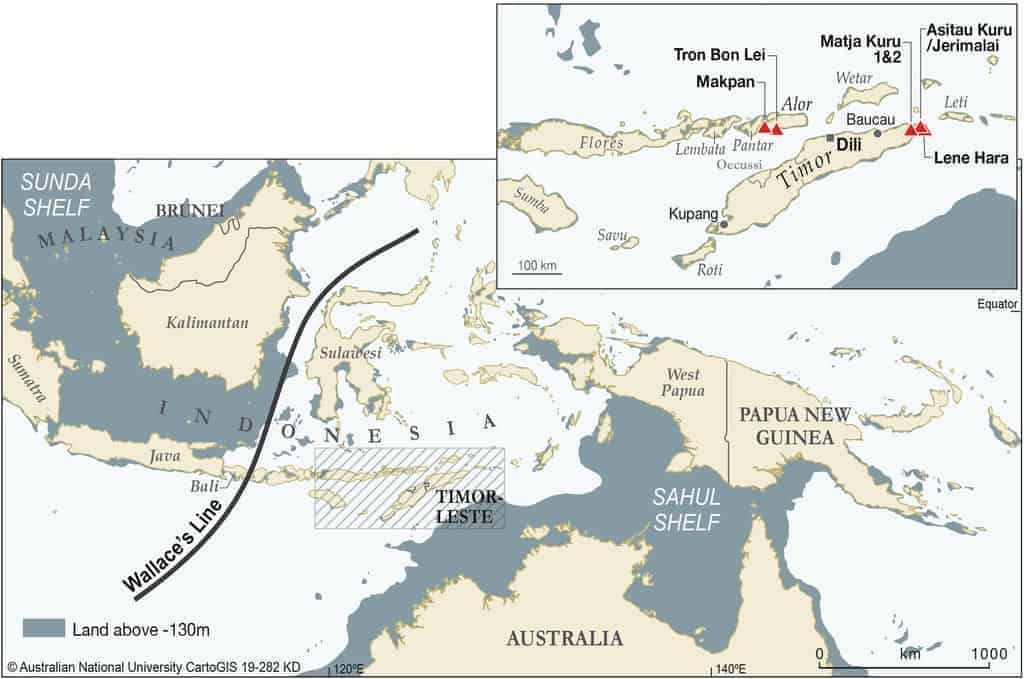
via Nature Communications, 29 April 2020: Analysis of human and animal tooth enamel indicate that while the earliest known humans in Wallacea relied on coastal resources, by 20,000 years ago they had increasingly switched to inland sources of food which indicates evidence of a diversified diet.
The resource-poor, isolated islands of Wallacea have been considered a major adaptive obstacle for hominins expanding into Australasia. Archaeological evidence has hinted that coastal adaptations in Homo sapiens enabled rapid island dispersal and settlement; however, there has been no means to directly test this proposition. Here, we apply stable carbon and oxygen isotope analysis to human and faunal tooth enamel from six Late Pleistocene to Holocene archaeological sites across Wallacea. The results demonstrate that the earliest human forager found in the region c. 42,000 years ago made significant use of coastal resources prior to subsequent niche diversification shown for later individuals. We argue that our data provides clear insights into the huge adaptive flexibility of our species, including its ability to specialize in the use of varied environments, particularly in comparison to other hominin species known from Island Southeast Asia.
See also:
![This week in Southeast Asian Archaeology: Prambanan gets some renewed attention, Phimai Black pottery surfaces at Mun Bon Dam, and I’m taking a short break next week.⠀
⠀
The featured stories look at the new Indonesia–India conservation project at Prambanan, focusing on the temple complex’s ruined perwara shrines, and a striking Late Prehistoric find in northeast Thailand: a remarkably complete Phimai Black vessel discovered as water levels fell at Mun Bon Dam.⠀
⠀
Temples, pottery, reservoirs, and a little scheduled rest. Back again on 27 July.⠀
⠀
Read this week’s newsletter: [link in bio]⠀
⠀
#SoutheastAsianArchaeology #Archaeology #Heritage #Prambanan #Thailand #Indonesia #Cambodia #Vietnam #CulturalHeritage #Substack This week in Southeast Asian Archaeology: Prambanan gets some renewed attention, Phimai Black pottery surfaces at Mun Bon Dam, and I’m taking a short break next week.⠀
⠀
The featured stories look at the new Indonesia–India conservation project at Prambanan, focusing on the temple complex’s ruined perwara shrines, and a striking Late Prehistoric find in northeast Thailand: a remarkably complete Phimai Black vessel discovered as water levels fell at Mun Bon Dam.⠀
⠀
Temples, pottery, reservoirs, and a little scheduled rest. Back again on 27 July.⠀
⠀
Read this week’s newsletter: [link in bio]⠀
⠀
#SoutheastAsianArchaeology #Archaeology #Heritage #Prambanan #Thailand #Indonesia #Cambodia #Vietnam #CulturalHeritage #Substack](https://scontent-sin6-3.cdninstagram.com/v/t51.82787-15/744214042_18361115071209510_2262608560893170251_n.jpg?stp=dst-jpg_e35_tt6&_nc_cat=110&ccb=7-5&_nc_sid=18de74&efg=eyJlZmdfdGFnIjoiRkVFRC5iZXN0X2ltYWdlX3VybGdlbi5DMyJ9&_nc_ohc=efvF5aVfY5EQ7kNvwHCwB5Y&_nc_oc=Adrhygfs4_3OVhjr2Rgbgpm8FmeWkE2yymjBA2vziLdP9JGysLT5sw8HvP0DyoT9ok0&_nc_zt=23&_nc_ht=scontent-sin6-3.cdninstagram.com&edm=ANo9K5cEAAAA&_nc_gid=E2a971KxU5zWh5nw04VahQ&_nc_tpa=Q5bMBQG3isXxBQ6X2iiWSZMjLP-e67HFOBtkU91-gQ-AKbsKRt5f8E-T4V3vusgBi5f3KhWHhujQj78B&oh=00_AQDe-6UC5alsUH9NnC76ElPMhHOuQqr5Md7rQWU22phWgQ&oe=6A65E271)