
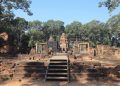
via Phnom Penh Post, 23 February 2020: The rice fossils from this site in Stung Treng are dated to 900 years ago and is the oldest secure dates thus far, but rice cultivation in general is older in this region.
Scientific test results of black rice fossils found in the basement of the Preah Ko temple site in Thala Barivat district, Stung Treng province late last year show that Cambodians have been cultivating and producing rice since the early Neolithic period.
The Neolithic age began around 12,000 years ago and ended as civilizations started to rise around 3500BCE.
In July last year, Thuy Chanthourn, the deputy director of the Institute of Arts and Culture of the Royal Academy of Cambodia and deputy president of the Cambodian Historians Association, brought the mysterious samples of black rice fossils from Preah Ko temple to the laboratory of the Australian National University (ANU) to conduct experiments to date the fossils.
With technical support from Rachel Wood, an archaeological and anthropological specialist at the ANU Research School of Earth Sciences, Chanthourn successfully examined the rice which has since become the earliest scientific dating of early rice cultivation in Cambodia.
Source: Black rice fossils found to date from at least 900 years | Phnom Penh Post
![This week in Southeast Asian Archaeology: Prambanan gets some renewed attention, Phimai Black pottery surfaces at Mun Bon Dam, and I’m taking a short break next week.⠀
⠀
The featured stories look at the new Indonesia–India conservation project at Prambanan, focusing on the temple complex’s ruined perwara shrines, and a striking Late Prehistoric find in northeast Thailand: a remarkably complete Phimai Black vessel discovered as water levels fell at Mun Bon Dam.⠀
⠀
Temples, pottery, reservoirs, and a little scheduled rest. Back again on 27 July.⠀
⠀
Read this week’s newsletter: [link in bio]⠀
⠀
#SoutheastAsianArchaeology #Archaeology #Heritage #Prambanan #Thailand #Indonesia #Cambodia #Vietnam #CulturalHeritage #Substack This week in Southeast Asian Archaeology: Prambanan gets some renewed attention, Phimai Black pottery surfaces at Mun Bon Dam, and I’m taking a short break next week.⠀
⠀
The featured stories look at the new Indonesia–India conservation project at Prambanan, focusing on the temple complex’s ruined perwara shrines, and a striking Late Prehistoric find in northeast Thailand: a remarkably complete Phimai Black vessel discovered as water levels fell at Mun Bon Dam.⠀
⠀
Temples, pottery, reservoirs, and a little scheduled rest. Back again on 27 July.⠀
⠀
Read this week’s newsletter: [link in bio]⠀
⠀
#SoutheastAsianArchaeology #Archaeology #Heritage #Prambanan #Thailand #Indonesia #Cambodia #Vietnam #CulturalHeritage #Substack](https://scontent-sin6-3.cdninstagram.com/v/t51.82787-15/744214042_18361115071209510_2262608560893170251_n.jpg?stp=dst-jpg_e35_tt6&_nc_cat=110&ccb=7-5&_nc_sid=18de74&efg=eyJlZmdfdGFnIjoiRkVFRC5iZXN0X2ltYWdlX3VybGdlbi5DMyJ9&_nc_ohc=xWgcEbcGABIQ7kNvwFx63N6&_nc_oc=Adoe3NBLPcXYeu2Q4WRCzWnJf1ph4tRSl-ndybF0lr1wsJa0WKbjmjX6eHkay-SU5Dk&_nc_zt=23&_nc_ht=scontent-sin6-3.cdninstagram.com&edm=ANo9K5cEAAAA&_nc_gid=dMcRRCmLrU8vIjIWuykhnw&_nc_tpa=Q5bMBQG5vqf4e5fIO0chtZGhHMc0t4iJSvRKIjH0mUwQ4mAL0XnRhUWCa3QyBVw826n_vqBqmRNCfsRP&oh=00_AQDPeFDmCshofY_1cjAQWqyOU02u0lMfxO-CyI0CXLzMFw&oe=6A6490F1)