
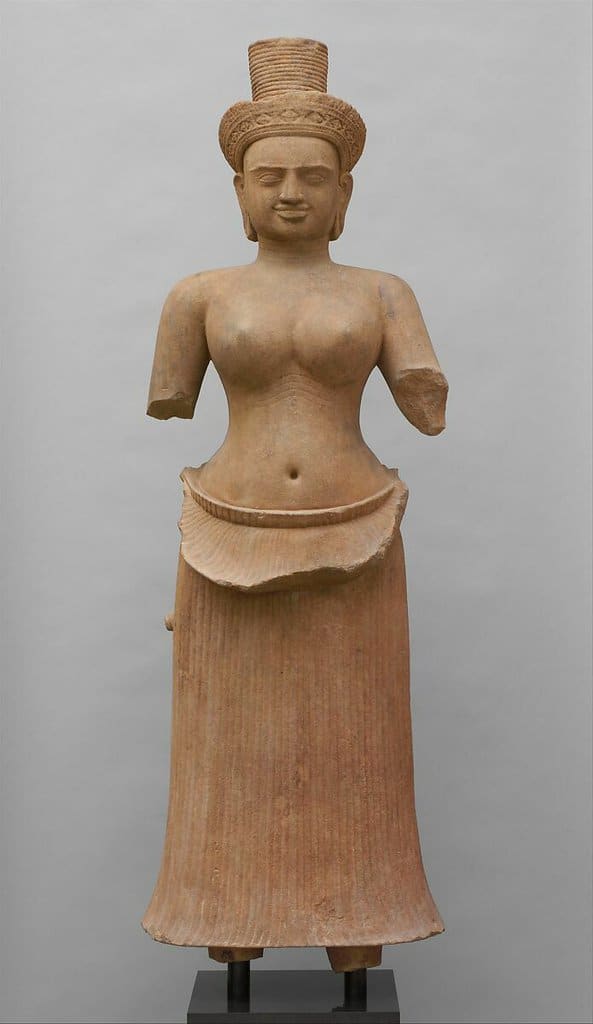
via the London Review of Books Blog: Erin Thompson’s blog post discusses the looting of sculptures from the Koh Ker site in Cambodia, their sale on the international art market, and the efforts to repatriate them.
Gordon had arranged for us to meet Chhay Visoth, the museum’s director. I asked about the cups of water and coffee I had seen every day on a stone block half-hidden in the bushes near the museum café, next to a vase of half-burnt sticks of incense. Visoth told me that the museum staff set out the cups each morning as an offering to the spirits. Many Cambodians, he said, both visitors and staff, consider the museum a sacred place. A family carried a plastic bag filled with lotus blossoms into the courtyard where we were talking. They placed the flowers into the arms of a concrete copy of Preah Kum Long, the Leper King.
The eighth-century stone original was at Angkor until 1967, when a would-be thief tried to saw off his head. The sculpture was transferred to the museum for safety and now sits near his replica in the courtyard. His fangs identify him as Yama, the Hindu god of death. But his fingers broke off over time, and after the Khmer state religion switched from Hinduism to Buddhism in the 13th century, viewers came to understand him as a legendary king of Angkor who was stricken with leprosy.
Visoth said that many visitors come to the museum in search of a new place to worship after leaving the countryside for the city. More than 90 per cent of Cambodians identify as Buddhist. Dhakal asked Visoth why Buddhist visitors offer worship to sculptures of Hindu deities. We asked many other people the same question, and they all gave the same answer: the external forms of a statue chosen by the spirits do not matter.
![This week in Southeast Asian Archaeology: Prambanan gets some renewed attention, Phimai Black pottery surfaces at Mun Bon Dam, and I’m taking a short break next week.⠀
⠀
The featured stories look at the new Indonesia–India conservation project at Prambanan, focusing on the temple complex’s ruined perwara shrines, and a striking Late Prehistoric find in northeast Thailand: a remarkably complete Phimai Black vessel discovered as water levels fell at Mun Bon Dam.⠀
⠀
Temples, pottery, reservoirs, and a little scheduled rest. Back again on 27 July.⠀
⠀
Read this week’s newsletter: [link in bio]⠀
⠀
#SoutheastAsianArchaeology #Archaeology #Heritage #Prambanan #Thailand #Indonesia #Cambodia #Vietnam #CulturalHeritage #Substack This week in Southeast Asian Archaeology: Prambanan gets some renewed attention, Phimai Black pottery surfaces at Mun Bon Dam, and I’m taking a short break next week.⠀
⠀
The featured stories look at the new Indonesia–India conservation project at Prambanan, focusing on the temple complex’s ruined perwara shrines, and a striking Late Prehistoric find in northeast Thailand: a remarkably complete Phimai Black vessel discovered as water levels fell at Mun Bon Dam.⠀
⠀
Temples, pottery, reservoirs, and a little scheduled rest. Back again on 27 July.⠀
⠀
Read this week’s newsletter: [link in bio]⠀
⠀
#SoutheastAsianArchaeology #Archaeology #Heritage #Prambanan #Thailand #Indonesia #Cambodia #Vietnam #CulturalHeritage #Substack](https://scontent-sin6-3.cdninstagram.com/v/t51.82787-15/744214042_18361115071209510_2262608560893170251_n.jpg?stp=dst-jpg_e35_tt6&_nc_cat=110&ccb=7-5&_nc_sid=18de74&efg=eyJlZmdfdGFnIjoiRkVFRC5iZXN0X2ltYWdlX3VybGdlbi5DMyJ9&_nc_ohc=efvF5aVfY5EQ7kNvwHCwB5Y&_nc_oc=Adrhygfs4_3OVhjr2Rgbgpm8FmeWkE2yymjBA2vziLdP9JGysLT5sw8HvP0DyoT9ok0&_nc_zt=23&_nc_ht=scontent-sin6-3.cdninstagram.com&edm=ANo9K5cEAAAA&_nc_gid=E2a971KxU5zWh5nw04VahQ&_nc_tpa=Q5bMBQG3isXxBQ6X2iiWSZMjLP-e67HFOBtkU91-gQ-AKbsKRt5f8E-T4V3vusgBi5f3KhWHhujQj78B&oh=00_AQDe-6UC5alsUH9NnC76ElPMhHOuQqr5Md7rQWU22phWgQ&oe=6A65E271)