
• This week on Southeast Asian Archaeology: rare bronze Mahoratuek drums surface in Thailand, gold-glazed terracotta helps redraw Vietnam’s Ho Citadel, and Aceh War “loot” gets a long-overdue digital reckoning.⠀
⠀
https://bit.ly/46lX88H
  • Circuits, Ceramics, and Colonial Archives is out now 🏛️🌊📜 CNY/Tết (Year of the Horse) greetings + this week’s theme: heritage in a hurry—Angkor’s “high risk” Baksei Chamkrong, Sibonga church repairs post-Odette, and Indonesia’s 152-site revitalisation push. Read: https://bit.ly/3Mswq7G
  • Heritage isn’t just awe—it’s upkeep. This week: a historic building floor collapse at Siak Palace, Beng Mealea’s walkway repairs, Ponagar Tower’s arts show paused over losses.⠀
 ⠀
https://bit.ly/4chkwIb⠀
  • Biases, Bones & Burāq — this week’s Southeast Asian Archaeology newsletter is all about how small corrections can change big histories.⠀
⠀
We’ve got four fresh research reads:⠀
 🐟 Neolithic expansion that looks a lot more “rice and fish” once recovery bias is taken seriously⠀
 📜 An illuminated Qur’an section from Java on dluwang (treebark paper), with clues that push it earlier than you might expect⠀
 🐀 Timor-Leste’s giant/large murids, measured in detail to track changing ecologies (and a late crash)⠀
 ⚱️ Ban Non Wat grave size and offerings, mapping a sharp spike—and then easing—of social distinction⠀
⠀
And for a screen break: a small mention of PBS’s Angkor: Hidden Jungle Empire.⠀
⠀
Read the full roundup here: https://bit.ly/45Gh2uN ⠀
 #Archaeology #SoutheastAsia #Heritage #Anthropology #Museums #History
  • This week in Southeast Asian Archaeology: Sulawesi just delivered a headline-grabbing ~67,800-year-old hand-stencil date, Huế’s Imperial Citadel restoration has revealed a trilingual astronomical mural, and Malaysia’s new Guar Kepah Archaeological Gallery opens with the “Penang Woman” at centre stage. Deep time, dynastic science, and fresh public heritage spaces—come catch up on the week’s stories.⠀
⠀
https://bit.ly/3NG7WIg
  • New week, new reads: a “Southwestern Silk Road” model for amber into Han China, the biggest Austroasiatic genomic dataset yet (with Dvaravati/Angkor-era signals), plus rock art methods and fresh motifs from Malaysia and Laos. Molecules, motifs, and migration stories — all in one roundup.

Amber, Ancestry and Arty hands https://bit.ly/3LAK20c
  • New year, new (very full) newsletter From Java Man coming home to Jakarta to Khmer sculptures heading back to Cambodia and a bleak month on the Thai–Cambodian border, catch up on a whole month of Southeast Asian archaeology: https://bit.ly/4syuWJh
  • This week’s Southeast Asian Archaeology newsletter is all about the invisible infrastructure of knowledge — the stuff behind the sites. We look at Cambodia’s push to access the late Emma Bunker’s notebooks as a potential roadmap to looted Khmer art, a Thanh Hóa village communal house where 47 imperial edicts were quietly stashed in bamboo tubes for centuries, and Jingdezhen’s “ceramic gene bank” in China, where millions of sherds and glaze recipes are treated like DNA for porcelain. From roof beams to databases, it’s a reminder that archives, records and lab data shape what we think we know about the past just as much as temples and shipwrecks do. Plus the usual mix of regional news, grants, jobs and heritage politics — link in bio/newsletter below.

https://bit.ly/3XIeV5h
  • Genomes point to a 60,000-year “long chronology” for the first settlers of Sahul, while new DNA links China’s hanging coffins to the modern Bo people. #southeastasianarchaeology
 
Read here: https://bit.ly/4a64D6z
  • Southeast Asia’s past is on tour this week — from Bangkok’s royal treasures in Beijing’s Palace Museum to Cham sculptures in Đà Nẵng, Khmer–Chinese exchanges in Phnom Penh, and 14th-century Temasek sherds greeting commuters in a Singapore MRT station. 

In the latest Southeast Asian Archaeology newsletter, a look at how exhibitions are carrying the region’s history into train platforms, diplomatic halls and hands-on museum workshops, plus what this means for soft power, heritage policy and public archaeology. US readers will also spot a small Thanksgiving note of gratitude to the people and institutions who keep these stories alive.

Read the full issue and subscribe here: https://bit.ly/4oeZz2S 

#SoutheastAsia #Archaeology #Museums #Heritage #Thailand #Cambodia #Vietnam #Singapore #Beijing #PalaceMuseum
Saturday, March 7, 2026
Southeast Asian Archaeology
  • News
  • Resources
  • Countries
    • Southeast Asia
    • Mainland Southeast Asia
      • Cambodia
      • Laos
      • Malaysia
      • Myanmar
      • Thailand
      • Vietnam
    • Island Southeast Asia
      • Brunei
      • Indonesia
      • Malaysia
      • Philippines
      • Singapore
      • Timor Leste
    • Peripheral Southeast Asia
  • Topics
    • Artifact Type
      • Architecture
      • Bones and Burials
      • Ceramics
      • Intangible Cultural Heritage
      • Lithics
      • Megaliths
      • Rock Art
      • Sculpture
    • Field
      • Anthropology
      • Bioarchaeology
      • Epigraphy
      • General Archaeology
      • Metallurgy and Metalworking
      • Paleontology
      • Underwater Archaeology
      • Visual Art
      • Zooarchaeology
    • Other Themes
      • Animism
      • Buddhism
      • Christianity
      • Disaster Risk Management
      • Hinduism
      • Islam
      • Archaeological Tourism in Southeast Asia
  • Visit
    • Virtual Archaeology
    • Unesco World Heritage
  • Jobs
  • Subscribe
  • About
    • About
    • Supporters
    • Terms of Use
    • Privacy Policy
    • Contact
No Result
View All Result
Southeast Asian Archaeology
  • News
  • Resources
  • Countries
    • Southeast Asia
    • Mainland Southeast Asia
      • Cambodia
      • Laos
      • Malaysia
      • Myanmar
      • Thailand
      • Vietnam
    • Island Southeast Asia
      • Brunei
      • Indonesia
      • Malaysia
      • Philippines
      • Singapore
      • Timor Leste
    • Peripheral Southeast Asia
  • Topics
    • Artifact Type
      • Architecture
      • Bones and Burials
      • Ceramics
      • Intangible Cultural Heritage
      • Lithics
      • Megaliths
      • Rock Art
      • Sculpture
    • Field
      • Anthropology
      • Bioarchaeology
      • Epigraphy
      • General Archaeology
      • Metallurgy and Metalworking
      • Paleontology
      • Underwater Archaeology
      • Visual Art
      • Zooarchaeology
    • Other Themes
      • Animism
      • Buddhism
      • Christianity
      • Disaster Risk Management
      • Hinduism
      • Islam
      • Archaeological Tourism in Southeast Asia
  • Visit
    • Virtual Archaeology
    • Unesco World Heritage
  • Jobs
  • Subscribe
  • About
    • About
    • Supporters
    • Terms of Use
    • Privacy Policy
    • Contact
No Result
View All Result
Southeast Asian Archaeology
No Result
View All Result
ADVERTISEMENT

Related Posts

[Paper] Investigating the Risk of Violence During the Neolithic to the Late Iron Age in Northeast Thailand (c. 1400 B.C. – A.D. 800)

31 July 2024
0
42

...

Source: The Debrief 20240727

51,200-Year-Old Sulawesi Cave Art: Hominin or Human?

29 July 2024
0
104

...

[Paper] Intangible maritime heritage protection in Malaysia: The need for a revision of the National Heritage Act of 2005

26 July 2024
0
31

...

Source Taninai 2024

[Paper] International Coordinating Committee for Angkor (ICC-Angkor): Reflections from Diplomatic Perspectives

24 July 2024
0
26

...

Popular This Week

  • Southeast Asian Archaeology from a Rock Art Perspective (with annotations)

    Southeast Asian Archaeology from a Rock Art Perspective (with annotations)

    0 shares
    Share 0 Tweet 0
  • The most influential books on Southeast Asian Archaeology (a crowdsourced list)

    0 shares
    Share 0 Tweet 0
  • Southeast Asian Archaeology memes that will tickle your funny bone and also make you ponder

    68 shares
    Share 68 Tweet 0
  • Negritos or Malays: Who are the original inhabitants of the Philippines?

    2 shares
    Share 2 Tweet 0
  • Explore Southeast Asia through these virtual galleries

    616 shares
    Share 616 Tweet 0
Buy me a coffeeBuy me a coffee

If you found this site useful, you can help support it by buying me a coffee!

[Paper] The eastern Kendeng Hills (Java, Indonesia) and the hominin-bearing beds of Mojokerto, a re-interpretation

19 October 2022
in Indonesia
Tags: hominidHomo erectusJava (island)research papers
0
SHARES
50
VIEWS
Source: Berghuis et al. 2022

Source: Berghuis et al. 2022

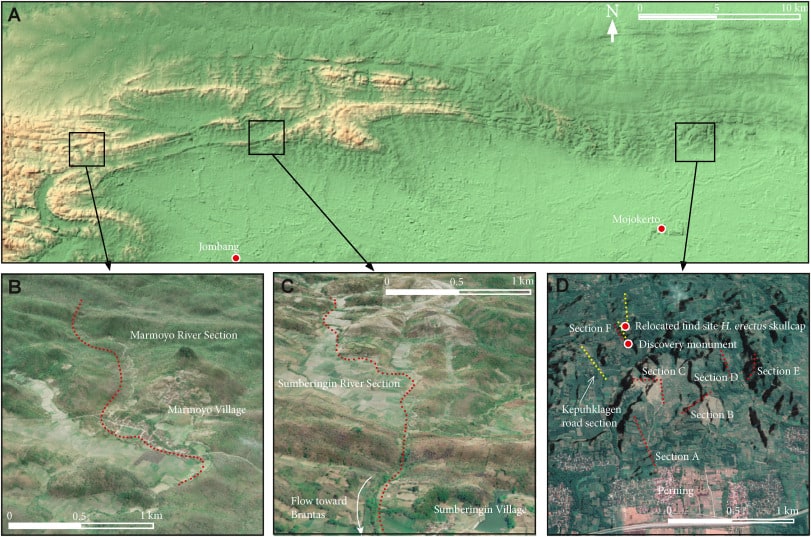
via Quaternary Science Reviews, 1 November 2022: Re-analysis of the straigraphy of the Kendeng Hills suggest that the Mojokerto Homo erectus is dated to around 550 thousand years agao, and may shed some new light on the arrival of hominins to Java.

The eastern Kendeng Hills (Java, Indonesia) expose a 1000 m thick series that is used as a stratigraphic standard, representing the emergence of eastern Java from the sea. The fluvial top is rich in vertebrate fossils and yielded the Mojokerto (Perning) hominin skullcap, which is regarded as the earliest evidence of Homo erectus on Java, with age estimates ranging between 1.9 and 1.49 Ma. The series is commonly regarded as an uninterrupted record of coastal progradation. However, recent studies show that the emergence of eastern Java has been a complex process, under influence of tectonism, volcanism, sea-level fluctuations and fluvial dynamics, leaving a fragmented depositional record that varies from site to site. This is at odds with the prevailing stratigraphic practice of long-distance correlations and questions the existing interpretations of the eastern Kendeng reference sections. Here we present the results of a fieldwork-based re-interpretation of this key stratigraphic record, which we identified as the fill of a previously unrecognized Plio-Pleistocene embayment, surrounded by elongate uplift zones. Clinoform-bedded sandstones relate to a stage of explosive, high-silica volcanism, supplying large volumes of ash. The embayment fill is incised and covered by fluvial deposits, which we relate to the Middle Pleistocene Brantas. The fluvial strata have a cyclic build-up, probably representing sea-level controlled stages of aggradation and degradation. Based on a reconstruction of fluvial cycles, we provisionally link the conglomerate bed in which the Mojokerto Homo erectus was found to MIS14 (∼550ka). We infer that the published radiometric ages derive from reworked volcanic clasts that make up this incisive fluvial lag and are not representative for the age of deposition. Our study places the eastern Kendeng series in a new landscape context and changes our view of the timing of hominin migration to Java.

Source: The eastern Kendeng Hills (Java, Indonesia) and the hominin-bearing beds of Mojokerto, a re-interpretation – ScienceDirect

Subscribe to the weekly Southeast Asian Archaeology news digest

Latest Books

The following are affiliate links for which I may earn a commission if you click and make a purchase. Click here for more books about Indonesian archaeology.
Sale Patterned Splendour: Textiles Presented on Javanese Metal and Stone Sculptures; Eighth to Fifteenth Century
Patterned Splendour: Textiles Presented on...
Amazon Prime
$30.54
Buy on Amazon
Sale Majapahit: Sculptures from a Forgotten Kingdom
Majapahit: Sculptures from a Forgotten Kingdom
$44.08
Buy on Amazon
Sale Little Species, Big Mystery: The Story of Homo Floresiensis
Little Species, Big Mystery: The Story of Homo...
Amazon Prime
$26.53
Buy on Amazon
Sale Majapahit: Intrigue, Betrayal and War in Indonesia’s Greatest Empire
Majapahit: Intrigue, Betrayal and War in...
Amazon Prime
$15.74
Buy on Amazon
Seaways and Gatekeepers: Trade and State in the Eastern Archipelagos of Southeast Asia, c.1600–c.1906
Seaways and Gatekeepers: Trade and State in the...
Amazon Prime
$46.00
Buy on Amazon
Heroes, Gods and Guardians: Hilts and Keris of Indonesia, Huntington Miller Collection
Heroes, Gods and Guardians: Hilts and Keris of...
Buy on Amazon

Leave a Reply

Your email address will not be published. Required fields are marked *

I agree to the Terms & Conditions and Privacy Policy.

This site uses Akismet to reduce spam. Learn how your comment data is processed.

Southeast Asian Archaeology

© 2019

Navigate Site

  • News
  • Resources
  • Countries
  • Topics
  • Visit
  • Jobs
  • Subscribe
  • About

Follow

Never Miss a Discovery
Subscribe for Exclusive Southeast Asian Archaeology News!

Stay connected with the latest breakthroughs, research, and events from across Southeast Asia’s archaeology scene. Sign up today for exclusive weekly updates, trusted by over 2,000 subscribers.

×
No Result
View All Result
  • News
  • Resources
  • Countries
    • Southeast Asia
    • Mainland Southeast Asia
      • Cambodia
      • Laos
      • Malaysia
      • Myanmar
      • Thailand
      • Vietnam
    • Island Southeast Asia
      • Brunei
      • Indonesia
      • Malaysia
      • Philippines
      • Singapore
      • Timor Leste
    • Peripheral Southeast Asia
  • Topics
    • Artifact Type
      • Architecture
      • Bones and Burials
      • Ceramics
      • Intangible Cultural Heritage
      • Lithics
      • Megaliths
      • Rock Art
      • Sculpture
    • Field
      • Anthropology
      • Bioarchaeology
      • Epigraphy
      • General Archaeology
      • Metallurgy and Metalworking
      • Paleontology
      • Underwater Archaeology
      • Visual Art
      • Zooarchaeology
    • Other Themes
      • Animism
      • Buddhism
      • Christianity
      • Disaster Risk Management
      • Hinduism
      • Islam
      • Archaeological Tourism in Southeast Asia
  • Visit
    • Virtual Archaeology
    • Unesco World Heritage
  • Jobs
  • Subscribe
  • About
    • About
    • Supporters
    • Terms of Use
    • Privacy Policy
    • Contact

© 2019

This website uses cookies. By continuing to use this website you are giving consent to cookies being used. Visit our Privacy and Cookie Policy.
