
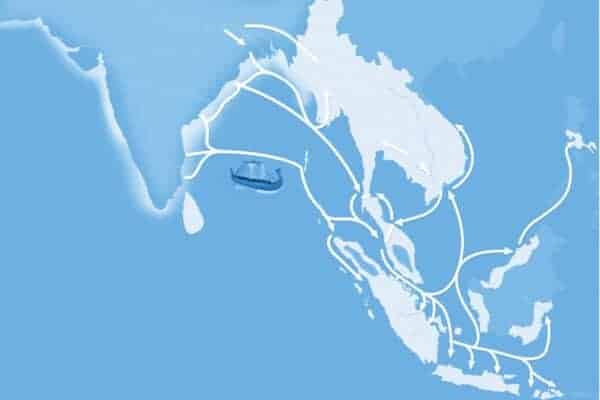
via Fountain Ink, 02 Feb 2019: Bujang Valley and Sungai Batu in Malaysia’s northern Kedah state contain some spectacular archaeological remains that hint of Indian influence in this region.
ungai Batu is just a crow’s flight from the far better known Bujang Valley, first discovered by Lt Colonel James Low, colonial administrator of the neighbouring Penang Straits Settlement, in the 1830s. Systematic excavation of the earliest sites, however, began only just before World War I by H.G. Quaritch Wales and his wife Dorothy. Bujang Valley is variously named in literary sources as Kalagam, Kilagam, Kadaram and Kataha by Tamils in India, by the Chinese as Chieh-Cha, Chia-Cha, Chi-to, Chi-ta and Kie-tcha, and by the Persians as Kalah. These names are directly linked to its iron industry because those words mean iron in different languages.
Over the decades as the work progressed, it was definitively identified as an early culture with Indic features. The name Bujang, for instance, is believed to be a variant of Sanskrit “Bhujanga”, serpent. In other words, it is Serpent Valley. More significantly, the large number of old temples (called candi) that dot the area establish its Hindu-Buddhist provenance. Finally, its location makes it highly likely that the original founders of the site were Indians, and from the south at that.
The Bujang complex lies six degrees north of the equator, the same latitude as Sri Lanka (known to Rome as Serendivis, Arabs as Serandib, and Persians as Serendip). So it was in a direct line east from Chola and Pallava country in modern Tamil Nadu. These two kingdoms have had a profound influence upon the history of Southeast Asia and in turn been influenced by it.
Source: Mysteries of an ancient migration from India | Fountain Ink
![This week in Southeast Asian Archaeology: Prambanan gets some renewed attention, Phimai Black pottery surfaces at Mun Bon Dam, and I’m taking a short break next week.⠀
⠀
The featured stories look at the new Indonesia–India conservation project at Prambanan, focusing on the temple complex’s ruined perwara shrines, and a striking Late Prehistoric find in northeast Thailand: a remarkably complete Phimai Black vessel discovered as water levels fell at Mun Bon Dam.⠀
⠀
Temples, pottery, reservoirs, and a little scheduled rest. Back again on 27 July.⠀
⠀
Read this week’s newsletter: [link in bio]⠀
⠀
#SoutheastAsianArchaeology #Archaeology #Heritage #Prambanan #Thailand #Indonesia #Cambodia #Vietnam #CulturalHeritage #Substack This week in Southeast Asian Archaeology: Prambanan gets some renewed attention, Phimai Black pottery surfaces at Mun Bon Dam, and I’m taking a short break next week.⠀
⠀
The featured stories look at the new Indonesia–India conservation project at Prambanan, focusing on the temple complex’s ruined perwara shrines, and a striking Late Prehistoric find in northeast Thailand: a remarkably complete Phimai Black vessel discovered as water levels fell at Mun Bon Dam.⠀
⠀
Temples, pottery, reservoirs, and a little scheduled rest. Back again on 27 July.⠀
⠀
Read this week’s newsletter: [link in bio]⠀
⠀
#SoutheastAsianArchaeology #Archaeology #Heritage #Prambanan #Thailand #Indonesia #Cambodia #Vietnam #CulturalHeritage #Substack](https://scontent-sin6-3.cdninstagram.com/v/t51.82787-15/744214042_18361115071209510_2262608560893170251_n.jpg?stp=dst-jpg_e35_tt6&_nc_cat=110&ccb=7-5&_nc_sid=18de74&efg=eyJlZmdfdGFnIjoiRkVFRC5iZXN0X2ltYWdlX3VybGdlbi5DMyJ9&_nc_ohc=xWgcEbcGABIQ7kNvwFx63N6&_nc_oc=Adoe3NBLPcXYeu2Q4WRCzWnJf1ph4tRSl-ndybF0lr1wsJa0WKbjmjX6eHkay-SU5Dk&_nc_zt=23&_nc_ht=scontent-sin6-3.cdninstagram.com&edm=ANo9K5cEAAAA&_nc_gid=dMcRRCmLrU8vIjIWuykhnw&_nc_tpa=Q5bMBQG5vqf4e5fIO0chtZGhHMc0t4iJSvRKIjH0mUwQ4mAL0XnRhUWCa3QyBVw826n_vqBqmRNCfsRP&oh=00_AQDPeFDmCshofY_1cjAQWqyOU02u0lMfxO-CyI0CXLzMFw&oe=6A6490F1)