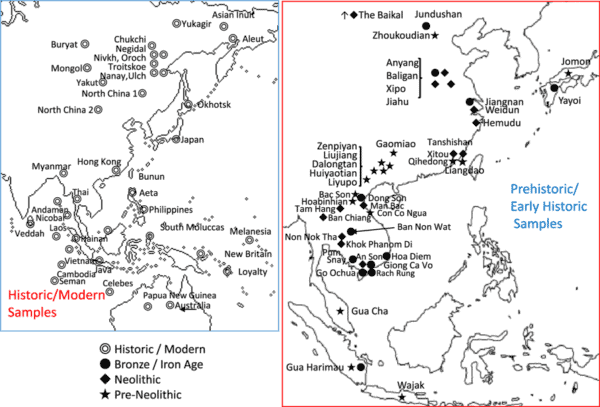
via Nature Scientific Reports, 05 Feb 2019: Analysis of skulls from archaeological sites in Southeast and East Asia support a two-layer model of anatomically modern populations entering into Asia.
Craniometrics Reveal “Two Layers” of Prehistoric Human Dispersal in Eastern Eurasia
Nature Scientific Reports, Matsumura et al., https://www.nature.com/articles/s41598-018-35426-z
This cranio-morphometric study emphasizes a “two-layer model” for eastern Eurasian anatomically modern human (AMH) populations, based on large datasets of 89 population samples including findings directly from ancient archaeological contexts. Results suggest that an initial “first layer” of AMH had related closely to ancestral Andaman, Australian, Papuan, and Jomon groups who likely entered this region via the Southeast Asian landmass, prior to 65–50 kya. A later “second layer” shared strong cranial affinities with Siberians, implying a Northeast Asian source, evidenced by 9 kya in central China and then followed by expansions of descendant groups into Southeast Asia after 4 kya. These two populations shared limited initial exchange, and the second layer grew at a faster rate and in greater numbers, linked with contexts of farming that may have supported increased population densities. Clear dichotomization between the two layers implies a temporally deep divergence of distinct migration routes for AMH through both southern and northern Eurasia.
![This week in Southeast Asian Archaeology: Prambanan gets some renewed attention, Phimai Black pottery surfaces at Mun Bon Dam, and I’m taking a short break next week.⠀
⠀
The featured stories look at the new Indonesia–India conservation project at Prambanan, focusing on the temple complex’s ruined perwara shrines, and a striking Late Prehistoric find in northeast Thailand: a remarkably complete Phimai Black vessel discovered as water levels fell at Mun Bon Dam.⠀
⠀
Temples, pottery, reservoirs, and a little scheduled rest. Back again on 27 July.⠀
⠀
Read this week’s newsletter: [link in bio]⠀
⠀
#SoutheastAsianArchaeology #Archaeology #Heritage #Prambanan #Thailand #Indonesia #Cambodia #Vietnam #CulturalHeritage #Substack This week in Southeast Asian Archaeology: Prambanan gets some renewed attention, Phimai Black pottery surfaces at Mun Bon Dam, and I’m taking a short break next week.⠀
⠀
The featured stories look at the new Indonesia–India conservation project at Prambanan, focusing on the temple complex’s ruined perwara shrines, and a striking Late Prehistoric find in northeast Thailand: a remarkably complete Phimai Black vessel discovered as water levels fell at Mun Bon Dam.⠀
⠀
Temples, pottery, reservoirs, and a little scheduled rest. Back again on 27 July.⠀
⠀
Read this week’s newsletter: [link in bio]⠀
⠀
#SoutheastAsianArchaeology #Archaeology #Heritage #Prambanan #Thailand #Indonesia #Cambodia #Vietnam #CulturalHeritage #Substack](https://scontent-sin6-3.cdninstagram.com/v/t51.82787-15/744214042_18361115071209510_2262608560893170251_n.jpg?stp=dst-jpg_e35_tt6&_nc_cat=110&ccb=7-5&_nc_sid=18de74&efg=eyJlZmdfdGFnIjoiRkVFRC5iZXN0X2ltYWdlX3VybGdlbi5DMyJ9&_nc_ohc=xWgcEbcGABIQ7kNvwFx63N6&_nc_oc=Adoe3NBLPcXYeu2Q4WRCzWnJf1ph4tRSl-ndybF0lr1wsJa0WKbjmjX6eHkay-SU5Dk&_nc_zt=23&_nc_ht=scontent-sin6-3.cdninstagram.com&edm=ANo9K5cEAAAA&_nc_gid=dMcRRCmLrU8vIjIWuykhnw&_nc_tpa=Q5bMBQG5vqf4e5fIO0chtZGhHMc0t4iJSvRKIjH0mUwQ4mAL0XnRhUWCa3QyBVw826n_vqBqmRNCfsRP&oh=00_AQDPeFDmCshofY_1cjAQWqyOU02u0lMfxO-CyI0CXLzMFw&oe=6A6490F1)


![[Paper] Craniometrics Reveal “Two Layers” of Prehistoric Human Dispersal in Eastern Eurasia](https://www.southeastasianarchaeology.com/wp-content/uploads/2019/02/41598_2018_35426_Fig1_HTML-750x509.png)