• Can inscriptions help reconstruct how a kingdom expanded across a landscape?

King Citrasena (Chitrasen, later known as Mahendravarman) ruled Chenla in the late 6th to early 7th centuries, during a period when Chenla’s influence was extending across parts of what are now Cambodia, Laos and northeastern Thailand. His reign is known partly through inscriptions recording religious foundations, royal achievements and other acts of authority. 

Pailoplee and Khatshima map 21 inscriptions from at least 19 locations associated with Citrasena, and asked if people were moving between these places, which routes would they have taken? To explore this, they use Least Cost Path (LCP) modelling in a GIS. LCP calculates routes that minimise the “cost” of movement across terrain.

In archaeology, this can help identify plausible corridors shaped by features such as slopes, river valleys and mountain barriers. These models show how movement could have been structured by the landscape under the assumptions of the model.

Across several scenarios, the reconstructed paths repeatedly concentrate around major river systems—especially the Mun River—and particular passes through the Phnom Dong Rek (Dangrek) mountain range. The authors also compare the modelled network with archaeological sites attributed to Citrasena’s period, many of which fall along these reconstructed corridors.

Where river navigation would have been difficult (such as the Khone Phapheng Falls), the authors propose that Citrasena’s forces may instead have moved overland along riverbanks, using waterways as natural guides through the landscape.

The placement of several inscriptions near river confluences also suggests that these locations may have been important for controlling movement, communication and exchange, not simply access to water.

Reference
Pailoplee, S. & Khatshima, K. 2026. “The role of King Chitrasen (Mahendravarman) in the expansion of the Chenla Kingdom: A study of inscriptions and historical geography.” Social Sciences & Humanities Open 14, 103503.
10.1016/j.ssaho.2026.103503

#SoutheastAsianArchaeology #Cambodia #Thailand #Laos #Chenla
  • Sometimes the biggest archaeological questions depend on evidence we cannot see during excavation.

Microarchaeology investigates archaeological deposits at microscopic and microstratigraphic scales. In Southeast Asia, this can be especially valuable because monsoonal wetness, tropical weathering, intensive land use and complex depositional histories can affect how archaeological evidence survives. 

Researchers can examine the surrounding sediment for traces of past activity and later disturbance. Methods discussed in this new paper include sediment micromorphology, laboratory micro-excavation, high-resolution imaging, FTIR microscopy and SEM-EDS. Depending on the context, microscopic evidence can help identify burning, trampling, plant processing, sediment movement and environmental change. 

The importance of that context is illustrated by work in northern Laos. At Tam Ngu Hao 2, microstratigraphy was used alongside lithological observations and dating to establish the stratigraphic context of Denisovan fossil evidence. At Tam Pà Ling, it has shown potential for investigating environmental seasonality and possible patterns of early modern human presence. These methods help archaeologists understand what happened to a deposit before drawing conclusions from what it contains.
 
The paper also introduces the Australian Microarchaeology and Palaeosciences Facility (AusMAP) and argues for greater collaboration, training and locally based microarchaeological expertise across Southeast Asia. 

Reference:
Hernandez et al. 2026. Scaling down to look further back: Southeast Asia, deep-time science and microarchaeology. SPAFA Journal 10.
10.26721/spafajournal.651369a4y8 

#SoutheastAsianArchaeology #Archaeology #Microarchaeology #Geoarchaeology #ArchaeologicalScience
  • This week on Southeast Asian Archaeology: claims, contexts and careful reading.⠀
⠀
With Malaysia’s National Day, Vietnam’s National Day, Timor-Leste’s Popular Consultation Day, and International Literacy Day all close together, I’m thinking about literacy not just as reading words, but reading evidence: museum labels, old spellings, dates, maps, artefacts, archives, and the occasional viral post with a raised eyebrow.⠀
⠀
The catalyst this week is the recent controversy over historical claims in Malaysia, alongside a timely RSIS piece on how historians, archaeologists, archivists, librarians and curators can help push back against disinformation. Not by attacking people, but by helping everyone ask better questions of the past.⠀
⠀
Also in this week’s issue: Penang’s historical Malay spellings, Cambodia’s new artefact database grant, Singapore’s revised History Gallery, UNESCO’s maritime museum project, new research on Sundadonty, Roti Island, Chenla inscriptions, ancient Myanmar, and more.⠀
⠀
Link in bio.⠀
⠀
#SoutheastAsianArchaeology #Archaeology #Heritage #InformationLiteracy
  • How old are the rock paintings of Mainland Southeast Asia? 🎨🪨

A new study from Mangguan in Yunnan, southwestern China, provides another important piece of the puzzle.

Using uranium-thorium dating, researchers analysed tiny calcite deposits that had formed over the paintings. Because the calcite must be younger than the pigment underneath, the dates provide a minimum age for the art. One deposit covering a human figure shows that the painting was already there at least 4,220 years ago.

Mangguan is particularly interesting because it lies only about 15 km from the better-known Cangyuan rock art complex. The two have stylistic similarities and overlapping dates, suggesting they formed part of a broader regional rock art tradition, a comparison can be taken farther south.

The rock paintings at Pha Taem in Luang Prabang, Laos, have previously been compared with Cangyuan, raising intriguing questions about relationships between the rock art traditions of southwestern China and Mainland Southeast Asia.

Most rock art in Mainland Southeast Asia remains poorly dated, so dates like those from Mangguan give us increasingly useful chronological anchors for thinking about these connections.

References:
Wu, Y. et al. 2026. U-Th dating of rock paintings in southwestern China: minimum age of ~4.2 ka BP at the Mangguan site. Journal of Archaeological Science: Reports 74, 105987. DOI: 10.1016/j.jasrep.2026.105987.

Bo, X. 2020. On the relationship between the Cangyuan rock art in Yunnan, China, and the Pha Taem rock art in Laos. Rock Art Research 37(2).

Tan, N.H. 2018. The Cliff Paintings of Pha Taem, Luang Prabang, Lao PDR. Rock Art Research 35(1).

#RockArt #SoutheastAsianArchaeology #Yunnan #China
  • Extraordinary claims about the past can be exciting. But how do we tell an exciting new hypothesis from pseudoarchaeology?

Recent controversy in Malaysia over claims that ancient Malays taught the Romans shipbuilding provides a useful case study. Rather than piling on the person behind the claims, I think there is a more useful question to ask: how would we actually test an idea like this?

Archaeology gives us some simple tools.

Do the dates work? What is the primary evidence? Does the evidence actually demonstrate the connection being claimed? Are there better explanations? And perhaps most importantly: what evidence would make us reject the hypothesis?

Ancient Southeast Asians really were sophisticated seafarers. Srivijaya really was one of Asia’s great maritime powers. Sungai Batu really does preserve remarkable evidence for early iron production.

None of those achievements needs embellishment to make Southeast Asian archaeology extraordinary.

Swipe through for five questions you can use the next time you encounter an astonishing claim about the ancient past.

🚩 Remember: possibility is not evidence, similarity does not necessarily mean transmission, and extraordinary claims still have to survive ordinary archaeological scrutiny.

Read more about the archaeology behind these claims in this week’s Southeast Asian Archaeology Newsletter.

#SoutheastAsianArchaeology #Pseudoarchaeology #Malaysia #MaritimeArchaeology #MediaLiteracy
  • A 4,000-year-old painted stone from Wetar Island may change how we understand the Austronesian story.⠀
⠀
Archaeologists excavating Huknaur 1 in Southeast Indonesia found a painted plaque with a red sun-ray motif linked to the Austronesian Painting Tradition — a wider visual tradition known from eastern Indonesia and nearby islands.⠀
⠀
What makes this find so important is that the plaque appears to be older than the first pottery at the site. That means a shared symbolic tradition may have been present before the full Neolithic package usually associated with Austronesian expansion. This discovery suggests that ideas, symbols, and identity may have travelled ahead of pottery.⠀
⠀
It is a reminder that the spread of people goes beyond tools, crops, or ceramics, and may also have been about belief, belonging, and a shared visual language carried across the sea.⠀
⠀
Swipe through to see why this small object has such big implications.⠀
⠀
Reference:⠀
O’Connor, S., Kealy, S., Kaharudin, H.A.F., et al. (2026). 4000-year-old painted plaque from Southeast Indonesia reveals Austronesian Painting Tradition preceded Neolithic pottery. PNAS 123(34): e2611580123.⠀
⠀
#SoutheastAsianArchaeology #RockArt #Austronesian #Indonesia #Wetar #SoutheastAsia #IslandSoutheastAsia #AustronesianPaintingTradition
  • Plaques, Ponds and Provenance⠀
⠀
This week’s newsletter begins with a 4,000-year-old painted plaque from Wetar Island — a small object with a big story.⠀
⠀
The plaque carries a red sun-like motif linked to the Austronesian Painting Tradition, and it appears before pottery at the site. That suggests visual symbols and shared ideas may have moved through maritime Southeast Asia before some of the usual archaeological markers we associate with Austronesian expansion.⠀
⠀
Also this week: archaeology beneath Angkor’s Sras Srang, suspected Ban Chiang artefacts offered for return from Switzerland, and more heritage news from across the region.⠀
⠀
Link in bio.
  • How do you make a 3-metre stone stand upright for centuries?

At Hintang in northern Laos, archaeologists are beginning to answer that question.

In 2025, a Lao-Australian team excavated Site 7A — the first excavation at a Hintang standing-stone site in around 90 years. Beneath the surface, they found that the stones had been set deeply into pits, with smaller rocks packed around their bases to stabilise them. Roughly one-third of each standing stone was buried underground.

One big question remains, though — how old are the Hintang stones?

Samples were collected for dating, but those results are still being analysed. So, for now, we understand a little more about how these monuments were built.

📖 Shewan, L., O’Reilly, D., Armstrong, B. & Butphachit, A. (2026). “Surveys of Hintang standing stone sites and excavations at Site 7A, Houaphanh, Lao PDR.” Antiquity.
doi: 10.15184/aqy.2026.10408

#Archaeology #SoutheastAsianArchaeology #Laos #Megaliths #Hintang #AncientTechnology #ArchaeologicalResearch #Heritage #NewResearch
  • Angkor’s water system is famous for its scale: enormous reservoirs, long canals, and monumental engineering.⠀
⠀
New research by archaeologist Sarah Klassen highlights how Angkor’s agricultural system also depended on more than 1,000 local temple communities spread across the Greater Angkor Region. These communities helped organise labour, manage local water systems, and coordinate rice production - and suggests that Angkor’s success was built through a combination of top-down and bottom-up management.⠀
⠀
The state created the large hydraulic framework. Local communities adapted to it, expanded around it, and helped make the wider agricultural landscape function.⠀
⠀
Over time, however, this balance changed. Land and resources became increasingly concentrated, the system became more centralised, and some of the flexibility that had helped Angkor cope with earlier environmental stress may have been lost.⠀
⠀
Beyond its temples and kings, Angkor
  • New Evidence from the Southeast Asian Borderlands⠀
⠀
This week in Southeast Asian Archaeology: new dates, new methods, and some wonderfully untidy timelines.⠀
⠀
🪨 Uranium-thorium dating pushes the Mangguan rock paintings in Yunnan back to at least 4,220 years ago⠀
 🥁 AI-assisted restoration takes on damaged imagery on Guangxi bronze drums⠀
 🌾 New work at Angkor asks how infrastructure, local communities and water management shaped resilience⠀
 🗿 Lao-Australian fieldwork maps and excavates the enigmatic Hintang standing stones⠀
⠀
Plus archaeology and heritage news from across Southeast Asia, new research, opportunities, and more.⠀
⠀
I’ve also started experimenting with short visual explainers of new archaeology papers here on Instagram — so follow along if you like your archaeology with fewer footnotes and more pixels.⠀
⠀
Read the latest SEAArch newsletter via the link in bio.⠀
⠀
#Archaeology #SoutheastAsianArchaeology #SoutheastAsia #RockArt #Angkor #Laos #Yunnan #Heritage #ArchaeologicalResearch #DigitalHeritage
Sunday, September 6, 2026
Southeast Asian Archaeology
  • News
  • Resources
  • Countries
    • Southeast Asia
    • Mainland Southeast Asia
      • Cambodia
      • Laos
      • Malaysia
      • Myanmar
      • Thailand
      • Vietnam
    • Island Southeast Asia
      • Brunei
      • Indonesia
      • Malaysia
      • Philippines
      • Singapore
      • Timor Leste
    • Peripheral Southeast Asia
  • Topics
    • Artifact Type
      • Architecture
      • Bones and Burials
      • Ceramics
      • Intangible Cultural Heritage
      • Lithics
      • Megaliths
      • Rock Art
      • Sculpture
    • Field
      • Anthropology
      • Bioarchaeology
      • Epigraphy
      • General Archaeology
      • Metallurgy and Metalworking
      • Paleontology
      • Underwater Archaeology
      • Visual Art
      • Zooarchaeology
    • Other Themes
      • Animism
      • Buddhism
      • Christianity
      • Disaster Risk Management
      • Hinduism
      • Islam
      • Archaeological Tourism in Southeast Asia
  • Visit
    • Virtual Archaeology
    • Unesco World Heritage
  • Jobs
  • Subscribe
  • About
    • About
    • Supporters
    • Terms of Use
    • Privacy Policy
    • Contact
No Result
View All Result
Southeast Asian Archaeology
  • News
  • Resources
  • Countries
    • Southeast Asia
    • Mainland Southeast Asia
      • Cambodia
      • Laos
      • Malaysia
      • Myanmar
      • Thailand
      • Vietnam
    • Island Southeast Asia
      • Brunei
      • Indonesia
      • Malaysia
      • Philippines
      • Singapore
      • Timor Leste
    • Peripheral Southeast Asia
  • Topics
    • Artifact Type
      • Architecture
      • Bones and Burials
      • Ceramics
      • Intangible Cultural Heritage
      • Lithics
      • Megaliths
      • Rock Art
      • Sculpture
    • Field
      • Anthropology
      • Bioarchaeology
      • Epigraphy
      • General Archaeology
      • Metallurgy and Metalworking
      • Paleontology
      • Underwater Archaeology
      • Visual Art
      • Zooarchaeology
    • Other Themes
      • Animism
      • Buddhism
      • Christianity
      • Disaster Risk Management
      • Hinduism
      • Islam
      • Archaeological Tourism in Southeast Asia
  • Visit
    • Virtual Archaeology
    • Unesco World Heritage
  • Jobs
  • Subscribe
  • About
    • About
    • Supporters
    • Terms of Use
    • Privacy Policy
    • Contact
No Result
View All Result
Southeast Asian Archaeology
No Result
View All Result
ADVERTISEMENT

Related Posts

Source: Vietnam Net 20240724

UNESCO Approves Vietnam’s Plan for Thang Long Citadel Preservation

29 July 2024
0
22

...

Source: Koad and Deesamutara 2024

[Paper] Examining trade routes through the Thai–Malay Peninsula: A simulation analysis

23 July 2024
0
199

...

ICOMOS

ICOMOS Culture-Nature Prize

24 April 2024
0
84

...

Enhancing Our Heritage Toolkit 2.0

[Free Book] Enhancing Our Heritage Toolkit 2.0

23 November 2023
0
40

...

Popular This Week

  • Southeast Asian Archaeology memes that will tickle your funny bone and also make you ponder

    Southeast Asian Archaeology memes that will tickle your funny bone and also make you ponder

    68 shares
    Share 68 Tweet 0
  • The most influential books on Southeast Asian Archaeology (a crowdsourced list)

    0 shares
    Share 0 Tweet 0
  • Southeast Asian Archaeology from a Rock Art Perspective (with annotations)

    0 shares
    Share 0 Tweet 0
  • [Paper] Early Metal Age Settlement at the Site of Palemba, Kalumpang, Karama Valley, West Sulawesi

    0 shares
    Share 0 Tweet 0
  • Negritos or Malays: Who are the original inhabitants of the Philippines?

    2 shares
    Share 2 Tweet 0
Buy me a coffeeBuy me a coffee

If you found this site useful, you can help support it by buying me a coffee!

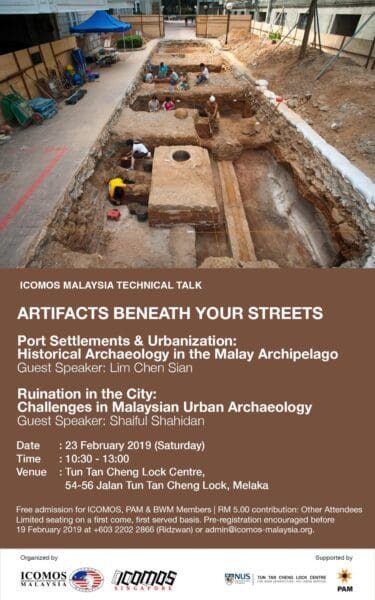
[Lecture] Artifacts Beneath Your Streets

4 February 2019
in Malaysia, Singapore
Tags: ICOMOSLim Chen Sian (person)Malay Peninsula (region)Shaiful Shahidan (person)
0
SHARES
99
VIEWS
[Lecture] Artifacts Beneath Your Streets

Readers in Malacca may be interested in this double lecture organised by ICOMOS Malaysia on 23 Feb 2019 focusing on the archaeologies of Singapore and Malaysia.

ARTIFACTS BENEATH YOUR STREETS
Date: 23 February 2019
Time: 10:30-13:00
Venue: Tun Tan Cheng Lock Centre, No. 54-56 Jalan Tun Tan Cheng Lock, Banda Hilir, Melaka

Organised by ICOMOS Malaysia & ICOMOS Singapore
Supported by Pertubuhan Akitek Malaysia & NUS Tun Tan Cheng Lock Centre

Session 01
Port Settlements & Urbanisation: Historical Archaeology in the Malay Archipelago by Lim Chen Sian

In popular imagination, archaeology is typified by dust-covered individuals excavating for wondrous artifacts from lost civilizations hidden in the jungle or desert. While certainly not factually incorrect, it is a somewhat romantic portrayal of the work and people. Increasingly, archaeologists can be encountered quietly excavating in the city center or a suburban neighborhood nearby. Archaeology is the study of past societies, and the archaeology of urbanization and modern settlements are some of the many themes of research.

Archaeological investigations of port settlements such as Melaka and Singapore are still underexplored and much can be told from the material cultural remains that lay unobtrusively around us. Melaka and Singapore are prominent examples of the long history and evolution of harbors and cities in island Southeast Asia over the past millennium. What does the archaeology of downtown Singapore and Melaka and other port settlements in the Malay Archipelago reveal? What connects these seemingly disparate polities?

This talk looks at how archaeologists study and interpret the distant and more recent past of port settlements, and how the specialized sub-field of historical archaeology is making inroads unveiling new dimensions to our understanding.

***

Session 02

Ruination in the City: Challenges in Malaysian Urban Archaeology by Shaiful Shahidan

Urban development in Malaysia frequently ignores or relinquishes the need for saving and safeguarding the history of a place. A constant “collision” between conservation values and the need for development, present a continuous challenge in the field of urban archaeology and heritage conservation in Malaysia, as reflected by few cases in the recent past. What are the factors that cause this collision? What is the best approach to balance the development needs and sustainability of heritage within the city? Nonetheless, in recent years, there has been a considerable change in the urban areas, especially among the stakeholders and the public, with increasing mindfulness regarding the preservation and conservation of heritage.

This presentation will feature a problem encountered in archaeological works in urban areas as well as its future sustainability. It will also discuss on few approaches of bringing the local community together to conserve and preserve their heritage, in both urban and semi-urban setting.

Profile of Speakers

Lim Chen Sian is the Vice President of ICOMOS Singapore, and an Associate Fellow at the Archaeology Unit, ISEAS-Yusof Ishak Institute, Singapore. He is a historical archaeologist interested in the transitional period between pre-and-post European contact in Southeast Asia and the development of port settlements, military fortifications, and the material culture of trade. He has excavated in Central America, Burma, Egypt, Java, Kampuchea, Malay Peninsula, and Sumatra. He has been involved in Singapore archaeology since 2002. As of 2006 he led all the major archaeological investigations in the country, and works extensively on lobbying for legislative changes pertaining to the necessity for impact assessments, protection of archaeological sites, and artifact ownership.

Shaiful Shahidan is a Council Member of ICOMOS Malaysia, as well as an ASTS Fellow at the Centre for Global Archaeological Research, Universiti Sains Malaysia. He was a recipient of the Erasmus Mundus Scholarship under European Commission and has spent several years of training in field archaeology in Europe and Southeast Asia. He was also one of the expert panels for the Lenggong Valley dossier preparation, before its inscription into the UNESCO World Heritage Site. For the past 15 years, he has been involved in archaeological research in Peninsular Malaysia and East Malaysia, covering extensive research and analysis. His current work focuses on field archaeological project in key sites within the Georgetown World Heritage Sites.

Subscribe to the weekly Southeast Asian Archaeology news digest

Latest Books

The following are affiliate links for which I may earn a commission if you click and make a purchase. Click here for more books about Southeast Asian archaeology.
Sale Malay Silver and Gold: Courtly Splendour from Indonesia, Malaysia, Singapore, Brunei and Thailand
Malay Silver and Gold: Courtly Splendour from...
Amazon Prime
$38.54
Buy on Amazon
Sale The Oxford Guide to the Malayo-Polynesian Languages of Southeast Asia (Oxford Guides to the World's Languages)
The Oxford Guide to the Malayo-Polynesian...
Amazon Prime
$165.87
Buy on Amazon
Sale Majapahit: Sculptures from a Forgotten Kingdom
Majapahit: Sculptures from a Forgotten Kingdom
$44.08
Buy on Amazon
Sale Majapahit: Intrigue, Betrayal and War in Indonesia’s Greatest Empire
Majapahit: Intrigue, Betrayal and War in...
Amazon Prime
$15.74
Buy on Amazon
Sale The Story of Southeast Asia
The Story of Southeast Asia
$24.11
Buy on Amazon
Buddhist Landscapes: Art and Archaeology of the Khorat Plateau, 7th to 11th Centuries
Buddhist Landscapes: Art and Archaeology of the...
Amazon Prime
$56.00
Buy on Amazon

Leave a Reply

Your email address will not be published. Required fields are marked *

I agree to the Terms & Conditions and Privacy Policy.

This site uses Akismet to reduce spam. Learn how your comment data is processed.

Southeast Asian Archaeology

© 2019

Navigate Site

  • News
  • Resources
  • Countries
  • Topics
  • Visit
  • Jobs
  • Subscribe
  • About

Follow

Never Miss a Discovery
Subscribe for Exclusive Southeast Asian Archaeology News!

Stay connected with the latest breakthroughs, research, and events from across Southeast Asia’s archaeology scene. Sign up today for exclusive weekly updates, trusted by over 2,000 subscribers.

×
No Result
View All Result
  • News
  • Resources
  • Countries
    • Southeast Asia
    • Mainland Southeast Asia
      • Cambodia
      • Laos
      • Malaysia
      • Myanmar
      • Thailand
      • Vietnam
    • Island Southeast Asia
      • Brunei
      • Indonesia
      • Malaysia
      • Philippines
      • Singapore
      • Timor Leste
    • Peripheral Southeast Asia
  • Topics
    • Artifact Type
      • Architecture
      • Bones and Burials
      • Ceramics
      • Intangible Cultural Heritage
      • Lithics
      • Megaliths
      • Rock Art
      • Sculpture
    • Field
      • Anthropology
      • Bioarchaeology
      • Epigraphy
      • General Archaeology
      • Metallurgy and Metalworking
      • Paleontology
      • Underwater Archaeology
      • Visual Art
      • Zooarchaeology
    • Other Themes
      • Animism
      • Buddhism
      • Christianity
      • Disaster Risk Management
      • Hinduism
      • Islam
      • Archaeological Tourism in Southeast Asia
  • Visit
    • Virtual Archaeology
    • Unesco World Heritage
  • Jobs
  • Subscribe
  • About
    • About
    • Supporters
    • Terms of Use
    • Privacy Policy
    • Contact

© 2019

This website uses cookies. By continuing to use this website you are giving consent to cookies being used. Visit our Privacy and Cookie Policy.