
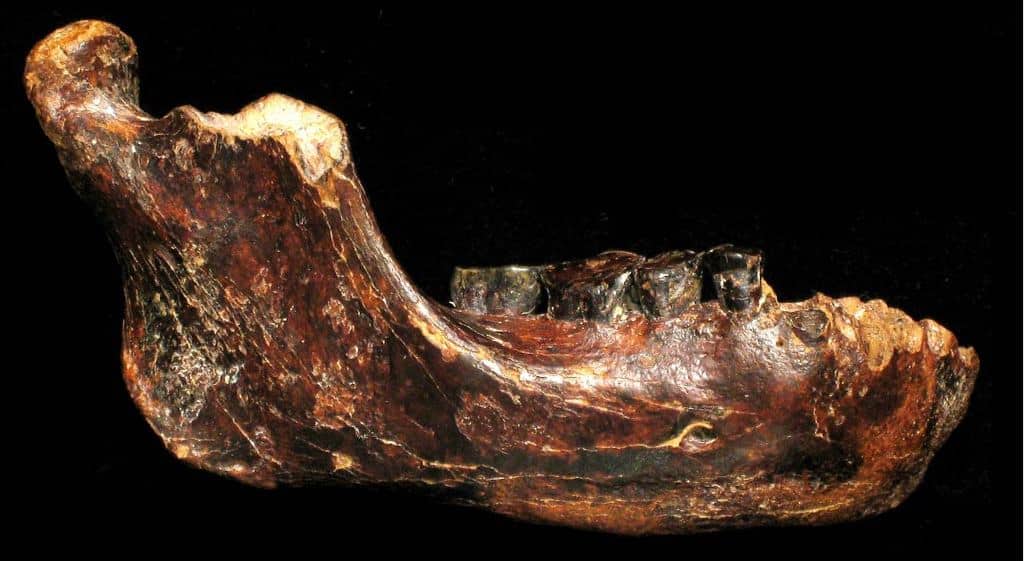
A fossil jawbone recovered from the seabed near Taiwan represents the first ancient hominid find from the region; dating is imprecise – anywhere from 10 to 190ka – but the form is more reminiscent of archaic hominids rather than recent ones. If so, it lends weight to the theory that there were multiple groups of ancient hominids that existed outside of Africa.

The first archaic Homo from Taiwan
Nature Communications, 27 January 2015
doi:10.1038/ncomms7037
Ancient Human Fossil Could Be New Primitive Species
Live Science, 27 January 2015
Taiwan Jaw Bone Connected to the Origins of Humanity, May Reveal Entirely New Prehistoric Species
Ancient Origins, 28 January 2015
Recent studies of an increasing number of hominin fossils highlight regional and chronological diversities of archaic Homo in the Pleistocene of eastern Asia. However, such a realization is still based on limited geographical occurrences mainly from Indonesia, China and Russian Altai. Here we describe a newly discovered archaic Homo mandible from Taiwan (Penghu 1), which further increases the diversity of Pleistocene Asian hominins. Penghu 1 revealed an unexpectedly late survival (younger than 450 but most likely 190–10 thousand years ago) of robust, apparently primitive dentognathic morphology in the periphery of the continent, which is unknown among the penecontemporaneous fossil records from other regions of Asia except for the mid-Middle Pleistocene Homo from Hexian, Eastern China. Such patterns of geographic trait distribution cannot be simply explained by clinal geographic variation of Homo erectus between northern China and Java, and suggests survival of multiple evolutionary lineages among archaic hominins before the arrival of modern humans in the region.
Read the full paper here.
![This week in Southeast Asian Archaeology: Prambanan gets some renewed attention, Phimai Black pottery surfaces at Mun Bon Dam, and I’m taking a short break next week.⠀
⠀
The featured stories look at the new Indonesia–India conservation project at Prambanan, focusing on the temple complex’s ruined perwara shrines, and a striking Late Prehistoric find in northeast Thailand: a remarkably complete Phimai Black vessel discovered as water levels fell at Mun Bon Dam.⠀
⠀
Temples, pottery, reservoirs, and a little scheduled rest. Back again on 27 July.⠀
⠀
Read this week’s newsletter: [link in bio]⠀
⠀
#SoutheastAsianArchaeology #Archaeology #Heritage #Prambanan #Thailand #Indonesia #Cambodia #Vietnam #CulturalHeritage #Substack This week in Southeast Asian Archaeology: Prambanan gets some renewed attention, Phimai Black pottery surfaces at Mun Bon Dam, and I’m taking a short break next week.⠀
⠀
The featured stories look at the new Indonesia–India conservation project at Prambanan, focusing on the temple complex’s ruined perwara shrines, and a striking Late Prehistoric find in northeast Thailand: a remarkably complete Phimai Black vessel discovered as water levels fell at Mun Bon Dam.⠀
⠀
Temples, pottery, reservoirs, and a little scheduled rest. Back again on 27 July.⠀
⠀
Read this week’s newsletter: [link in bio]⠀
⠀
#SoutheastAsianArchaeology #Archaeology #Heritage #Prambanan #Thailand #Indonesia #Cambodia #Vietnam #CulturalHeritage #Substack](https://scontent-sin6-3.cdninstagram.com/v/t51.82787-15/744214042_18361115071209510_2262608560893170251_n.jpg?stp=dst-jpg_e35_tt6&_nc_cat=110&ccb=7-5&_nc_sid=18de74&efg=eyJlZmdfdGFnIjoiRkVFRC5iZXN0X2ltYWdlX3VybGdlbi5DMyJ9&_nc_ohc=xWgcEbcGABIQ7kNvwFx63N6&_nc_oc=Adoe3NBLPcXYeu2Q4WRCzWnJf1ph4tRSl-ndybF0lr1wsJa0WKbjmjX6eHkay-SU5Dk&_nc_zt=23&_nc_ht=scontent-sin6-3.cdninstagram.com&edm=ANo9K5cEAAAA&_nc_gid=dMcRRCmLrU8vIjIWuykhnw&_nc_tpa=Q5bMBQG5vqf4e5fIO0chtZGhHMc0t4iJSvRKIjH0mUwQ4mAL0XnRhUWCa3QyBVw826n_vqBqmRNCfsRP&oh=00_AQDPeFDmCshofY_1cjAQWqyOU02u0lMfxO-CyI0CXLzMFw&oe=6A6490F1)


