







Well, more closer to 12 days. My first two weeks of January was spent documenting the rock art of Gua Tambun, in a limestone mountain just outside the city of Ipoh, the capital of Perak in Peninsular Malaysia. This documentation and research project is the main focus of my MA thesis at Universiti Sains Malaysia.
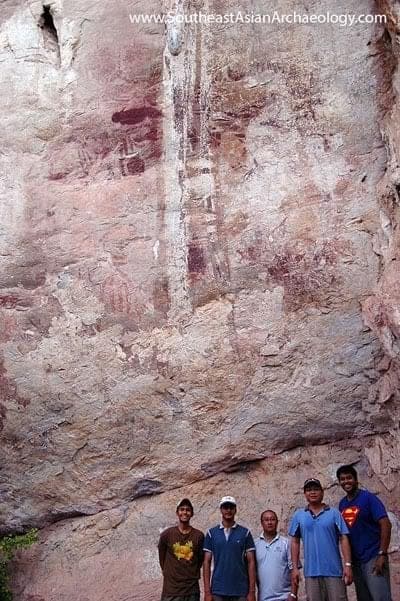
The rock art is situated in a rock shelter approximately 175m above sea-level and contains numerous depictions of animals and humans, along with plenty of other shapes that have yet to be discerned as well as many others that have been damaged by erosion and quarrying. The purpose for this field session was to map and survey the site, while documenting rock art in order to compile an inventory. For this purpose, a scaffolding was erected, about 30 feet high and 25 feet wide, in order to take a close look at the rock art situated at the main cluster in the centre of the rock shelter. Samples from the site were also collected for later investigation.
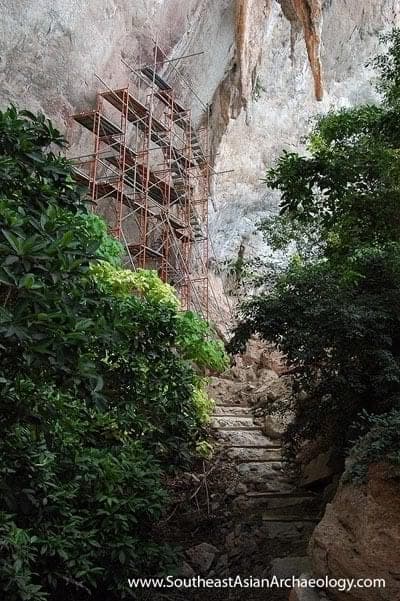
The typical day starts around 8 am, starting with breakfast at one of Ipoh’s many fine coffee shops for our daily dose of ba-kopi (white coffee) or cham (a tea and coffee mixture). Then begins a short trek to the site, which involves cutting through a polo field, a short walk through a newly-placed gravel track and then a gruelling climb up a steep flight of stairs. Work usually starts before nine, and doesn’t stop until after one where we break for lunch. Most of the fieldwork was spent inspecting and defining each rock art ‘element’ before documenting and photographically recording them. In the afternoon it was much harder to take photographs, because the sun shining onto the westward-facing site and the shadows cast by the scaffolding, so work was more geared towards documentation and field surveys. At the end of the day, we lock up the access ladder to the scaffolding before heading back to our rented rooms nearby. Nights were spent reconciling forms with the photographs taken that day, and backing up the data on two sources – my laptop and a portable hard disk.
While I can’t reveal many specific details of the results (you’ll just have to wait until publication), the preliminary findings are certainly quite exciting: we’ve documented far more rock art than was initially thought to be there (50 years ago, the estimate was between 30-50 paintings); back at the labs, I’ll be doing more digital analysis to tease out more details from the art while also running some physical and chemical tests on some of the physical samples.
You can check out more of the pictures from the fieldwork here.



Astro’s animal Channel 556 is currently (August 2009) showing a programme callled “Dugong and Din”. It’s about a boy and a dugong who befriend each other in the sea off Sabah. Interestingly there is about a 10 second reference to the Tambun ‘dugong’. It is shown about 25-30 minutes into the programme.
did they say anything specific about the Tambu dugong? or was it just filler space? =D shucks, I got no astro lah!
They just referred to the Tambun painting as a dugong, obviously assuming the painting is that animal !