• This week: a human-faced megalith spotted in Lore Lindu—right in an illegal gold-mining zone—and Korea & Vietnam’s first joint underwater survey in Quảng Ngãi, chasing shipwrecks + Chinese ceramics across old sea lanes
 
https://bit.ly/4btzR7E
  • This week on Southeast Asian Archaeology: rare bronze Mahoratuek drums surface in Thailand, gold-glazed terracotta helps redraw Vietnam’s Ho Citadel, and Aceh War “loot” gets a long-overdue digital reckoning.⠀
⠀
https://bit.ly/46lX88H
  • Circuits, Ceramics, and Colonial Archives is out now 🏛️🌊📜 CNY/Tết (Year of the Horse) greetings + this week’s theme: heritage in a hurry—Angkor’s “high risk” Baksei Chamkrong, Sibonga church repairs post-Odette, and Indonesia’s 152-site revitalisation push. Read: https://bit.ly/3Mswq7G
  • Heritage isn’t just awe—it’s upkeep. This week: a historic building floor collapse at Siak Palace, Beng Mealea’s walkway repairs, Ponagar Tower’s arts show paused over losses.⠀
 ⠀
https://bit.ly/4chkwIb⠀
  • Biases, Bones & Burāq — this week’s Southeast Asian Archaeology newsletter is all about how small corrections can change big histories.⠀
⠀
We’ve got four fresh research reads:⠀
 🐟 Neolithic expansion that looks a lot more “rice and fish” once recovery bias is taken seriously⠀
 📜 An illuminated Qur’an section from Java on dluwang (treebark paper), with clues that push it earlier than you might expect⠀
 🐀 Timor-Leste’s giant/large murids, measured in detail to track changing ecologies (and a late crash)⠀
 ⚱️ Ban Non Wat grave size and offerings, mapping a sharp spike—and then easing—of social distinction⠀
⠀
And for a screen break: a small mention of PBS’s Angkor: Hidden Jungle Empire.⠀
⠀
Read the full roundup here: https://bit.ly/45Gh2uN ⠀
 #Archaeology #SoutheastAsia #Heritage #Anthropology #Museums #History
  • This week in Southeast Asian Archaeology: Sulawesi just delivered a headline-grabbing ~67,800-year-old hand-stencil date, Huế’s Imperial Citadel restoration has revealed a trilingual astronomical mural, and Malaysia’s new Guar Kepah Archaeological Gallery opens with the “Penang Woman” at centre stage. Deep time, dynastic science, and fresh public heritage spaces—come catch up on the week’s stories.⠀
⠀
https://bit.ly/3NG7WIg
  • New week, new reads: a “Southwestern Silk Road” model for amber into Han China, the biggest Austroasiatic genomic dataset yet (with Dvaravati/Angkor-era signals), plus rock art methods and fresh motifs from Malaysia and Laos. Molecules, motifs, and migration stories — all in one roundup.

Amber, Ancestry and Arty hands https://bit.ly/3LAK20c
  • New year, new (very full) newsletter From Java Man coming home to Jakarta to Khmer sculptures heading back to Cambodia and a bleak month on the Thai–Cambodian border, catch up on a whole month of Southeast Asian archaeology: https://bit.ly/4syuWJh
  • This week’s Southeast Asian Archaeology newsletter is all about the invisible infrastructure of knowledge — the stuff behind the sites. We look at Cambodia’s push to access the late Emma Bunker’s notebooks as a potential roadmap to looted Khmer art, a Thanh Hóa village communal house where 47 imperial edicts were quietly stashed in bamboo tubes for centuries, and Jingdezhen’s “ceramic gene bank” in China, where millions of sherds and glaze recipes are treated like DNA for porcelain. From roof beams to databases, it’s a reminder that archives, records and lab data shape what we think we know about the past just as much as temples and shipwrecks do. Plus the usual mix of regional news, grants, jobs and heritage politics — link in bio/newsletter below.

https://bit.ly/3XIeV5h
  • Genomes point to a 60,000-year “long chronology” for the first settlers of Sahul, while new DNA links China’s hanging coffins to the modern Bo people. #southeastasianarchaeology
 
Read here: https://bit.ly/4a64D6z
Monday, March 16, 2026
Southeast Asian Archaeology
  • News
  • Resources
  • Countries
    • Southeast Asia
    • Mainland Southeast Asia
      • Cambodia
      • Laos
      • Malaysia
      • Myanmar
      • Thailand
      • Vietnam
    • Island Southeast Asia
      • Brunei
      • Indonesia
      • Malaysia
      • Philippines
      • Singapore
      • Timor Leste
    • Peripheral Southeast Asia
  • Topics
    • Artifact Type
      • Architecture
      • Bones and Burials
      • Ceramics
      • Intangible Cultural Heritage
      • Lithics
      • Megaliths
      • Rock Art
      • Sculpture
    • Field
      • Anthropology
      • Bioarchaeology
      • Epigraphy
      • General Archaeology
      • Metallurgy and Metalworking
      • Paleontology
      • Underwater Archaeology
      • Visual Art
      • Zooarchaeology
    • Other Themes
      • Animism
      • Buddhism
      • Christianity
      • Disaster Risk Management
      • Hinduism
      • Islam
      • Archaeological Tourism in Southeast Asia
  • Visit
    • Virtual Archaeology
    • Unesco World Heritage
  • Jobs
  • Subscribe
  • About
    • About
    • Supporters
    • Terms of Use
    • Privacy Policy
    • Contact
No Result
View All Result
Southeast Asian Archaeology
  • News
  • Resources
  • Countries
    • Southeast Asia
    • Mainland Southeast Asia
      • Cambodia
      • Laos
      • Malaysia
      • Myanmar
      • Thailand
      • Vietnam
    • Island Southeast Asia
      • Brunei
      • Indonesia
      • Malaysia
      • Philippines
      • Singapore
      • Timor Leste
    • Peripheral Southeast Asia
  • Topics
    • Artifact Type
      • Architecture
      • Bones and Burials
      • Ceramics
      • Intangible Cultural Heritage
      • Lithics
      • Megaliths
      • Rock Art
      • Sculpture
    • Field
      • Anthropology
      • Bioarchaeology
      • Epigraphy
      • General Archaeology
      • Metallurgy and Metalworking
      • Paleontology
      • Underwater Archaeology
      • Visual Art
      • Zooarchaeology
    • Other Themes
      • Animism
      • Buddhism
      • Christianity
      • Disaster Risk Management
      • Hinduism
      • Islam
      • Archaeological Tourism in Southeast Asia
  • Visit
    • Virtual Archaeology
    • Unesco World Heritage
  • Jobs
  • Subscribe
  • About
    • About
    • Supporters
    • Terms of Use
    • Privacy Policy
    • Contact
No Result
View All Result
Southeast Asian Archaeology
No Result
View All Result
[vc_row][vc_column width="1/3" offset="vc_hidden-xs"]
ADVERTISEMENT

Related Posts

Source: Pattaya Mail 20240720

Thai Olympic Jerseys Inspired by Ban Chiang Heritage

25 July 2024
0
0

...

Bones and Burials

[Call for Papers] Advances in the Bioarchaeology of Southeast Asia

20 May 2024
0
0

...

Source: Antara 20240506

Indonesia Eyes UNESCO Status for Reog, Kolintang, Kebaya

7 May 2024
0
0

...

Source: Vietnam Plus 20240426

Yen Bai Unveils Over 200 Artifacts from the 1954 Dien Bien Phu Campaign

30 April 2024 - Updated on 2 May 2024
0
0

...

Popular This Week

Plugin Install : Popular Post Widget need JNews - View Counter to be installed
[vc_raw_html]JTNDY2VudGVyJTNFJTNDc3R5bGUlM0UuYm1jLWJ1dHRvbiUyMGltZyU3QndpZHRoJTNBJTIwMzVweCUyMCUyMWltcG9ydGFudCUzQm1hcmdpbi1ib3R0b20lM0ElMjAxcHglMjAlMjFpbXBvcnRhbnQlM0Jib3gtc2hhZG93JTNBJTIwbm9uZSUyMCUyMWltcG9ydGFudCUzQmJvcmRlciUzQSUyMG5vbmUlMjAlMjFpbXBvcnRhbnQlM0J2ZXJ0aWNhbC1hbGlnbiUzQSUyMG1pZGRsZSUyMCUyMWltcG9ydGFudCUzQiU3RC5ibWMtYnV0dG9uJTdCcGFkZGluZyUzQSUyMDdweCUyMDVweCUyMDdweCUyMDEwcHglMjAlMjFpbXBvcnRhbnQlM0JsaW5lLWhlaWdodCUzQSUyMDM1cHglMjAlMjFpbXBvcnRhbnQlM0JoZWlnaHQlM0E1MXB4JTIwJTIxaW1wb3J0YW50JTNCbWluLXdpZHRoJTNBMjE3cHglMjAlMjFpbXBvcnRhbnQlM0J0ZXh0LWRlY29yYXRpb24lM0ElMjBub25lJTIwJTIxaW1wb3J0YW50JTNCZGlzcGxheSUzQWlubGluZS1mbGV4JTIwJTIxaW1wb3J0YW50JTNCY29sb3IlM0ElMjNmZmZmZmYlMjAlMjFpbXBvcnRhbnQlM0JiYWNrZ3JvdW5kLWNvbG9yJTNBJTIzNzlENkI1JTIwJTIxaW1wb3J0YW50JTNCYm9yZGVyLXJhZGl1cyUzQSUyMDVweCUyMCUyMWltcG9ydGFudCUzQmJvcmRlciUzQSUyMDFweCUyMHNvbGlkJTIwdHJhbnNwYXJlbnQlMjAlMjFpbXBvcnRhbnQlM0JwYWRkaW5nJTNBJTIwN3B4JTIwNXB4JTIwN3B4JTIwMTBweCUyMCUyMWltcG9ydGFudCUzQmZvbnQtc2l6ZSUzQSUyMDI4cHglMjAlMjFpbXBvcnRhbnQlM0JsZXR0ZXItc3BhY2luZyUzQTAuNnB4JTIwJTIxaW1wb3J0YW50JTNCYm94LXNoYWRvdyUzQSUyMDBweCUyMDFweCUyMDJweCUyMHJnYmElMjgxOTAlMkMlMjAxOTAlMkMlMjAxOTAlMkMlMjAwLjUlMjklMjAlMjFpbXBvcnRhbnQlM0Itd2Via2l0LWJveC1zaGFkb3clM0ElMjAwcHglMjAxcHglMjAycHglMjAycHglMjByZ2JhJTI4MTkwJTJDJTIwMTkwJTJDJTIwMTkwJTJDJTIwMC41JTI5JTIwJTIxaW1wb3J0YW50JTNCbWFyZ2luJTNBJTIwMCUyMGF1dG8lMjAlMjFpbXBvcnRhbnQlM0Jmb250LWZhbWlseSUzQSUyN0Nvb2tpZSUyNyUyQyUyMGN1cnNpdmUlMjAlMjFpbXBvcnRhbnQlM0Itd2Via2l0LWJveC1zaXppbmclM0ElMjBib3JkZXItYm94JTIwJTIxaW1wb3J0YW50JTNCYm94LXNpemluZyUzQSUyMGJvcmRlci1ib3glMjAlMjFpbXBvcnRhbnQlM0Itby10cmFuc2l0aW9uJTNBJTIwMC4zcyUyMGFsbCUyMGxpbmVhciUyMCUyMWltcG9ydGFudCUzQi13ZWJraXQtdHJhbnNpdGlvbiUzQSUyMDAuM3MlMjBhbGwlMjBsaW5lYXIlMjAlMjFpbXBvcnRhbnQlM0ItbW96LXRyYW5zaXRpb24lM0ElMjAwLjNzJTIwYWxsJTIwbGluZWFyJTIwJTIxaW1wb3J0YW50JTNCLW1zLXRyYW5zaXRpb24lM0ElMjAwLjNzJTIwYWxsJTIwbGluZWFyJTIwJTIxaW1wb3J0YW50JTNCdHJhbnNpdGlvbiUzQSUyMDAuM3MlMjBhbGwlMjBsaW5lYXIlMjAlMjFpbXBvcnRhbnQlM0IlN0QuYm1jLWJ1dHRvbiUzQWhvdmVyJTJDJTIwLmJtYy1idXR0b24lM0FhY3RpdmUlMkMlMjAuYm1jLWJ1dHRvbiUzQWZvY3VzJTIwJTdCLXdlYmtpdC1ib3gtc2hhZG93JTNBJTIwMHB4JTIwMXB4JTIwMnB4JTIwMnB4JTIwcmdiYSUyODE5MCUyQyUyMDE5MCUyQyUyMDE5MCUyQyUyMDAuNSUyOSUyMCUyMWltcG9ydGFudCUzQnRleHQtZGVjb3JhdGlvbiUzQSUyMG5vbmUlMjAlMjFpbXBvcnRhbnQlM0Jib3gtc2hhZG93JTNBJTIwMHB4JTIwMXB4JTIwMnB4JTIwMnB4JTIwcmdiYSUyODE5MCUyQyUyMDE5MCUyQyUyMDE5MCUyQyUyMDAuNSUyOSUyMCUyMWltcG9ydGFudCUzQm9wYWNpdHklM0ElMjAwLjg1JTIwJTIxaW1wb3J0YW50JTNCY29sb3IlM0ElMjNmZmZmZmYlMjAlMjFpbXBvcnRhbnQlM0IlN0QlM0MlMkZzdHlsZSUzRSUzQ2xpbmslMjBocmVmJTNEJTIyaHR0cHMlM0ElMkYlMkZmb250cy5nb29nbGVhcGlzLmNvbSUyRmNzcyUzRmZhbWlseSUzRENvb2tpZSUyMiUyMHJlbCUzRCUyMnN0eWxlc2hlZXQlMjIlM0UlM0NhJTIwY2xhc3MlM0QlMjJibWMtYnV0dG9uJTIyJTIwdGFyZ2V0JTNEJTIyX2JsYW5rJTIyJTIwaHJlZiUzRCUyMmh0dHBzJTNBJTJGJTJGd3d3LmJ1eW1lYWNvZmZlZS5jb20lMkZzZWFhcmNoJTIyJTNFJTNDaW1nJTIwc3JjJTNEJTIyaHR0cHMlM0ElMkYlMkZjZG4uYnV5bWVhY29mZmVlLmNvbSUyRmJ1dHRvbnMlMkZibWMtbmV3LWJ0bi1sb2dvLnN2ZyUyMiUyMGFsdCUzRCUyMkJ1eSUyMG1lJTIwYSUyMGNvZmZlZSUyMiUzRSUzQ3NwYW4lMjBzdHlsZSUzRCUyMm1hcmdpbi1sZWZ0JTNBMTVweCUzQmZvbnQtc2l6ZSUzQTI4cHglMjAlMjFpbXBvcnRhbnQlM0IlMjIlM0VCdXklMjBtZSUyMGElMjBjb2ZmZWUlM0MlMkZzcGFuJTNFJTNDJTJGYSUzRSUzQyUyRmNlbnRlciUzRSUwQSUzQ3AlM0VJZiUyMHlvdSUyMGZvdW5kJTIwdGhpcyUyMHNpdGUlMjB1c2VmdWwlMkMlMjB5b3UlMjBjYW4lMjBoZWxwJTIwc3VwcG9ydCUyMGl0JTIwYnklMjBidXlpbmclMjBtZSUyMGElMjBjb2ZmZWUlMjElM0MlMkZwJTNF[/vc_raw_html][/vc_column][vc_column width="2/3"][vc_row_inner][vc_column_inner]

Excavations of Burial Sites at Vietnamese Re-Education Camps by The Returning Casualty

[/vc_column_inner][/vc_row_inner][vc_row_inner][vc_column_inner width="2/3"]
1 March 2012
in Vietnam
Tags: bioarchaeologyclothingexhumationSecond Indochina War (Vietnam War)war graveYen Bai (province)
[/vc_column_inner][vc_column_inner width="1/3"]
[/vc_column_inner][/vc_row_inner][vc_row_inner][vc_column_inner]

And now, for archaeology of a more recent time. The Returning Casualty is a American-Vietnamese charity  whose work involves the excavation of camp cemeteries so the remains of the soldiers can be returned to their families after DNA testing. Julie Martin, who is studying for an MSc in Forensic Archaeology and Anthropology at Cranfield University in the UK shares her recent work with The Returning Casualty at a 2010 excavation in Yen Bai Province. [Text and photos by Julie Martin.]

Brief history of the re-education camps in Vietnam
On April 30, 1975 the South Vietnamese Government fell to the Communist regime under Ho Chi Minh and those individuals involved in the political and military running of the former government were ordered to register with the new government and await further orders. In the summer of 1975 the transportation of these individuals to camps throughout the newly united country began, with the higher ranking members of the ARVN taken to the most remote camps in the highland jungles of the north. Although not specifically told the extent of their stay in the camps, the authorities informed military personnel from the rank of second lieutenant to captain and lower ranking police officials to report to sites with a 10 day supply of food, clothing and personal effects. Officers of the rank of major to general, high ranking police and intelligence officers and all elected member of the Senate and House of Representatives were to report to their designated sites with enough clothing, food and supplies for one month.

Life in the camps consisted of a regimen of forced hard labor, including landmine clearance and road building and political indoctrination denouncing ‘American imperialism’ and celebrating the inevitable superiority of communism. The prisoners were organized into work units and forced to compete against each other for better work records. The evenings were spent in studying the writings of the Communist regime, confessing to anti communist and pro American leanings and denouncing those fellow prisoners who lacked a sufficient ‘work ethic’ or who still harbored anti communist thoughts. The scanty diet was supplemented by scavenging during work time and occasional visits from relatives, but starvation and illness claimed the lives of thousands of prisoners.

In 1981 a memorandum by the Communist government to Amnesty International claimed that all those imprisoned in the re-education camps were guilty of acts of national treason as defined in Article 3 of the 30 October 1967 Law on Counter-revolutionary Crimes which specifies twenty years to life imprisonment or the death penalty. The punishment of re-education was seen by the Vietnamese government as the most ‘humanitarian’ system.

The United Nations High Commissioner for Refugees (UNHCR) Orderly Departure Program (ODP) was instituted at the first International Congress on Indochinese Refugees in Geneva in May 1979 as a humanitarian endeavor in response to the suffering of the boat people escaping the Communist regime in Vietnam after the fall of Saigon, many falling victim to abuse, exploitation and death at the hands of Thai pirates while at sea. Almost thirty nations took part in the program which closed on 30 September 1994, but on 15 November 2005 the US and Vietnamese governments signed an agreement re-establishing the ODP and the McCain Amendment allowed the adult children of re-education camp prisoners to immigrate to the United States with their parents. The ODP ended on 28 February 2009, and the McCain Amendment ended on 30 September 2009.

Results from the excavation at Lang Da
In July 2010 twelve skeletons were exhumed from the grave site of the Lang Da re-education camp, deep in the northern highlands northwest of Hanoi. The site had seen previous excavations of individual graves by family members, but by 2010 grave markers had been moved making the identification of the surviving burials impossible without DNA analysis. The need to fully excavate the site became apparent when a new road was planned for the area, and in 21/2 days not only were all the graves emptied, but the remains were reinterred in a temporary grave site a safe distance from the proposed new road.

Of the twelve skeletons recovered, eleven provided viable mtDNA, a very positive result considering the acidic condition of the soil and the unfavorable climate for preservation of skeletal remains. All the bodies were buried with their heads at the west except for Skeleton 6, who was buried with the head to the east. There are known burial practices of ordained Christian clergy buried with the head at the eastern end of the grave, supposedly in readiness to minister to their congregation after the Resurrection.

Many South Vietnamese embraced Catholicism during the time of French colonization, and many Catholic clergy were sent to re-education camps after 1975. Skeleton 8 was found to have survived a blast injury resulting in the partial traumatic amputation of the left tibia and fibula, and the right femur displayed evidence of shrapnel wounds. Re-education camp detainees were forced to clear mine fields as part of their labor routine, therefore such injuries were not unusual. Almost all the skeletons were buried with personal effects, and we had two surviving detainees from the camp at Lang Da, including the founder of the charity, Mr. Thanh Nguyen, with us during the excavation to explain why the men were buried with their possessions. He stated that all the detainees made a promise that whatever the men brought with them to the camp would be buried with them; including mosquito nets, medicine and clothing, and we recovered many objects including ceramic rice bowls, toothbrushes, syringes, plastic rain coats, a hand knitted scarf, and a variety of glass medicine vials and bottles.

At present, at least three families await permission to reclaim the remains of their fathers, husbands and brothers, and the results of the DNA tests will remain at the Center for Human Identification in the hope that other families will come forward to claim their loved ones.
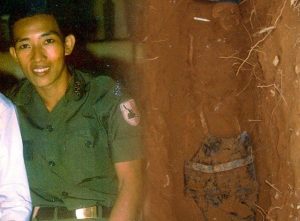
Captain Lương Văn Hoa, Grave 21.

Medicine vials

History of the Charity
In 1975, after the fall of Saigon, the newly established Socialist Republic of Vietnam called for the detainment of thousands of individuals from South Vietnam including military personnel, intellectuals, Catholic and Buddhist monks and nuns, public officials and individuals involved with Americans stationed in the country. These prisoners were transferred to re-education camps located throughout the country to take part in political indoctrination under the Communist regime. While most of the prisoners were requested to bring enough clothing, food, medicine and other supplies for a two week to one month stay, it was not unusual for high ranking officers of the South Vietnamese Army of the Republic of Vietnam (ARVN) to remain imprisoned in the camps for up to a decade or more. Many individuals languished and died in these camps, buried in makeshift cemeteries by their fellow prisoners.

The last camp was closed in 1998, leaving behind thousands of dead in grave sites forgotten and abandoned.

In December 1993, Thanh Dac Nguyen, a major in the army of the former Republic of Vietnam and a survivor of the re-education camps, established the Vietnamese American Foundation – VAF (originally known as the Mutual Assistance Association of HO). He wanted to assist other survivors who came to live in the United States under a humanitarian resettlement program initiated in the early 1980s, and help their transition into their new lives as American citizens. Today, Association chapters are located throughout the United States, Germany, France and Australia, where there exist large Vietnamese expatriate communities. The charity is a non-political, humanitarian organization.

December 2006 welcomed a new chapter in the life of the Foundation as The Returning Casualty (TRC) initiative began to take shape. Through this project, we hope to bring closure and peace of mind to the many Vietnamese who lost their relatives in the post-war reeducation camps, while honoring those who perished in the jungle camps. Since December 2007, we have successfully located nearly 300 reeducation camp graves, and helped over 68 families collect the remains of their loved ones.

In July 2010 The Returning Casualty undertook its first large scale archaeological excavation of a burial site at a former camp at Lang Da, Yen Bai Province, northwest of Hanoi. Under my supervision as the archaeological advisor to the Charity, we successfully exhumed the remains of twelve former prisoners and took samples of each individual for mtDNA analysis which were transported to The University of North Texas Center for Human Identification. In addition, the remaining skeleton elements were placed in individual ceramic ossuries and taken to a temporary burial site until the results of the DNA analysis and familial matches were complete and the remains returned to their families.

An archaeological approach to the retrieval of human remains had never been achieved by the Charity. In the past the Charity relied on local laborers to excavate specific grave sites of individual families. On this excavation, under archaeological consultation, each grave was excavated, with the skeleton and personal effects photographed in situ. Each grave and skeleton was given a discrete number and the personal effects including clothing, rice bowls, medicine vials and mosquito nets removed and taken back to the Charity’s headquarters in Texas in the hope that these possessions will one day be exhibited to educate the public on a relatively unknown chapter of the history of Vietnam.

The Charity’s Mission
The mission of The Returning Casualty is to bring closure and peace of mind to the South Vietnamese people who lost relatives in the post-war re-education camps by helping them locate and recover the remains of their loved ones. Through this process, family members make peace by finally releasing and honoring those who died. The project seeks to relieve the pain and suffering of these unfortunate families, many of whom never knew what became of their fathers, husbands, sons, and brothers.

Future work
The Returning Casualty’s next excavation is provisionally planned for the beginning of March 2012 in Phu Yen Province on the central coast, subject to approval by the Vietnamese Government. The site was a temporary camp for South Vietnamese detainees before they were transported to re-education camps in the north. Thirty individuals died before being transported and were buried in shallow, unmarked graves without coffins on the site. Although The Returning Casualty and the Vietnam American Foundation have Non-governmental Organization (NGO) status, it is not recognized in Vietnam, and the excavation will only be allowed to commence if The Returning Casualty is sponsored by the Project Vietnam Foundation, a charitable organization that provides medical aid to remote villages throughout the country. If government approval is given, thirty graves will be excavated, DNA samples taken, personal effects retrieved and the human remains stored until DNA matches can be made and the remains handed over to the families. The land can then be returned to the local population for agricultural use.

In addition to the Charity’s work locating the remains of re-education camp detainees and returning them to their families for burial, the reinstatement of the South Vietnamese military cemetery at Bien Hoa is close to the heart of many surviving prisoners and their families. After the fall of Saigon, the cemetery was ransacked and later abandoned. One of the objectives of The Returning Casualty is the restoration of Bien Hoa (now known as Binh An) as a final resting place for former South Vietnamese soldiers and citizens. Outside of the cemetery’s perimeter is a mass grave of approximately 200 ARVN soldiers. The Returning Casualty hopes to one day obtain approval from the Vietnamese government for the monumental task of excavating this mass war grave.

References
McKelvey, R. 2002. A Gift of Barbed Wire-America’s Allies Abandoned in South Vietnam. University of Washington Press. Seattle and London

Sagen G. and Denney S. 1982. The Indochina Newsletter ‘Re-education in Unliberated Vietnam: Loneliness, Suffering and Death. Draft report for the Aurora Foundation.

Truong, H.M. 2010. The Dark Journey-Inside the Reeducation Camps of Vietcong. Eloquent Books. Durham, Ct., USA.

Websites:
The Returning Casualty www.vietremains.org
Project Vietnam Foundation www.pvnf.org

[vc_column_text]

Subscribe to the weekly Southeast Asian Archaeology news digest

[/vc_column_text][vc_column_text css=""]

Latest Books

The following are affiliate links for which I may earn a commission if you click and make a purchase. Click here for more books about Southeast Asian archaeology.
[amazon box="019880735X, 6164510775, 9813252138, 1915310288, 3897907011, 9813252340" grid="3" orderby="amount_saved" order="desc"][/vc_column_text][vc_raw_html]JTNDYnIlM0UlM0NkaXYlMjBpZCUzRCUyMmFtem4tYXNzb2MtYWQtMzQ2NTU4MDctZTcwYy00NDUzLWE5YTQtZTM1YzU3NmFmNzAxJTIyJTNFJTNDJTJGZGl2JTNFJTNDc2NyaXB0JTIwYXN5bmMlMjBzcmMlM0QlMjIlMkYlMkZ6LW5hLmFtYXpvbi1hZHN5c3RlbS5jb20lMkZ3aWRnZXRzJTJGb25lanMlM0ZNYXJrZXRQbGFjZSUzRFVTJTI2YWRJbnN0YW5jZUlkJTNEMzQ2NTU4MDctZTcwYy00NDUzLWE5YTQtZTM1YzU3NmFmNzAxJTIyJTNFJTNDJTJGc2NyaXB0JTNF[/vc_raw_html]

Leave a Reply

Your email address will not be published. Required fields are marked *

I agree to the Terms & Conditions and Privacy Policy.

[/vc_column_inner][/vc_row_inner][/vc_column][/vc_row]
Southeast Asian Archaeology

© 2019

Navigate Site

  • News
  • Resources
  • Countries
  • Topics
  • Visit
  • Jobs
  • Subscribe
  • About

Follow

No Result
View All Result
  • News
  • Resources
  • Countries
    • Southeast Asia
    • Mainland Southeast Asia
      • Cambodia
      • Laos
      • Malaysia
      • Myanmar
      • Thailand
      • Vietnam
    • Island Southeast Asia
      • Brunei
      • Indonesia
      • Malaysia
      • Philippines
      • Singapore
      • Timor Leste
    • Peripheral Southeast Asia
  • Topics
    • Artifact Type
      • Architecture
      • Bones and Burials
      • Ceramics
      • Intangible Cultural Heritage
      • Lithics
      • Megaliths
      • Rock Art
      • Sculpture
    • Field
      • Anthropology
      • Bioarchaeology
      • Epigraphy
      • General Archaeology
      • Metallurgy and Metalworking
      • Paleontology
      • Underwater Archaeology
      • Visual Art
      • Zooarchaeology
    • Other Themes
      • Animism
      • Buddhism
      • Christianity
      • Disaster Risk Management
      • Hinduism
      • Islam
      • Archaeological Tourism in Southeast Asia
  • Visit
    • Virtual Archaeology
    • Unesco World Heritage
  • Jobs
  • Subscribe
  • About
    • About
    • Supporters
    • Terms of Use
    • Privacy Policy
    • Contact

© 2019

This website uses cookies. By continuing to use this website you are giving consent to cookies being used. Visit our Privacy and Cookie Policy.