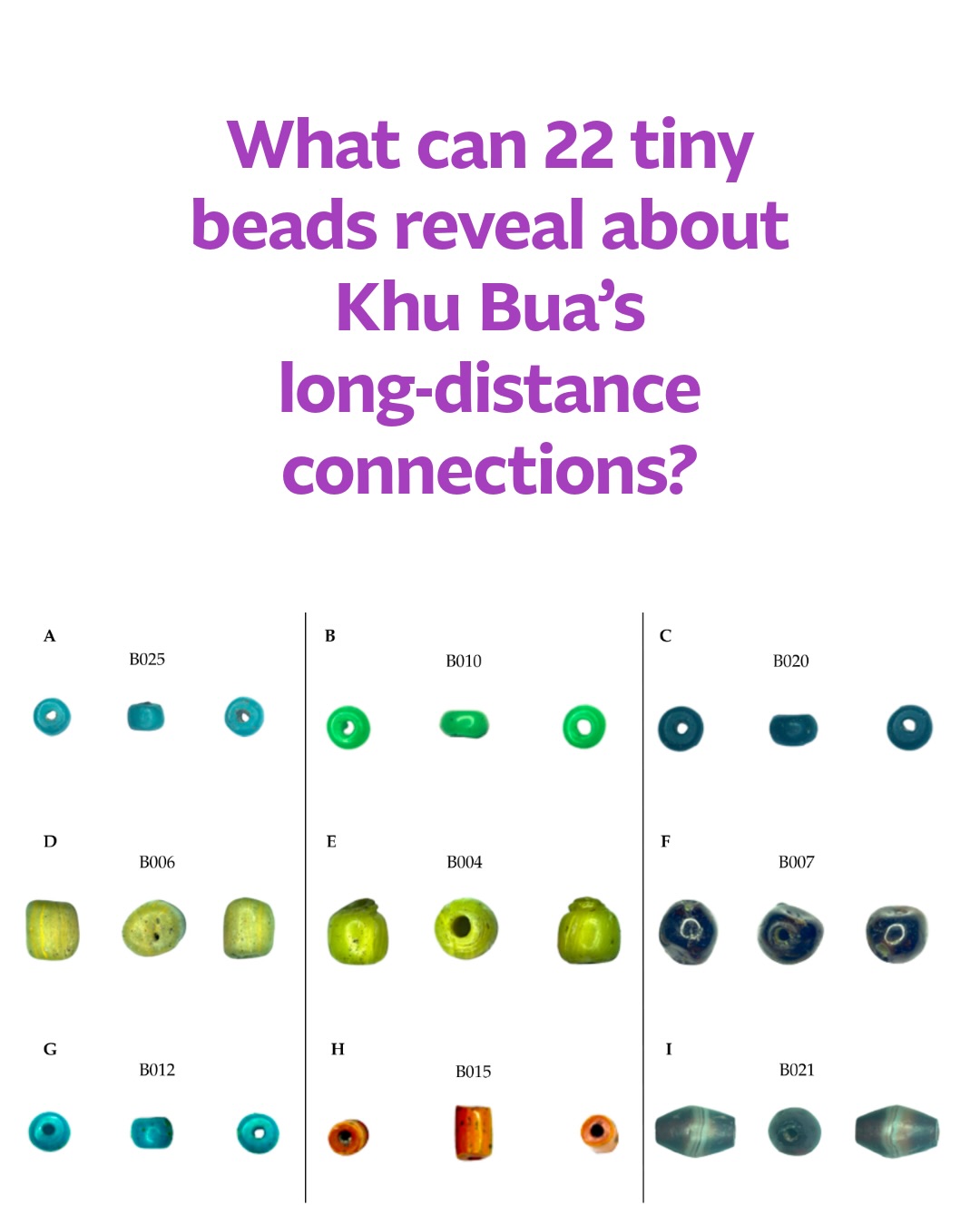

• This week in Southeast Asian Archaeology: ancient mosquitoes hint at early hominins in Sundaland, AI takes a crack at reconstructing the Singapore Stone, and a call for your AMA questions! #southeastasianarchaeology

https://bit.ly/4bHlkW2
  • This week: a human-faced megalith spotted in Lore Lindu—right in an illegal gold-mining zone—and Korea & Vietnam’s first joint underwater survey in Quảng Ngãi, chasing shipwrecks + Chinese ceramics across old sea lanes
 
https://bit.ly/4btzR7E
  • This week on Southeast Asian Archaeology: rare bronze Mahoratuek drums surface in Thailand, gold-glazed terracotta helps redraw Vietnam’s Ho Citadel, and Aceh War “loot” gets a long-overdue digital reckoning.⠀
⠀
https://bit.ly/46lX88H
  • Circuits, Ceramics, and Colonial Archives is out now 🏛️🌊📜 CNY/Tết (Year of the Horse) greetings + this week’s theme: heritage in a hurry—Angkor’s “high risk” Baksei Chamkrong, Sibonga church repairs post-Odette, and Indonesia’s 152-site revitalisation push. Read: https://bit.ly/3Mswq7G
  • Heritage isn’t just awe—it’s upkeep. This week: a historic building floor collapse at Siak Palace, Beng Mealea’s walkway repairs, Ponagar Tower’s arts show paused over losses.⠀
 ⠀
https://bit.ly/4chkwIb⠀
  • Biases, Bones & Burāq — this week’s Southeast Asian Archaeology newsletter is all about how small corrections can change big histories.⠀
⠀
We’ve got four fresh research reads:⠀
 🐟 Neolithic expansion that looks a lot more “rice and fish” once recovery bias is taken seriously⠀
 📜 An illuminated Qur’an section from Java on dluwang (treebark paper), with clues that push it earlier than you might expect⠀
 🐀 Timor-Leste’s giant/large murids, measured in detail to track changing ecologies (and a late crash)⠀
 ⚱️ Ban Non Wat grave size and offerings, mapping a sharp spike—and then easing—of social distinction⠀
⠀
And for a screen break: a small mention of PBS’s Angkor: Hidden Jungle Empire.⠀
⠀
Read the full roundup here: https://bit.ly/45Gh2uN ⠀
 #Archaeology #SoutheastAsia #Heritage #Anthropology #Museums #History
  • This week in Southeast Asian Archaeology: Sulawesi just delivered a headline-grabbing ~67,800-year-old hand-stencil date, Huế’s Imperial Citadel restoration has revealed a trilingual astronomical mural, and Malaysia’s new Guar Kepah Archaeological Gallery opens with the “Penang Woman” at centre stage. Deep time, dynastic science, and fresh public heritage spaces—come catch up on the week’s stories.⠀
⠀
https://bit.ly/3NG7WIg
  • New week, new reads: a “Southwestern Silk Road” model for amber into Han China, the biggest Austroasiatic genomic dataset yet (with Dvaravati/Angkor-era signals), plus rock art methods and fresh motifs from Malaysia and Laos. Molecules, motifs, and migration stories — all in one roundup.

Amber, Ancestry and Arty hands https://bit.ly/3LAK20c
  • New year, new (very full) newsletter From Java Man coming home to Jakarta to Khmer sculptures heading back to Cambodia and a bleak month on the Thai–Cambodian border, catch up on a whole month of Southeast Asian archaeology: https://bit.ly/4syuWJh
  • This week’s Southeast Asian Archaeology newsletter is all about the invisible infrastructure of knowledge — the stuff behind the sites. We look at Cambodia’s push to access the late Emma Bunker’s notebooks as a potential roadmap to looted Khmer art, a Thanh Hóa village communal house where 47 imperial edicts were quietly stashed in bamboo tubes for centuries, and Jingdezhen’s “ceramic gene bank” in China, where millions of sherds and glaze recipes are treated like DNA for porcelain. From roof beams to databases, it’s a reminder that archives, records and lab data shape what we think we know about the past just as much as temples and shipwrecks do. Plus the usual mix of regional news, grants, jobs and heritage politics — link in bio/newsletter below.

https://bit.ly/3XIeV5h
Friday, March 20, 2026
Southeast Asian Archaeology
  • News
  • Resources
  • Countries
    • Southeast Asia
    • Mainland Southeast Asia
      • Cambodia
      • Laos
      • Malaysia
      • Myanmar
      • Thailand
      • Vietnam
    • Island Southeast Asia
      • Brunei
      • Indonesia
      • Malaysia
      • Philippines
      • Singapore
      • Timor Leste
    • Peripheral Southeast Asia
  • Topics
    • Artifact Type
      • Architecture
      • Bones and Burials
      • Ceramics
      • Intangible Cultural Heritage
      • Lithics
      • Megaliths
      • Rock Art
      • Sculpture
    • Field
      • Anthropology
      • Bioarchaeology
      • Epigraphy
      • General Archaeology
      • Metallurgy and Metalworking
      • Paleontology
      • Underwater Archaeology
      • Visual Art
      • Zooarchaeology
    • Other Themes
      • Animism
      • Buddhism
      • Christianity
      • Disaster Risk Management
      • Hinduism
      • Islam
      • Archaeological Tourism in Southeast Asia
  • Visit
    • Virtual Archaeology
    • Unesco World Heritage
  • Jobs
  • Subscribe
  • About
    • About
    • Supporters
    • Terms of Use
    • Privacy Policy
    • Contact
No Result
View All Result
Southeast Asian Archaeology
  • News
  • Resources
  • Countries
    • Southeast Asia
    • Mainland Southeast Asia
      • Cambodia
      • Laos
      • Malaysia
      • Myanmar
      • Thailand
      • Vietnam
    • Island Southeast Asia
      • Brunei
      • Indonesia
      • Malaysia
      • Philippines
      • Singapore
      • Timor Leste
    • Peripheral Southeast Asia
  • Topics
    • Artifact Type
      • Architecture
      • Bones and Burials
      • Ceramics
      • Intangible Cultural Heritage
      • Lithics
      • Megaliths
      • Rock Art
      • Sculpture
    • Field
      • Anthropology
      • Bioarchaeology
      • Epigraphy
      • General Archaeology
      • Metallurgy and Metalworking
      • Paleontology
      • Underwater Archaeology
      • Visual Art
      • Zooarchaeology
    • Other Themes
      • Animism
      • Buddhism
      • Christianity
      • Disaster Risk Management
      • Hinduism
      • Islam
      • Archaeological Tourism in Southeast Asia
  • Visit
    • Virtual Archaeology
    • Unesco World Heritage
  • Jobs
  • Subscribe
  • About
    • About
    • Supporters
    • Terms of Use
    • Privacy Policy
    • Contact
No Result
View All Result
Southeast Asian Archaeology
No Result
View All Result
ADVERTISEMENT

Related Posts

Source: Koad and Deesamutara 2024

[Paper] Examining trade routes through the Thai–Malay Peninsula: A simulation analysis

23 July 2024
0
192

...

Source: The Conversation 20240708

[Paper] Ancient genomes reveal over two thousand years of dingo population structure

23 July 2024
0
16

...

Source: Bernama 20240713

Perak Museum Hosts Sundang Weaponry Exhibition

19 July 2024
0
20

...

Source: Bastille Post, 20240711

Taiwanese Amis Girl Explores Ancestral Roots in Fujian

18 July 2024
0
38

...

Popular This Week

  • Source: Manila Bulletin 20240301

    Unearthing Palawan’s Ice Age Past

    0 shares
    Share 0 Tweet 0
  • Yamashita Gold: Myth vs. Archaeological Reality

    0 shares
    Share 0 Tweet 0
  • Negritos or Malays: Who are the original inhabitants of the Philippines?

    2 shares
    Share 2 Tweet 0
  • The Princess of Khok Phanom Di

    0 shares
    Share 0 Tweet 0
  • [Book] Indigenous Peoples, Heritage and Landscape in the Asia Pacific

    0 shares
    Share 0 Tweet 0
Buy me a coffeeBuy me a coffee

If you found this site useful, you can help support it by buying me a coffee!

Jade analysis reveals ancient Southeast Asian network

20 November 2007
in Philippines, Southeast Asia
Tags: beadsbraceletsearringHung Hsiao-Chun (person)jade (nephrite/jadeite)jewellerylingling-oPNAS (journal)Taiwantrade and communication networksweaponry
0
SHARES
405
VIEWS
Jade analysis reveals ancient Southeast Asian network

20 November 2007 (ABC News in Science, Reuters) – A new study in the Proceedings of the National Academy of Sciences reveals the existence of an extensive interaction network involving Taiwanese jade (nephrite) as far back as 5,000 years ago. The jade artefacts turn up in Taiwan, Vietnam, Thailand, Malaysia and the Philippines (where it is known locally as lingling-o). Using a newly-developed process to analyse the jade, the study found that 116 out of the 144 artefacts came from the same source in Taiwan. The predominant source of jade in Taiwan, coupled with the distribution of the jade artefacts throughout Southeast Asia and their relative uniformity of the artefact types, leads to the conclusion that there must have been an extensive degree of interaction between different Southeast Asian populations, even across the sea. What’s left now is to uncover the technique used to create the jade artefacts. Experimental archaeology, anyone?


Jade earrings open door on ancient trade
by Dani Cooper

Taiwan was at the centre of a one of the most extensive sea-based trade networks in the prehistoric world, new research shows.

The network, which traded in Taiwanese jade, has been uncovered after mineral analysis determined the source of jade used in two types of earring.

Lead researcher Hsiao-chun Hung, of the Australian National University in Canberra, says since the 1930s archaeologists have noticed two very specific styles of ancient jade earring common across Southeast Asia.

These are the three-pointed, so-called lingling-o earring, and the double-headed animal ear pendant.

Hung says mineral analysis of a number of these has shown most are made from Taiwanese jade.

Her finding overturns the long-held theory that the earrings originated in northern Vietnam and spread to the Philippines and Taiwan.

It also suggests, she says in the latest Proceedings of the National Academy of Sciences journal, the existence of a small group of highly skilled jade craftsmen who carried or acquired the jade from Taiwan.

They then travelled the region, with or without the help of transporting middlemen, making “extremely uniform jade ear ornaments to suit the demands of the local elites”.

As part of the study, Hung and her colleagues created a mineralogical database for nephrite deposits in regions across East Asia and the Pacific.

Nephrite is one of two minerals, the other is jadeitite, that are commonly known as jade.

And it is the nephrite that’s found in artefacts studied from Taiwan, the Philippines and Vietnam.

The team developed a way of identifying Taiwanese jade based on the mineral chemistry of the nephrite and the zinc chromite inclusion minerals.

Of 144 jade artefacts from 49 sites the researchers analysed using non-invasive scanning equipment, 116 specimens from 38 sites were made from Taiwan jade.

Contact

“This is very strong evidence that ancient populations in different regions had very frequent contact and communication,” says Hung, of the university’s Department of Archaeology and Natural History.

She says this shows contact between Taiwan and the Philippines stretches back 4000 years.

Hung says the findings also help in understanding how skilled and technologically advanced the populations were at that time.

The ear ornaments, which were highly valued by the elite, required high levels of skill, but also considerable labour input, she says.

Hung says experimental archaeological research has shown eight hours of sawing jade using a stone knife and sand creates a groove only 11 millimetres deep.

And one hour of drilling using a hollow bamboo with sand and water cuts only 10 millimetres below the surface.

“We are very sure they had no iron tools,” Hung says.

“But at the moment we cannot reconstruct the whole process of [jade earring] production.”

Hung says she will now try to understanding the production techniques and how items such as bamboo drills and slate cutting tools are used.

Ancient jade study sheds light on sea trade
by Tan Ee Lyn

Over 100 ancient jade artifacts in museums across southeast Asia have been traced back to Taiwan, shedding new light on sea trade patterns dating back 5,000 years, researchers said.

Using X-ray spectrometers, the international team of scientists analyzed 144 jade ornaments dating from 3,000 BC to 500 AD and found that at least 116 originated from Fengtian in eastern Taiwan.

“The chemical composition of jade reveals its origin and … their analysis determined the relative amounts of iron, magnesium, and silicon in the jade,” the scientists wrote in a paper published in the latest issue of the Proceedings of the National Academy of Sciences.

“Based on elemental composition, 116 artifacts were identified as originating in Fengtian. The source of the others remains unknown.”

Fengtian jade has a distinctive translucent green hue and black spots.

The 144 artifacts were unearthed in archaeological excavations in Taiwan, the Philippines, Malaysia, Vietnam, and Thailand.

ANCIENT FACTORIES

Odds and ends of Fengtian jade were found at several sites in the Philippines, Thailand and southern Vietnam, which the lead researcher Hung Hsiao-chun said may have been workshops.

“Fengtian jade was shipped to these workshops in southeast Asia, which dated from 500 BC to 100 AD. They were very small and they churned out these ornaments that were then exported to other places,” said Hung, of the Australian National University in Canberra.

“What’s really interesting is their products (from different countries) were very similar,” she told Reuters in a telephone interview.

Jade earrings, beads, bracelets and pendants, some depicting two-headed animals, were popular in southeast Asia during the early Iron Age between 500 BC and 500 AD.

Prior to this period, however, Taiwan’s jade ornaments were likely to have been crafted back home in Fengtian.

“There was a very huge workshop in Fengtian, dating back to 3,000 BC,” Hung said, adding that one of the earliest pieces of Fengtian jade found in the Philippines dates back to 2,000 BC.

“Before, researchers thought all the jade in the Philippines was from China or Vietnam. With our analysis … we found that most of the ornamental jade in the Philippines was from Taiwan.”

The findings of Hung and her team revealed one of the largest prehistoric trades in semiprecious stone.

“Their seafaring methods must have been very superior, even back then,” Hung said.

“What we know now is the origin of the jade. We need to find out who these craftsmen were and what tools they used. We know very little about their manufacturing process.”

Related Books:
– Jewelry of Southeast Asia by A. Richter
– Burnished Beauty. The Art of Stone in Early Southeast Asia by C. J. Frape
– Uncovering Southeast Asia’s Past: Selected Papers from the 10th International Conference of the European Association of Southeast Asian Archaeologists by E. A. Bacus, I. Glover and V. C. Pigott (Eds)
– Arts of Southeast Asia (World of Art) by F. Kerlogue
– Man’s conquest of the Pacific: The prehistory of Southeast Asia and Oceania by P. Bellwood
– Prehistory of the Indo-Malaysian Archipelago by P. Bellwood
– Southeast Asia: From Prehistory to History by P. S. Bellwood and I. Glover (Eds)

Subscribe to the weekly Southeast Asian Archaeology news digest

Latest Books

The following are affiliate links for which I may earn a commission if you click and make a purchase. Click here for more books about Southeast Asian archaeology.
Sale Malay Silver and Gold: Courtly Splendour from Indonesia, Malaysia, Singapore, Brunei and Thailand
Malay Silver and Gold: Courtly Splendour from...
Amazon Prime
$38.54
Buy on Amazon
Sale The Oxford Guide to the Malayo-Polynesian Languages of Southeast Asia (Oxford Guides to the World's Languages)
The Oxford Guide to the Malayo-Polynesian...
Amazon Prime
$165.87
Buy on Amazon
Sale Majapahit: Sculptures from a Forgotten Kingdom
Majapahit: Sculptures from a Forgotten Kingdom
$44.08
Buy on Amazon
Sale Majapahit: Intrigue, Betrayal and War in Indonesia’s Greatest Empire
Majapahit: Intrigue, Betrayal and War in...
Amazon Prime
$15.74
Buy on Amazon
Sale The Story of Southeast Asia
The Story of Southeast Asia
$24.11
Buy on Amazon
Buddhist Landscapes: Art and Archaeology of the Khorat Plateau, 7th to 11th Centuries
Buddhist Landscapes: Art and Archaeology of the...
Amazon Prime
$56.00
Buy on Amazon

Leave a Reply

Your email address will not be published. Required fields are marked *

I agree to the Terms & Conditions and Privacy Policy.

This site uses Akismet to reduce spam. Learn how your comment data is processed.

Southeast Asian Archaeology

© 2019

Navigate Site

  • News
  • Resources
  • Countries
  • Topics
  • Visit
  • Jobs
  • Subscribe
  • About

Follow

Never Miss a Discovery
Subscribe for Exclusive Southeast Asian Archaeology News!

Stay connected with the latest breakthroughs, research, and events from across Southeast Asia’s archaeology scene. Sign up today for exclusive weekly updates, trusted by over 2,000 subscribers.

×
No Result
View All Result
  • News
  • Resources
  • Countries
    • Southeast Asia
    • Mainland Southeast Asia
      • Cambodia
      • Laos
      • Malaysia
      • Myanmar
      • Thailand
      • Vietnam
    • Island Southeast Asia
      • Brunei
      • Indonesia
      • Malaysia
      • Philippines
      • Singapore
      • Timor Leste
    • Peripheral Southeast Asia
  • Topics
    • Artifact Type
      • Architecture
      • Bones and Burials
      • Ceramics
      • Intangible Cultural Heritage
      • Lithics
      • Megaliths
      • Rock Art
      • Sculpture
    • Field
      • Anthropology
      • Bioarchaeology
      • Epigraphy
      • General Archaeology
      • Metallurgy and Metalworking
      • Paleontology
      • Underwater Archaeology
      • Visual Art
      • Zooarchaeology
    • Other Themes
      • Animism
      • Buddhism
      • Christianity
      • Disaster Risk Management
      • Hinduism
      • Islam
      • Archaeological Tourism in Southeast Asia
  • Visit
    • Virtual Archaeology
    • Unesco World Heritage
  • Jobs
  • Subscribe
  • About
    • About
    • Supporters
    • Terms of Use
    • Privacy Policy
    • Contact

© 2019

This website uses cookies. By continuing to use this website you are giving consent to cookies being used. Visit our Privacy and Cookie Policy.