• Brunei’s archaeology does not get nearly enough attention.⠀
⠀
For this bonus post, I’m looking at Kota Batu Archaeological Park, the site of Brunei’s old capital. It is not a spectacular ruin in the usual sense — no towering temples, no monumental gateways — but its fragments tell a fascinating story: tombs, ceramics, sandstone pillar bases, river defences, house posts, imported wares, and traces of a working port city.⠀
⠀
Kota Batu shows Brunei not as a quiet corner of Southeast Asian archaeology, but as part of the maritime world that linked Borneo with China, Vietnam, Thailand, the Philippines and beyond.
  • This week’s Southeast Asian Archaeology newsletter is about movement, adaptation, and why archaeology is rarely as tidy as we pretend.⠀
⠀
Inside:⠀
🏹 a new review of bow-and-arrow evidence from India to Oceania⠀
🪙 a study of how Roman materials were filtered and remade in Southeast Asia⠀
🌊 new work on maritime links between Angkor and China during the megadrought period⠀
⠀
Also this week: Angkor palace waterworks, the Cẩm An shipwreck, and the reopening of Phimai National Museum.⠀
⠀
Link in bio / https://bit.ly/4dV88wS ⠀
#SoutheastAsianArchaeology #Archaeology #Heritage #Angkor #Vietnam #Thailand #Cambodia #AncientTrade #MaritimeArchaeology
  • New this week in Southeast Asian Archaeology: the Plain of Jars, trade beads, burial rituals, Philippine obsidian, coastal watchtowers, public archaeology, and a museum rethink of the galleon trade.⠀
⠀
The lead story is a new paper from Laos, where one huge jar at Site 75 contained the remains of at least 37 people and hints at a long, careful mortuary tradition. From there, the issue moves across the region, with a particularly strong run of stories from the Philippines on exchange networks, local histories, and the stories archaeology tells in public.⠀
⠀
Jars, beads, boats, and the occasional inconvenient fact. https://bit.ly/3RqKWyW ⠀
⠀
#SoutheastAsianArchaeology #Archaeology #Heritage #Laos #Philippines #Museums #PublicHistory
  • This week: Đồng Dương, ancient Champa, broken bricks, border temples, Buddhist architecture on the move, and a reminder that archaeology is rarely just about the past.⠀
⠀
Link in bio / read here: https://bit.ly/4ePHSpL ⠀
⠀
#SoutheastAsianArchaeology #DongDuong #Champa #Vietnam #Cambodia #Thailand #Myanmar #Archaeology #Heritage
  • This week in Southeast Asian Archaeology: a remarkable burial find in Phetchaburi, an old perahu under review in Kelantan, and the Po Nagar festival in Vietnam as a case of living heritage in action. ⠀
⠀
https://bit.ly/48PAeI5 ⠀
⠀
#archaeology #southeastAsia #southeastasianarchaeology
  • The Ayala Museum’s Gold of Ancestors exhibition showcases over a thousand gold objects, many originating from Butuan and the Surigao Treasure and generally dated to the 10th–13th centuries CE. These pieces demonstrate the Philippines’ participation in extensive regional trade networks and the high level of craftsmanship achieved before Spanish colonisation.

#southeastasianarchaeology #philippines #ayalamuseum #surigao #butuan
  • A quick visit to the National Museum of the Philippines earlier this week, particularly to the National Museum of Anthropology. Here are my 5 highlights.

Have you been to the National Museum in Manila? What are your favourite pieces?

#manila #philippines #nationalmuseum #archaeology #southeastasianarchaeology
  • From Angkor wall repairs and Óc Eo museum plans to Preah Vihear restoration politics and Sulawesi cliff burials, this week’s newsletter rounds up Southeast Asian archaeology with context. Subscribe for the stories behind the headlines.

https://bit.ly/4w8870M
  • 20 years ago I started Southeast Asian Archaeology with a few blog posts.⠀
It somehow turned into a weekly newsletter read around the world.⠀
Reflections, AMA, and what readers want next: ⠀
https://bit.ly/4cNZVKi⠀
  • New finds lead this week’s Southeast Asian Archaeology newsletter: possible Khmer temple remains in Mondulkiri and Korat, a prehistoric settlement in Lào Cai dating to around 2000–1500 BCE, and wooden stakes in Hoa Lư that may yet reshape how we think about the Trần-era landscape.⠀
⠀
https://bit.ly/3QomnlM
Friday, June 5, 2026
Southeast Asian Archaeology
  • News
  • Resources
  • Countries
    • Southeast Asia
    • Mainland Southeast Asia
      • Cambodia
      • Laos
      • Malaysia
      • Myanmar
      • Thailand
      • Vietnam
    • Island Southeast Asia
      • Brunei
      • Indonesia
      • Malaysia
      • Philippines
      • Singapore
      • Timor Leste
    • Peripheral Southeast Asia
  • Topics
    • Artifact Type
      • Architecture
      • Bones and Burials
      • Ceramics
      • Intangible Cultural Heritage
      • Lithics
      • Megaliths
      • Rock Art
      • Sculpture
    • Field
      • Anthropology
      • Bioarchaeology
      • Epigraphy
      • General Archaeology
      • Metallurgy and Metalworking
      • Paleontology
      • Underwater Archaeology
      • Visual Art
      • Zooarchaeology
    • Other Themes
      • Animism
      • Buddhism
      • Christianity
      • Disaster Risk Management
      • Hinduism
      • Islam
      • Archaeological Tourism in Southeast Asia
  • Visit
    • Virtual Archaeology
    • Unesco World Heritage
  • Jobs
  • Subscribe
  • About
    • About
    • Supporters
    • Terms of Use
    • Privacy Policy
    • Contact
No Result
View All Result
Southeast Asian Archaeology
  • News
  • Resources
  • Countries
    • Southeast Asia
    • Mainland Southeast Asia
      • Cambodia
      • Laos
      • Malaysia
      • Myanmar
      • Thailand
      • Vietnam
    • Island Southeast Asia
      • Brunei
      • Indonesia
      • Malaysia
      • Philippines
      • Singapore
      • Timor Leste
    • Peripheral Southeast Asia
  • Topics
    • Artifact Type
      • Architecture
      • Bones and Burials
      • Ceramics
      • Intangible Cultural Heritage
      • Lithics
      • Megaliths
      • Rock Art
      • Sculpture
    • Field
      • Anthropology
      • Bioarchaeology
      • Epigraphy
      • General Archaeology
      • Metallurgy and Metalworking
      • Paleontology
      • Underwater Archaeology
      • Visual Art
      • Zooarchaeology
    • Other Themes
      • Animism
      • Buddhism
      • Christianity
      • Disaster Risk Management
      • Hinduism
      • Islam
      • Archaeological Tourism in Southeast Asia
  • Visit
    • Virtual Archaeology
    • Unesco World Heritage
  • Jobs
  • Subscribe
  • About
    • About
    • Supporters
    • Terms of Use
    • Privacy Policy
    • Contact
No Result
View All Result
Southeast Asian Archaeology
No Result
View All Result
ADVERTISEMENT

Related Posts

Source: Vietnam Express 20240731

Hoi An’s Pagoda Bridge Repainted After ‘Too New’ Complaints

1 August 2024
0
62

...

Source: Borneo Post 20240730

Niah Caves to Attract Global Researchers

1 August 2024
0
33

...

Source: Borneo Post 20240730

Sarawak Boosts Niah Tourism After Unesco Recognition

1 August 2024
0
16

...

[Talk] The Ancient Town of Si Thep in Thailand: A Crossroads of Indianization

[Talk] The Ancient Town of Si Thep in Thailand: A Crossroads of Indianization

31 July 2024
0
76

...

Popular This Week

  • Southeast Asian Archaeology from a Rock Art Perspective (with annotations)

    Southeast Asian Archaeology from a Rock Art Perspective (with annotations)

    0 shares
    Share 0 Tweet 0
  • The most influential books on Southeast Asian Archaeology (a crowdsourced list)

    0 shares
    Share 0 Tweet 0
  • Southeast Asian Archaeology memes that will tickle your funny bone and also make you ponder

    68 shares
    Share 68 Tweet 0
  • The mystery of the Vietnamese mummies

    0 shares
    Share 0 Tweet 0
  • Unique 17th-Century Monk Relics at Dau Pagoda

    0 shares
    Share 0 Tweet 0
Buy me a coffeeBuy me a coffee

If you found this site useful, you can help support it by buying me a coffee!

Discovering Vietnam's imperial city

8 November 2007
in Vietnam
Tags: architectureHuế (city)Hue CitadelHuong River (Perfume River)Nguyen Dynasty (kingdom)palacePhú Xuân (ancient city)Thiên Mụ Pagoda (temple)Unesco World Heritage
0
SHARES
39
VIEWS
Discovering Vietnam's imperial city

07 November 2007 (Thanh Nien News) – Find out more about the history of Hue, Vietnam’s imperial city and UNESCO World Heritage site.

Hue: pearl of central Vietnam
by Thu Thuy

Hue, Vietnam’s imperial capital city, is known for its royal palaces and tombs, which UNESCO recognized as a collective World Heritage Site in 1993.

Ten years later, the lyrical city by the Huong (Perfume) River received further honors when UNESCO proclaimed nha nhac Hue (Hue court music) as a Masterpiece of Oral and Intangible Heritage of Humanity.


Palaces, mausoleums and gardens

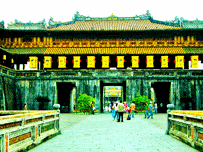
The fifth lord of the Nguyen dynasty, Nguyen Phuc Tran, also known as Lord Nghia, chose Phu Xuan Village on the Huong River as a suitable place for his capital in 1687.

More than 60 years later, Lord Nguyen Phuc Khoai proclaimed himself emperor and built more palaces, temples, communal houses and schools intending to turn Phu Xuan into the capital replacing Thang Long, present-day Hanoi, in the north.

Duong Xuan and Cam palaces are located on the upper Huong’s southern bank.

The magnificent Tuong Lac Palace and Duyet Vo House were also built nearby.

These and many more Nguyen Dynasty (1802-1945) structures concentrated mostly along the banks of the Huong River are all that remains of Vietnam’s last royal family.

By the late 19th century many French-style buildings and houses were built along the southern bank in a unique harmony with the older cityscape.

In addition to the ancient citadel, Hue houses seven mausoleums holding or once holding the earthly remains of the kings of the Nguyen Dynasty.

Along with other historic edifices, the Nguyen mausoleums form part of the UNESCO-listed World Heritage Site.

There were 13 Nguyen kings, but for various reasons tombs were only built for Gia Long, Minh Mang, Thieu Tri, Tu Duc, Duc Duc, Dong Khanh, and Khai Dinh.

Each sits well-positioned in quiet surroundings full of statues and monuments.

The typical structure is composed an outer wall and triple gate (called Tam Quan), the Court of Salutations, the Stele House, temples, lakes and ponds, pavilions, gardens, and, finally, the tomb.

The most beautiful mausoleum is considered to be that of Tu Duc, who died in 1883 after 35 years on the throne.

Built between 1864 and 1867, his burial place includes 50 monuments and is surrounded by a 1,500 meter wall.

Tu Duc was an authority on philosophy, history, and literature.

He left behind 4,000 verses and 600 pieces of prose.

Some of the poems are inscribed on the walls of the mausoleum, which was designed to blend with the natural setting.

Hue is also famous for its old pagodas, of which the best known are Thien Mu and Tu Dam, and for their historic houses and beautiful gardens.

The garden is a constant theme in Hue architecture.

Houses, pagodas, palaces, tombs, and villages all have elaborate gardens in Hue, known as the “garden city.”

It is the diversity of its gardens that defines Hue.

Different designs represent different aspects of life and philosophy, depending on the creator’s outlook.

However, many gardens within the royal citadel and mandarins’ mansions have deteriorated over time.

Royal sounds

Nha nhac, “elegant music,” was originally a genre of court music reserved for annual ceremonies and special events like coronations, funerals, and official receptions.

Although its roots can be traced to the 13th century, nha nhac reached its zenith in Hue’s royal court under the Nguyen Dynasty.

The kings favored nha nhac to the point of making it the official music of the court, thereby establishing it as a symbol of the dynasty’s power and longevity.

Nha nhac became an essential part of over 100 royal ceremonies each year.

Rich in spiritual content, nha nhac not only provided a means of communicating with and paying tribute to the gods and kings, but also served as a vehicle for transmitting aspects of Vietnamese philosophy and cosmogony.

City of festivals

In 1992, Hue’s Vietnam-France Culture Festival drew the attention of many foreign visitors previously unaware of the city’s majesty.

Eight years later the city organized the first biennial Hue Festival.

The festival has become a huge success showcasing the diversity of Hue’s culture, landscape, and traditional handicraft villages.

Among the highlights are shows featuring nha nhac, traditional music & dance, and excursions to traditional villages that make non la (conical palm hats), lanterns, wood carvings, and lacquer and bronze products.

The city’s efforts have borne fruit with the number of visitors rising from 243,000 in 1993 to 1.33 million in 2002.

Hue is determined to capitalize on its advantages and develop into one of the most popular destinations not in only Vietnam, but the whole Southeast Asian region.

Subscribe to the weekly Southeast Asian Archaeology news digest

Latest Books

The following are affiliate links for which I may earn a commission if you click and make a purchase. Click here for more books about Vietnamese archaeology.
A Maritime Vietnam
A Maritime Vietnam
Amazon Prime
$34.99
Buy on Amazon
Heritage Conservation and Tourism Development at Cham Sacred Sites in Vietnam: Living Heritage Has A Heart (Global Vietnam: Across Time, Space and Community)
Heritage Conservation and Tourism Development at...
Amazon Prime
$59.99
Buy on Amazon
From the Red River to the Mekong Delta: Masterpieces of the History Museum Ho Chi Minh City
From the Red River to the Mekong Delta:...
Amazon Prime
$65.00
Buy on Amazon
Discovering Vietnam’s Ancient Capital: The Archaeology and History of the Imperial Citadel of Thang Long-Hanoi
Discovering Vietnam’s Ancient Capital: The...
Amazon Prime
$28.00
Buy on Amazon
Museum-Making in Vietnam, Laos, and Cambodia: Cultural Institutions and Policies from Colonial to Post-Colonial Times
Museum-Making in Vietnam, Laos, and Cambodia:...
$41.79
Buy on Amazon
A History of Maritime Trade in Northern Vietnam, 12th to 18th Centuries: Archaeological Investigations in Vandon and Phohien (Studies in Economic History)
A History of Maritime Trade in Northern Vietnam,...
$103.88
Buy on Amazon

Leave a Reply

Your email address will not be published. Required fields are marked *

I agree to the Terms & Conditions and Privacy Policy.

This site uses Akismet to reduce spam. Learn how your comment data is processed.

Southeast Asian Archaeology

© 2019

Navigate Site

  • News
  • Resources
  • Countries
  • Topics
  • Visit
  • Jobs
  • Subscribe
  • About

Follow

Never Miss a Discovery
Subscribe for Exclusive Southeast Asian Archaeology News!

Stay connected with the latest breakthroughs, research, and events from across Southeast Asia’s archaeology scene. Sign up today for exclusive weekly updates, trusted by over 2,000 subscribers.

×
No Result
View All Result
  • News
  • Resources
  • Countries
    • Southeast Asia
    • Mainland Southeast Asia
      • Cambodia
      • Laos
      • Malaysia
      • Myanmar
      • Thailand
      • Vietnam
    • Island Southeast Asia
      • Brunei
      • Indonesia
      • Malaysia
      • Philippines
      • Singapore
      • Timor Leste
    • Peripheral Southeast Asia
  • Topics
    • Artifact Type
      • Architecture
      • Bones and Burials
      • Ceramics
      • Intangible Cultural Heritage
      • Lithics
      • Megaliths
      • Rock Art
      • Sculpture
    • Field
      • Anthropology
      • Bioarchaeology
      • Epigraphy
      • General Archaeology
      • Metallurgy and Metalworking
      • Paleontology
      • Underwater Archaeology
      • Visual Art
      • Zooarchaeology
    • Other Themes
      • Animism
      • Buddhism
      • Christianity
      • Disaster Risk Management
      • Hinduism
      • Islam
      • Archaeological Tourism in Southeast Asia
  • Visit
    • Virtual Archaeology
    • Unesco World Heritage
  • Jobs
  • Subscribe
  • About
    • About
    • Supporters
    • Terms of Use
    • Privacy Policy
    • Contact

© 2019

This website uses cookies. By continuing to use this website you are giving consent to cookies being used. Visit our Privacy and Cookie Policy.