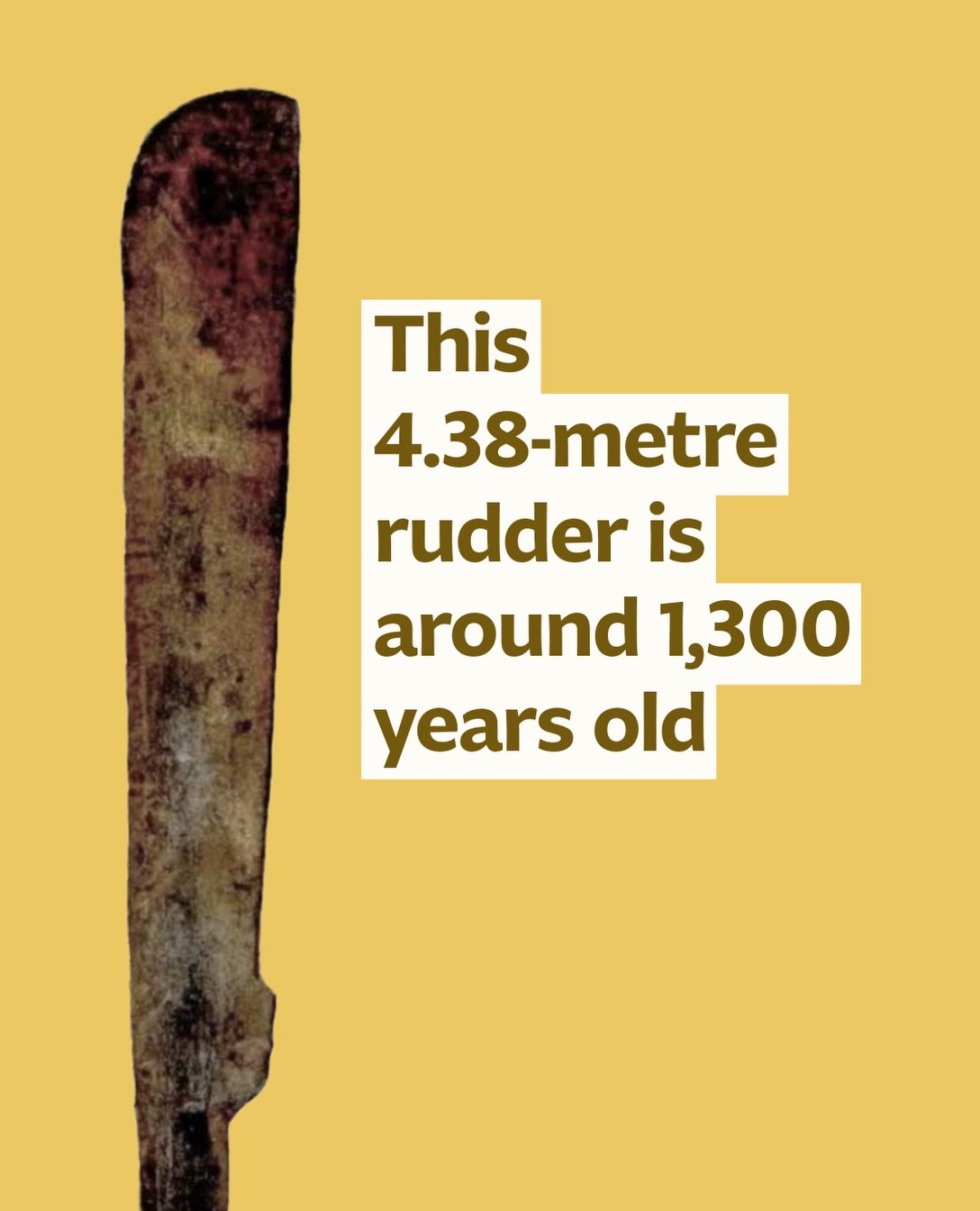

• A 4.38-metre-long wooden rudder from the west coast of Sumatra is providing a rare glimpse of Southeast Asian seafaring around 1,300 years ago.

The rudder was recovered at the Bongal Site in Central Tapanuli, North Sumatra. Today the site lies inland, but geomorphological research suggests that in the 7th–8th centuries CE it was part of a shallow bay or estuarine environment.

The quarter rudder was carved from a single log and measures 4.38 metres long. Radiocarbon dating of the wood produced a calibrated date of 656–687 CE, making it the earliest securely dated rudder currently known from Southeast Asia.

Researchers also documented hull planks with raised wooden lugs, dowels and surviving palm-fibre ropes. These suggest that parts of these boats were pegged and tied together—a construction method archaeologists call the Southeast Asian lashed-lug tradition. Differences between the surviving planks even suggest that several vessels may have been present. 

Bongal also produced ceramics, glass, beads and coins pointing to connections with much wider exchange networks. The researchers do not argue that the Bongal boats themselves were making long-distance voyages across the Indian Ocean, but propose that locally constructed vessels formed part of a regional maritime network, moving through rivers and along Sumatra’s coast and connecting communities there to broader systems of exchange.

Reference
Mochtar et al. 2026. “Lashed-Lug Boats from the Bongal Site: New Evidence for Early Maritime Networks on the West Coast of Sumatra.” International Journal of Nautical Archaeology.
10.1080/10572414.2026.2714901

#SoutheastAsianArchaeology #Indonesia #Sumatra #MaritimeArchaeology #NauticalArchaeology
  • Betel, Boats and Border Stones is this week’s Southeast Asian Archaeology Newsletter.⠀
⠀
This issue starts with a fascinating new paper on ancient teeth from South Sulawesi, where unusual dental wear may point to the habitual sucking of whole areca nuts by pre-agricultural foragers.⠀
⠀
Then we move from teeth to timbers: lashed-lug boat remains from Bongal on Sumatra’s west coast, including a 7th-century quarter rudder, add new detail to Southeast Asia’s early maritime networks.⠀
⠀
And yes, there are more boats: Phanom Surin in Thailand and the Butuan boat sites in the Philippines both make appearances this week.⠀
⠀
Plus: Preah Vihear, Koh Ker, Prambanan, Đông Sơn drums, repatriation, digital heritage, and more.⠀
⠀
Read the full issue at the link in bio.⠀
⠀
#SoutheastAsianArchaeology #Archaeology #MaritimeArchaeology
  • People in Sulawesi may have been habitually using a neuroactive plant as far back as 25,000–16,000 years ago.

A new study in Science Advances examines two preagricultural foragers from South Sulawesi, Indonesia, separated by thousands of years but sharing an unusual dental pattern: deep, rounded, circumferential wear that does not match ordinary chewing. The researchers argue that the wear formed through repeatedly holding, sucking or gently gnawing a small, hard object in different parts of the mouth. 

Using LC-MS, the team detected arecoline—a characteristic alkaloid of areca, or “betel”, nut—in dental samples from both individuals. One came from Leang Bulu Bettue and dates to 25–16 ka; the other, from Leang Cappalombo 1, is associated with deposits dating to around 7.6–6.3 ka. 

This was probably not betel chewing in the form familiar today. Modern betel quid typically combines processed areca nut with slaked lime and other ingredients. To test whether a simpler practice was plausible, the researchers soaked intact areca nuts and applied the resulting solutions to cells expressing human receptors. The experiments showed that intact nuts could release physiologically active arecoline without slaked lime. Combined with the dental wear, chemical residues and experiments support the authors’ interpretation that these foragers habitually sucked whole areca nuts.

For now, the sample is just two individuals, and psuggestions that the nuts were used for stimulation, pain relief or medicinal purposes remain hypotheses. What the study does show is that habitual neuroactive plant use may reach far deeper into the hunter-gatherer past than the archaeological record had previously demonstrated. 

Reference
Brumm et al. 2026. “Betel nut sucking is the earliest recorded evidence for the habitual use of a neuroactive plant drug.” Science Advances.
10.1126/sciadv.aei1901

#SoutheastAsianArchaeology #Sulawesi #IndonesiaArchaeology #Prehistory #BetelNut
  • Twenty-two small beads can preserve the traces of a much larger world of movement and exchange.

A new archaeometric study examines beads excavated in 2023 at Khok Phithak, within the ancient city of Khu Bua in Ratchaburi, central Thailand. Khu Bua was an important urban centre associated with the Dvaravatī cultural sphere, enclosed by earthen ramparts and moats and situated within the Mae Klong river system. 

The researchers analysed 21 glass beads and one chalcedony/agate bead, combining microscopic observations with VP-SEM-EDS, LA-ICP-MS and micro-Raman spectroscopy. Manufacturing traces—including axial colour streaks and elongated bubbles—indicate that most of the glass beads were made by drawing glass into tubes or canes before cutting them into individual beads. 

Their chemistry indicates that nineteen beads belong to the m-Na-Al-1 glass subgroup, consistent with glassmaking traditions documented in South Asia, particularly the wider technological sphere of southern India and Sri Lanka. Together with their manufacturing technique, the authors associate these beads with the large-scale Indo-Pacific beadmaking tradition. 

However, one blue bead, B014, is made from plant-ash soda–lime glass with a broad western Asian affinity—although the study cannot identify a specific production centre. Another remarkable bead, B007, appears to have been wound from recycled iron-smelting slag, suggesting an entirely different production history.

Rather than evidence for primary glassmaking at Khu Bua itself, the authors interpret the assemblage as reflecting an inland centre of consumption and possibly redistribution, connected through maritime and riverine networks to much wider systems of Indian Ocean exchange. 

Reference
Risteka et al. 2026. “Production Technology and Provenance of Dvaravatī Glass Beads from Khu Bua, Central Thailand: An Archaeometric Study.” Heritage 9, 347.
10.3390/heritage9090347

#SoutheastAsianArchaeology #ThailandArchaeology #Dvaravati #KhuBua #ancienttrade
  • Small finds, big stories this week.⠀
⠀
The latest Southeast Asian Archaeology newsletter focuses on Thailand, with newly reported rock art, worrying news of looting, and two new papers showing what archaeological science can reveal from humble materials.⠀
⠀
One study looks at prehistoric pottery from Don Up Mung in Nong Bua Lamphu, tracing differences in clay composition, firing and production choices. Another follows glass beads from Khu Bua in Ratchaburi into the wider world of South Asian glassmaking and Indian Ocean exchange.⠀
⠀
Also: a LOT of opportunities this week — jobs, scholarships, courses and calls for papers.⠀
⠀
Link in bio⠀
⠀
#SoutheastAsianArchaeology #Archaeology #CulturalHeritage #ArchaeologicalScience
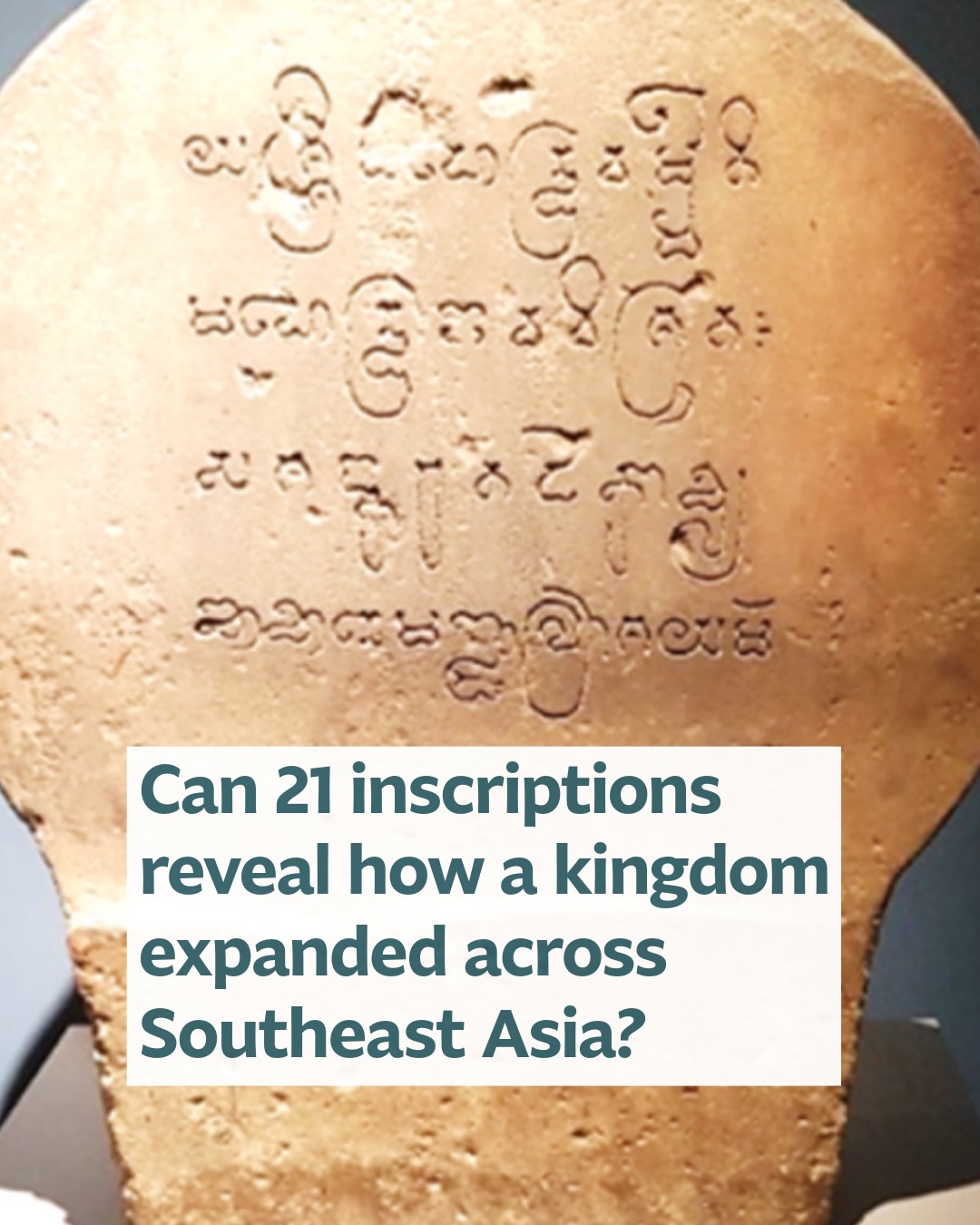
  • Can inscriptions help reconstruct how a kingdom expanded across a landscape?

King Citrasena (Chitrasen, later known as Mahendravarman) ruled Chenla in the late 6th to early 7th centuries, during a period when Chenla’s influence was extending across parts of what are now Cambodia, Laos and northeastern Thailand. His reign is known partly through inscriptions recording religious foundations, royal achievements and other acts of authority. 

Pailoplee and Khatshima map 21 inscriptions from at least 19 locations associated with Citrasena, and asked if people were moving between these places, which routes would they have taken? To explore this, they use Least Cost Path (LCP) modelling in a GIS. LCP calculates routes that minimise the “cost” of movement across terrain.

In archaeology, this can help identify plausible corridors shaped by features such as slopes, river valleys and mountain barriers. These models show how movement could have been structured by the landscape under the assumptions of the model.

Across several scenarios, the reconstructed paths repeatedly concentrate around major river systems—especially the Mun River—and particular passes through the Phnom Dong Rek (Dangrek) mountain range. The authors also compare the modelled network with archaeological sites attributed to Citrasena’s period, many of which fall along these reconstructed corridors.

Where river navigation would have been difficult (such as the Khone Phapheng Falls), the authors propose that Citrasena’s forces may instead have moved overland along riverbanks, using waterways as natural guides through the landscape.

The placement of several inscriptions near river confluences also suggests that these locations may have been important for controlling movement, communication and exchange, not simply access to water.

Reference
Pailoplee, S. & Khatshima, K. 2026. “The role of King Chitrasen (Mahendravarman) in the expansion of the Chenla Kingdom: A study of inscriptions and historical geography.” Social Sciences & Humanities Open 14, 103503.
10.1016/j.ssaho.2026.103503

#SoutheastAsianArchaeology #Cambodia #Thailand #Laos #Chenla
  • Sometimes the biggest archaeological questions depend on evidence we cannot see during excavation.

Microarchaeology investigates archaeological deposits at microscopic and microstratigraphic scales. In Southeast Asia, this can be especially valuable because monsoonal wetness, tropical weathering, intensive land use and complex depositional histories can affect how archaeological evidence survives. 

Researchers can examine the surrounding sediment for traces of past activity and later disturbance. Methods discussed in this new paper include sediment micromorphology, laboratory micro-excavation, high-resolution imaging, FTIR microscopy and SEM-EDS. Depending on the context, microscopic evidence can help identify burning, trampling, plant processing, sediment movement and environmental change. 

The importance of that context is illustrated by work in northern Laos. At Tam Ngu Hao 2, microstratigraphy was used alongside lithological observations and dating to establish the stratigraphic context of Denisovan fossil evidence. At Tam Pà Ling, it has shown potential for investigating environmental seasonality and possible patterns of early modern human presence. These methods help archaeologists understand what happened to a deposit before drawing conclusions from what it contains.
 
The paper also introduces the Australian Microarchaeology and Palaeosciences Facility (AusMAP) and argues for greater collaboration, training and locally based microarchaeological expertise across Southeast Asia. 

Reference:
Hernandez et al. 2026. Scaling down to look further back: Southeast Asia, deep-time science and microarchaeology. SPAFA Journal 10.
10.26721/spafajournal.651369a4y8 

#SoutheastAsianArchaeology #Archaeology #Microarchaeology #Geoarchaeology #ArchaeologicalScience
  • This week on Southeast Asian Archaeology: claims, contexts and careful reading.⠀
⠀
With Malaysia’s National Day, Vietnam’s National Day, Timor-Leste’s Popular Consultation Day, and International Literacy Day all close together, I’m thinking about literacy not just as reading words, but reading evidence: museum labels, old spellings, dates, maps, artefacts, archives, and the occasional viral post with a raised eyebrow.⠀
⠀
The catalyst this week is the recent controversy over historical claims in Malaysia, alongside a timely RSIS piece on how historians, archaeologists, archivists, librarians and curators can help push back against disinformation. Not by attacking people, but by helping everyone ask better questions of the past.⠀
⠀
Also in this week’s issue: Penang’s historical Malay spellings, Cambodia’s new artefact database grant, Singapore’s revised History Gallery, UNESCO’s maritime museum project, new research on Sundadonty, Roti Island, Chenla inscriptions, ancient Myanmar, and more.⠀
⠀
Link in bio.⠀
⠀
#SoutheastAsianArchaeology #Archaeology #Heritage #InformationLiteracy
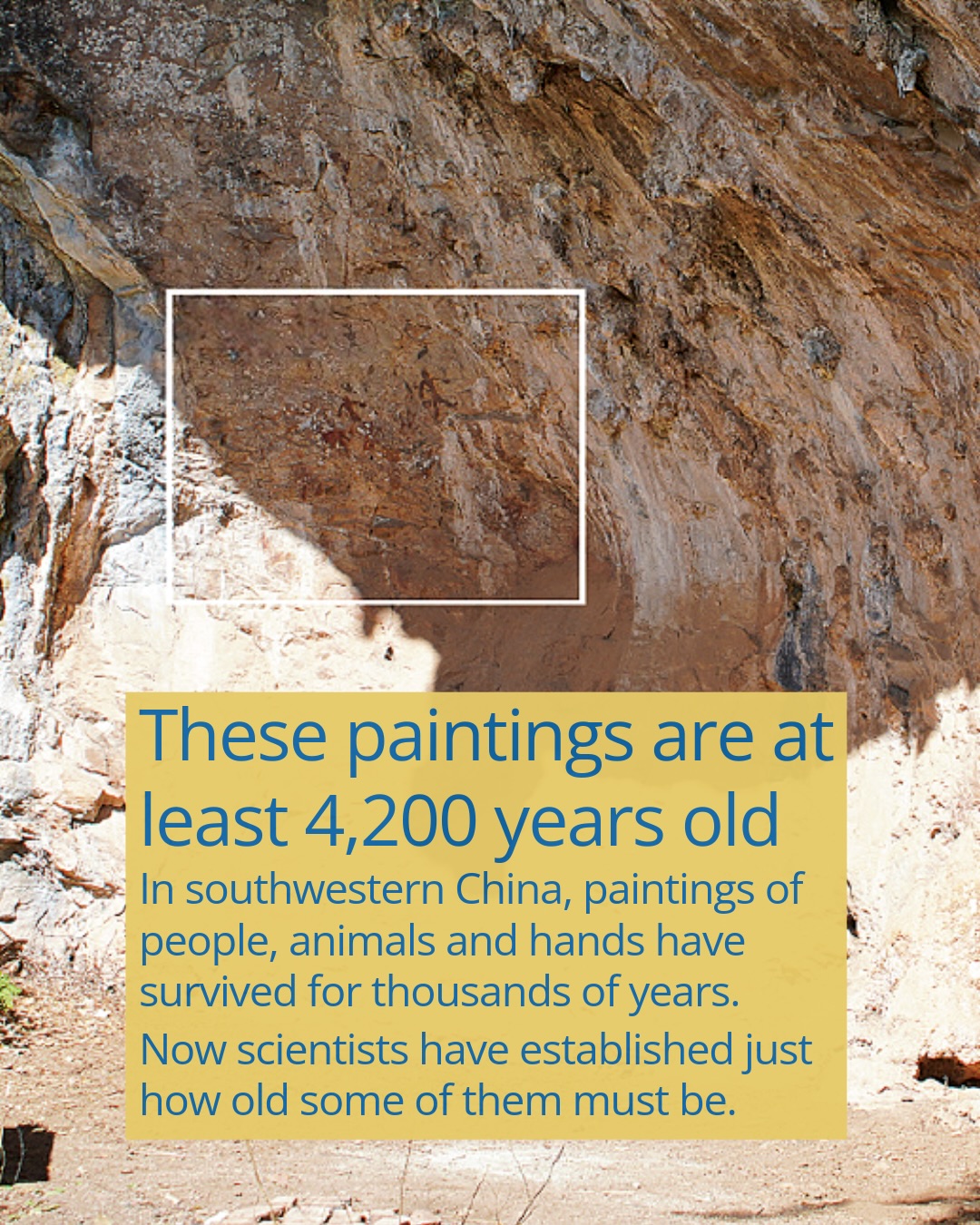
  • How old are the rock paintings of Mainland Southeast Asia? 🎨🪨

A new study from Mangguan in Yunnan, southwestern China, provides another important piece of the puzzle.

Using uranium-thorium dating, researchers analysed tiny calcite deposits that had formed over the paintings. Because the calcite must be younger than the pigment underneath, the dates provide a minimum age for the art. One deposit covering a human figure shows that the painting was already there at least 4,220 years ago.

Mangguan is particularly interesting because it lies only about 15 km from the better-known Cangyuan rock art complex. The two have stylistic similarities and overlapping dates, suggesting they formed part of a broader regional rock art tradition, a comparison can be taken farther south.

The rock paintings at Pha Taem in Luang Prabang, Laos, have previously been compared with Cangyuan, raising intriguing questions about relationships between the rock art traditions of southwestern China and Mainland Southeast Asia.

Most rock art in Mainland Southeast Asia remains poorly dated, so dates like those from Mangguan give us increasingly useful chronological anchors for thinking about these connections.

References:
Wu, Y. et al. 2026. U-Th dating of rock paintings in southwestern China: minimum age of ~4.2 ka BP at the Mangguan site. Journal of Archaeological Science: Reports 74, 105987. DOI: 10.1016/j.jasrep.2026.105987.

Bo, X. 2020. On the relationship between the Cangyuan rock art in Yunnan, China, and the Pha Taem rock art in Laos. Rock Art Research 37(2).

Tan, N.H. 2018. The Cliff Paintings of Pha Taem, Luang Prabang, Lao PDR. Rock Art Research 35(1).

#RockArt #SoutheastAsianArchaeology #Yunnan #China
  • Extraordinary claims about the past can be exciting. But how do we tell an exciting new hypothesis from pseudoarchaeology?

Recent controversy in Malaysia over claims that ancient Malays taught the Romans shipbuilding provides a useful case study. Rather than piling on the person behind the claims, I think there is a more useful question to ask: how would we actually test an idea like this?

Archaeology gives us some simple tools.

Do the dates work? What is the primary evidence? Does the evidence actually demonstrate the connection being claimed? Are there better explanations? And perhaps most importantly: what evidence would make us reject the hypothesis?

Ancient Southeast Asians really were sophisticated seafarers. Srivijaya really was one of Asia’s great maritime powers. Sungai Batu really does preserve remarkable evidence for early iron production.

None of those achievements needs embellishment to make Southeast Asian archaeology extraordinary.

Swipe through for five questions you can use the next time you encounter an astonishing claim about the ancient past.

🚩 Remember: possibility is not evidence, similarity does not necessarily mean transmission, and extraordinary claims still have to survive ordinary archaeological scrutiny.

Read more about the archaeology behind these claims in this week’s Southeast Asian Archaeology Newsletter.

#SoutheastAsianArchaeology #Pseudoarchaeology #Malaysia #MaritimeArchaeology #MediaLiteracy
Saturday, September 19, 2026
Southeast Asian Archaeology
  • News
  • Resources
  • Countries
    • Southeast Asia
    • Mainland Southeast Asia
      • Cambodia
      • Laos
      • Malaysia
      • Myanmar
      • Thailand
      • Vietnam
    • Island Southeast Asia
      • Brunei
      • Indonesia
      • Malaysia
      • Philippines
      • Singapore
      • Timor Leste
    • Peripheral Southeast Asia
  • Topics
    • Artifact Type
      • Architecture
      • Bones and Burials
      • Ceramics
      • Intangible Cultural Heritage
      • Lithics
      • Megaliths
      • Rock Art
      • Sculpture
    • Field
      • Anthropology
      • Bioarchaeology
      • Epigraphy
      • General Archaeology
      • Metallurgy and Metalworking
      • Paleontology
      • Underwater Archaeology
      • Visual Art
      • Zooarchaeology
    • Other Themes
      • Animism
      • Buddhism
      • Christianity
      • Disaster Risk Management
      • Hinduism
      • Islam
      • Archaeological Tourism in Southeast Asia
  • Visit
    • Virtual Archaeology
    • Unesco World Heritage
  • Jobs
  • Subscribe
  • About
    • About
    • Supporters
    • Terms of Use
    • Privacy Policy
    • Contact
No Result
View All Result
Southeast Asian Archaeology
  • News
  • Resources
  • Countries
    • Southeast Asia
    • Mainland Southeast Asia
      • Cambodia
      • Laos
      • Malaysia
      • Myanmar
      • Thailand
      • Vietnam
    • Island Southeast Asia
      • Brunei
      • Indonesia
      • Malaysia
      • Philippines
      • Singapore
      • Timor Leste
    • Peripheral Southeast Asia
  • Topics
    • Artifact Type
      • Architecture
      • Bones and Burials
      • Ceramics
      • Intangible Cultural Heritage
      • Lithics
      • Megaliths
      • Rock Art
      • Sculpture
    • Field
      • Anthropology
      • Bioarchaeology
      • Epigraphy
      • General Archaeology
      • Metallurgy and Metalworking
      • Paleontology
      • Underwater Archaeology
      • Visual Art
      • Zooarchaeology
    • Other Themes
      • Animism
      • Buddhism
      • Christianity
      • Disaster Risk Management
      • Hinduism
      • Islam
      • Archaeological Tourism in Southeast Asia
  • Visit
    • Virtual Archaeology
    • Unesco World Heritage
  • Jobs
  • Subscribe
  • About
    • About
    • Supporters
    • Terms of Use
    • Privacy Policy
    • Contact
No Result
View All Result
Southeast Asian Archaeology
No Result
View All Result
ADVERTISEMENT

Related Posts

Archaeology of Southeast Asia

Remembering Southeast Asian Scholar James C. Scott

30 July 2024
0
79

...

Roderick Orlina. Source: SEALG Blog 20240625

Remembering Roderick Orlina and his Contributions to Southeast Asian Epigraphy

26 June 2024
0
98

...

Source: Farouk Yahya 2024

[Obituary] Elizabeth Moore (1949–2024)

25 April 2024
0
60

...

Source: Popular Magazine 20240330

Tragic Loss of Promising Archaeologist Em Phearak Shocks Community

1 April 2024
0
36

...

Popular This Week

  • Southeast Asian Archaeology from a Rock Art Perspective (with annotations)

    Southeast Asian Archaeology from a Rock Art Perspective (with annotations)

    0 shares
    Share 0 Tweet 0
  • The most influential books on Southeast Asian Archaeology (a crowdsourced list)

    0 shares
    Share 0 Tweet 0
  • Southeast Asian Archaeology memes that will tickle your funny bone and also make you ponder

    68 shares
    Share 68 Tweet 0
  • Rebutting the myth that Malays have the second oldest genes in the world

    25 shares
    Share 25 Tweet 0
  • Explore Southeast Asia through these virtual galleries

    616 shares
    Share 616 Tweet 0
Buy me a coffeeBuy me a coffee

If you found this site useful, you can help support it by buying me a coffee!

In memoriam: Gale Sieveking 1925-2007

5 September 2007
in Malaysia
Tags: Gale Sieveking (person)Gua Cha (site)Johor LamaKelantan (state)Michael Tweedie (person)obituarysymposium
0
SHARES
288
VIEWS

Gale Sieveking was an archaeologist who worked in Malaya from the 1950s and onwards. He is best known for his excavation of Gua Cha in Kelantan, where over 30 humain remains have been found, buried in two distinct time frames, the Hoabinhian and the Neolithic. This tribute was published in the Newsletter of the Society of Antiquarians in London. Special thanks to Dr Ian Glover for this bit of news.

Memories of Gale Sieveking (1925–2007)

The call, in the last issue of Salon, for further reminiscences concerning our late Fellow Gale Sieveking produced a fruitful bounty of information. Since Gale played such an important part in the development of archaeology as a discipline and in our understanding of prehistory, these valuable insights into his life and work are worth recording in full.

Our Fellow Ann Sieveking has generously provided a copy of the address that she gave at her late husband’s funeral. We are also very grateful to our Fellows Juliet Clutton-Brock, Michael Thompson, Michael Kerney and Phil Harding for their accounts of the lasting impression that Gale made on them, and to Professor Rory Mortimore, now Head of Civil Engineering and Geology at the University of Brighton, who provides an account of Gale’s ability to build multi-disciplinary teams around the study of flints and prehistoric technology.

Ann Sieveking writes: ‘Gale was born on 26 August 1925 at Cagnes-sur-Mer, in the Alpes Maritimes. Having been born in France he was entitled, at the age of seventeen, to choose between French and British nationality, but in 1942 there was little liberty to do so and, with certain regrets, he relinquished his French nationality.

‘On leaving school, he joined the Fleet Air Arm, trained in flying in Canada, swam in the sea of Colombo and sat in an outlook post on top of a fort in Malta. Gale once related that his flying duties were curtailed when, on a training flight, he neglected to lower the undercarriage of his craft through a small oversight.

‘As soon as he was able to do so, he went up to King’s College, Cambridge. A grateful but insolvent Government financed ex-service personnel for two years of a three-year degree. For the first part of the tripos, Gale read history, but he was captivated by archaeology and in his final year he studied prehistory.

‘He then embarked on a PhD, but he left this unfinished since he had married, was in need of an income and had been offered a post as Deputy Director of Museums in Malaya. In 1953, Malaya was in the midst of the state of emergency declared by the British colonial government in 1948 as a response to Communist insurgency. Opportunities for travelling and exploring were limited, but Gale still managed to open three new regional museums – in Malacca, Seremban and Kuala Kangsa – and he excavated sites of all periods wherever it was possible to do so.

‘The first of these was a seventeenth-century Portuguese fort in Johore Lama, facing Singapore across the Straits; another was an early Indian trading post in the mangrove swamps near Taiping, and a third, again in Johore, was the rescue of a collection of Chinese porcelain – one cannot say “excavation”, as the finder had put his pickaxe through the hoard when extending his vegetable patch. This had been buried for safety in a wooden box and included a number of blue and white Ming dynasty bowls of imperial quality, though how they came to be abandoned there remains a mystery.

‘Perhaps of most interest to Gale was his excavation of Gua Cha, a habitation site in a rock shelter on the Nengiri river in Kelantan. Gua Cha had been found in 1935 by H D Noon, but Noon had not survived the war. Working with our Fellow Michael Tweedie, then of the Raffles Museum, Singapore, Gale’s was the first systematic excavation of Gua Cha, where he found a slaughtering station for wild boar, along with human burials of both Mesolithic and Neolithic date, the latter with jadeite bracelets, polished stone axes and pottery bowls containing a supply of small animals, presumably for sustenance in the next world.

‘The site was in an isolated part of the jungle, but a police post had been established here to round up the indigenous people of this part of the peninsula who were suspected of supporting the insurgents with food and intelligence. Attired in jungle green, Gale and Ann Sieveking, along with Michael Tweedie and a number of museum staff, worked under military escort, and were kept supplied by parachute drops with food and – marvellously – paperback thrillers to read. When the dig was finished, all returned to civilisation down the Nengiri river on bamboo rafts; the human cargo survived the hazards better than did some of the finds.

‘After three years in Malaya, four Sievekings returned to England. Gale joined the British Museum, where he stayed for the rest of his professional career. Gale’s first research project was an analysis of Grand Pressigny flint, a beautiful honey-coloured stone found in east-central France and mined, worked and traded in the Neolithic. Grand Pressigny flint was unusual in being identifiable by its colour; at this date most flints were considered indistinguishable one from another. Gale was one of a group of researchers who established that flint from different localities could be identified by their trace elements. This analysis made it possible to map the distribution of flints from different mines; for example, axes from Grimes Graves were identified and shown to be distributed widely in England and in France, while French flint travelled in the opposite direction.

‘For the British Museum, Gale dug at High Lodge, near Mildenhall, in Suffolk, a site that vexes geologists and archaeologists since the chronological order of the flint tools discovered in the gravel and brickearth deposits apparently contradicts the geological succession. In this confrontation, the archaeologists have given way. A flake industry, usually accepted as of later date, has been acknowledged as uniquely early here, existing before the level with the handaxes. Gale dug further early sites, in the Thames valley at Ebbsfleet and Northfleet and at Creffield Road, Acton, and then, with a change in date, he reopened the Neolithic flint mines at Grimes Graves, in Norfolk.

‘In the later seasons here, he was joined by our Fellow Ian Longworth who, looking for traces of habitation, worked above ground while Gale worked both below and above. Much of Gale’s surface work was experimental. How fast could a hole be dug in the chalk; how much flint was wasted in the production of a single stone axe; and how far would a scatter of waste flakes extend beyond the location of the flint worker?

‘For Gale, prehistory was a total occupation, and he was fortunate in that, in his professional career, he was employed to do what interested him. If asked what hobbies he had, he looked uncomprehending. He was not practical, as was alarmingly demonstrated by his dangerous dealings with lawn mowers and London double decker buses.

‘I remember one Christmas Gale was given yet another gadget – a gas-powered wine bottle opener in the form of a hypodermic which was pushed through the cork, emitted a small amount of gas and pushed the cork out with a satisfying plop. Gale had the Christmas wine chilling in a large bathtub of ice and he tried out his new toy on one bottle; instead of a plop there was a loud bang. The cork was still firmly lodged in the neck of the bottle but the rest of the bottle had exploded, showering the kitchen with ice, wine, broken glass, blood and injured pride. Apparently Gale’s mistake was to use the device on a bottle of unconventional shape.

‘Gale had many interests: music, painting, buildings, travelling abroad – particularly in France – and good company. And in good company one was always aware of what an absolutely charming man he was. He always demonstrated an enormous interest in you and what you were about, whilst at the same time being fascinating in his interest in so many things. Perhaps it was this pleasure in so many things that prompted one of his Cambridge friends to comment that one always enjoyed oneself in his company, and indeed this was so.’

Juliet Clutton-Brock writes: ‘Gale will be sadly missed as an archaeologist of spirit and a loyal friend. Gale was an undergraduate at Cambridge during the crucial time when archaeology was in transition from an amateur occupation for treasure hunting to the practice of serious scientific research. The great names of this period – Graham Clark, Charles McBurney, Gordon Childe and Frederick Zeuner – had a determining and controlling influence on students who wished to join them in this endeavour, and they did not suffer fools gladly. Gale was one of the lucky few who was trained in prehistory on Clark’s excavations at Star Carr in the early 1950s, and it surely influenced his approach to prehistory and its interpretation for the rest of his career.

‘I was lucky to be given the opportunity, as an archaeozoologist, to work with Gale on the animal remains from his 1970s excavations at Grime’s Graves. Gale became a friend and colleague who was always supportive and always full of new ideas for how to approach the study of prehistoric remains. For me, these were the very large collection of antler picks from the flint mines as well as the skeleton of a dog, excavated so carefully that the remains of its last meal, tiny bones from a pig’s foot, were still with it, and the skull of an aged mare who had lost most of her teeth. Gale was an “ideas man”, but with a disciplined approach, and such people are sorely needed in any field of research.’

Michael Thompson writes: ‘Gale was at King’s College, Cambridge, when I met him as research student. We were both at Graham Clark’s famous early mesolithic excavation at Star Carr from 1949 to 1952. He had a spell under Harper Kelley at the Musée de l’Homme and I joined him on an excavation of a neolithic site in France, while he visited me in Portugal when I was engaged on material from the Tagus middens at Mugem.’

Michael Kerney writes: ‘Gale and I joined forces for an expedition to Thailand from 1 December 1965 to 31 March 1966. Our project had two aims: one was to locate sites in the limestone massifs in the country’s north and north-eastern provinces with Palaeolithic and earlier remains, sealed by stalagmite deposits, and thus datable using protactinium-thorium-uranium isotopic methods; the other was to investigate the relationship between the bronze age in Thailand and contemporary cultures in Yunnan.

‘Gale organised the digs superbly well. It was typical of him that he planned everything on a lavish scale. I remember that at one site he had a traditional bamboo hut built as a base. He was dissatisfied by the proposal made by the village builder, which he thought a bit mean, and so he rather airily increased the dimensions. I think that even he was taken by surprise at the result. Certainly it was a most impressive structure – abandoned, of course, to the forest when we left.

‘Also typical was his fascination with historical oddities of all kinds, as when we encountered a tribesman still using a tower musket, stamped with the cipher of George IV, for which he made his own bullets. Photographs were taken and an animated conversation was conducted through an interpreter.’

Phil Harding writes: ‘From 1972 to 1976, Sieveking undertook a major project of work with Ian Longworth to re-examine the important Neolithic flint mines at Grimes Graves, Norfolk. While Longworth concentrated on the rich Bronze Age deposits, Sieveking focused his attentions on the so-called “primitive” pits of the west fields, the flaking floor workshops in between them and the deep mines. He also sought to exploit the strengths of the British Museum Laboratory which allowed him to initiate challenging projects to resolve other outstanding questions at the site.

‘Typical of a man who had employed a bulldozer to shear off a large part of High Lodge hill to reach the important Lower Palaeolithic site beneath, Sieveking thought big. Vast area excavations up to 30 metres square were stripped by hand in the west fields using young offenders from North Sea Camp, Boston in Lincolnshire, before field archaeologists were introduced to excavate the deposits. He argued that excavations of this size were necessary to understand the distribution of mining pits in this part of the site.

‘But by far the most impressive and perhaps most enduring aspect of this programme was the re-excavation of mine shafts that had been investigated in the late nineteenth and early twentieth centuries. This approach allowed easy access to underground gallery systems to gather new data while removing the need to excavate undisturbed shafts. Again gaining access to many of these shafts was itself an ambitious challenge but, with the aid of heavy machinery, Sieveking systematically re-emptied many of the early excavations. This enabled miners from the Dutch Workgroup to use their expertise as miners to re-examine, record and re-interpret the complex underground mining system and extract antler samples for radiocarbon dating.

‘Sieveking was keen to harness their appreciation of Neolithic mining techniques and their practical skills as miners. He equipped them with antler picks to collect accurate figures that could be used to calculate work rates for the underground operations. The excavation of the deep mines culminated in the re-excavation of a shaft first emptied by Canon Greenwell in the late nineteenth century. This shaft, now capped off, remains open to this day to bear witness to the mining skills of the Neolithic miners.

‘Sieveking’s methods to resolve outstanding questions at the site were not restricted to excavation. He employed what, for the time, were ambitious multi-disciplinary programmes including geophysics, to trace the extent of mining. Extensive programmes of radiocarbon dating using freshly acquired samples from the mines, phosphate analysis to locate settlement associated with the mining, trace element analysis to study the composition of flint as a means of understanding trade distributions of flint axes were all undertaken by the Scientific Laboratory of the British Museum under Sieveking’s initiation. Some of these programmes enjoyed limited success at the time due to the technology then available; subsequent improvements in technology have proved their value.

‘His desire to understand activity at the site also extended to the use of experimentation. He actively involved a skilled flint knapper to study how the position of the knapper influenced the distribution of flaking waste. From this he hoped to speculate on the number and distribution of knappers on a flaking floor. The results of this project provided results that were invaluable not only to Grimes Graves but to countless other sites. They offered an experimental approach that has been replicated many times since.’

Professor Rory Mortimore writes: ‘I first met Gale Sieveking when he asked me to help in the evaluation of the Grimes Graves flint mines, Brandon, Norfolk, in 1976. It was typical of Gale to seek expertise outside the traditional field of archaeology. He saw the need for archaeological investigations to become more scientific and multidisciplinary. He brought the Felder brothers and their relations over from the Netherlands to help with the Grimes Graves excavations because of their expertise as traditional pick-and-shovel coal miners and for their experience in opening the Rijckholt St Geertruid Neolithic Flint Mines near Maastricht in Limburg. I had only just started out on my career as an engineering geologist and was working on the A26 Lewes Road Tunnel as part of my PhD. In association with Sir William Halcrow & Partners, the engineers for the Lewes project, we applied the rock-mass classification system that had only just been developed by the Norwegian Geotechnical Institute to assess the support requirements for this “open-face” tunnel. Somehow Gale had heard about this work and wanted to see if such systems could be applied to the Neolithic flint mines at Grimes Graves. From then on, and for several years into the mid-1980s, the classic Gale greeting of “Dear Boy” became a familiar part of life.

‘Having persuaded me and many others to present the Grimes Graves results at the Third 1979 Maastricht Flint Symposium, Gale then took on the task of making the “Flint Symposium” truly international and scientific. He got the agreement of the Maastricht Committee in 1979 to take the symposium out of the Netherlands to England for its fourth meeting in 1983. It was his drive, enthusiasm and vision that drew in a wide range of disciplines to focus on every aspect – geological and archaeological – of that extraordinary raw material, flint. I became the organising secretary for the Fourth Symposium, held at the Falmer Campus of Brighton Polytechnic, and saw at first hand the effort that Gale put in and the “politics” that had to be overcome to make a success of every aspect.

‘He got the excavations in the Sussex Downs at the Harrow Hill Flint Mines organised and arranged for the work to be carried out by the Maastricht Flint Mining Team, led by the Felder family. These excavations became the centrepiece of the Fourth Symposium. Gale pulled together an International Committee as well as a smaller and more manageable Organising Committee that led to future Flint Symposia being taken to France, Spain and Poland. The International Committee meetings were held at the Society of Antiquaries, Burlington House, London. Other field studies were also carried out in the South Downs to investigate where flint artefacts might have become buried by soil forming and other geomorphological processes. Pits were excavated in valley bottoms and along valley sides to try and find evidence to date the formation of the dry valleys. Flint-bearing horizons in the chalk of the South Downs that Neolithic flint miners had sought were also investigated. These field studies then formed part of the Symposium presentations and field programme in 1983. In addition, a memorable post-symposium field trip from Beachy Head (Sussex) to the Norfolk coast and on to Flamborough Head in Yorkshire was organised. All involved were international experts in their particular subjects.

‘The publication of the Fourth International Flint Symposium proceedings (in two volumes by Cambridge University Press in 1986) stands as a monument to Gale’s efforts and contains many seminal papers.

‘Stories about Gale abound. His heart was always in the right place and once you had made friends he was a loyal ally for life. He was not, however, above upsetting some people and sometimes appeared arrogant and pompous. But this was down to his old-fashioned English upper-crust bearing and was not a true reflection of his character. There were hilarious moments at the International Committee Meetings at the Society of Antiquaries in London. Chairing the meeting, a slightly pompous Gale leaned back on two legs of an incredibly valuable chair, presented to the Society by a former monarch, and suddenly disappeared in a cloud of dust. The chair had disintegrated! Our European colleagues sitting around a magnificent table in this ancient room were unsure how to react! We quickly helped Gale to his feet and brought over another chair for him to continue the meeting. All went well until, again leaning back on two legs, the second chair disintegrated and all the committee could see was a film of dust in the place where Gale had been. This time the committee could not contain their laughter!

‘The lasting memory of Gale is of a man with great enthusiasm for his subject and a drive to take it forward and whose contribution was not in the number of articles published but rather as a facilitator and motivator, bringing experts together to solve archaeological problems – someone who was an immensely loyal friend with an equally strong passion for his family.’

Subscribe to the weekly Southeast Asian Archaeology news digest

Latest Books

The following are affiliate links for which I may earn a commission if you click and make a purchase. Click here for more books about Southeast Asian archaeology.
Sale Malay Silver and Gold: Courtly Splendour from Indonesia, Malaysia, Singapore, Brunei and Thailand
Malay Silver and Gold: Courtly Splendour from...
Amazon Prime
$38.54
Buy on Amazon
Sale The Oxford Guide to the Malayo-Polynesian Languages of Southeast Asia (Oxford Guides to the World's Languages)
The Oxford Guide to the Malayo-Polynesian...
Amazon Prime
$165.87
Buy on Amazon
Sale Majapahit: Sculptures from a Forgotten Kingdom
Majapahit: Sculptures from a Forgotten Kingdom
$44.08
Buy on Amazon
Sale Majapahit: Intrigue, Betrayal and War in Indonesia’s Greatest Empire
Majapahit: Intrigue, Betrayal and War in...
Amazon Prime
$15.74
Buy on Amazon
Sale The Story of Southeast Asia
The Story of Southeast Asia
$24.11
Buy on Amazon
Buddhist Landscapes: Art and Archaeology of the Khorat Plateau, 7th to 11th Centuries
Buddhist Landscapes: Art and Archaeology of the...
Amazon Prime
$56.00
Buy on Amazon

Comments 2

  1. caving liz says:
    19 years ago

    Sad news that one of the great archaeologists has passed on. At least his name will be remembered in the archaelogy files. Do we know the date he died?

  2. noelbynature says:
    19 years ago

    Nope, I don’t have any info on the exact date he passed away. Must be earlier this year though.

Leave a Reply

Your email address will not be published. Required fields are marked *

I agree to the Terms & Conditions and Privacy Policy.

This site uses Akismet to reduce spam. Learn how your comment data is processed.

Southeast Asian Archaeology

© 2019

Navigate Site

  • News
  • Resources
  • Countries
  • Topics
  • Visit
  • Jobs
  • Subscribe
  • About

Follow

Never Miss a Discovery
Subscribe for Exclusive Southeast Asian Archaeology News!

Stay connected with the latest breakthroughs, research, and events from across Southeast Asia’s archaeology scene. Sign up today for exclusive weekly updates, trusted by over 2,000 subscribers.

×
No Result
View All Result
  • News
  • Resources
  • Countries
    • Southeast Asia
    • Mainland Southeast Asia
      • Cambodia
      • Laos
      • Malaysia
      • Myanmar
      • Thailand
      • Vietnam
    • Island Southeast Asia
      • Brunei
      • Indonesia
      • Malaysia
      • Philippines
      • Singapore
      • Timor Leste
    • Peripheral Southeast Asia
  • Topics
    • Artifact Type
      • Architecture
      • Bones and Burials
      • Ceramics
      • Intangible Cultural Heritage
      • Lithics
      • Megaliths
      • Rock Art
      • Sculpture
    • Field
      • Anthropology
      • Bioarchaeology
      • Epigraphy
      • General Archaeology
      • Metallurgy and Metalworking
      • Paleontology
      • Underwater Archaeology
      • Visual Art
      • Zooarchaeology
    • Other Themes
      • Animism
      • Buddhism
      • Christianity
      • Disaster Risk Management
      • Hinduism
      • Islam
      • Archaeological Tourism in Southeast Asia
  • Visit
    • Virtual Archaeology
    • Unesco World Heritage
  • Jobs
  • Subscribe
  • About
    • About
    • Supporters
    • Terms of Use
    • Privacy Policy
    • Contact

© 2019

This website uses cookies. By continuing to use this website you are giving consent to cookies being used. Visit our Privacy and Cookie Policy.