


![[Talk] The Ancient Town of Si Thep in Thailand: A Crossroads of Indianization](https://www.southeastasianarchaeology.com/wp-content/uploads/2024/07/the-ancient-town-of-si-thep-in-thailand-a-crossroads-of-indianization-502-120x86.jpg)


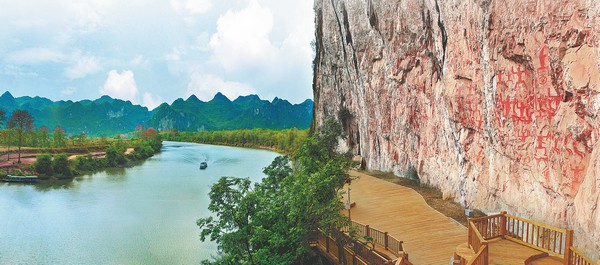
via China.org, 03 June 2022: The rock art of the Zuojiang River in Guangxi Zhuang is a Unesco World Heritage site with some similarities to rock art found in Laos.
That would be an apt description for the murals in Zuojiang Huashan that stand out red and bright even after thousands of years.
Guangxi Zhuang autonomous region is famous for the picturesque karst landscape in Guilin, its rich ethnic culture-it has over 40 of China’s 56 ethnic groups-and silver beaches facing the Beibu Gulf. It also has a World Heritage Site in the form of the Zuojiang Huashan Rock Art Cultural Landscape in Chongzuo, the only rock art entity among China’s 55 World Heritage Sites.
There are some 38 rock art sites on steep cliffs some 30-90 meters above the Zuojiang River and its tributary, the Mingjiang. The murals are drawn with a red pigment made of hematite and animal glue and date back to a 700-year period starting from the 5th century BC to the 2nd century AD.The body of work illustrates the life and rituals of the Luoyue people, the ancestors of the current day Zhuang people, who lived in the region about 2,000 years ago. They have all been well preserved thanks to, what the locals reason, the “faithful” protection of the rivers below.