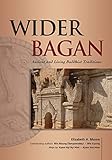
via SPAFA Journal, 19 January 2021: An Open Access paper about Arakanese ceramics by Saw Tun Lin.
Mrauk U is situated in the western part of modern Myanmar and was the capital of Arakan (Rakhine) from 1430 CE until the Burmese conquest in 1784 CE. Its unique position in the Bay of Bengal via the Kaladan river and its tributaries resulted in the development of a commercial and cultural center in its heyday. European travel accounts and chronicles describe Mrauk U as a prosperous cosmopolitan city with a polyglot court, not only using native Arakanese language but also Persian and Bengali. Consequently, the remnants of art and archaeology reveal that the artisans drew much of their inspiration from Indian, European and Burmese traditions (Gutman 2001; 2002; Leider 2002:83). This paper contextualizes decorative glazed tiles of Arakanese Buddhist monuments in relation to the historical, political and cultural situation of Mrauk U. Regional interaction will be taken into account to identify the origins and development of Arakanese glazing technology. Previous research has mainly focused on the art and architecture of the Mrauk U period and the origin of the glazing technique remains vague. The comparative analysis reveals that significant elements in Arakanese glazing art, such as the use of stylized, geometric, floral or vegetal designs and animal poses seem to be borrowed from Islamic art. This article argues that Islamic tile tradition exerted considerable influence on the Arakanese glazing technique, probably via Bengal.
![This week in Southeast Asian Archaeology: Prambanan gets some renewed attention, Phimai Black pottery surfaces at Mun Bon Dam, and I’m taking a short break next week.⠀
⠀
The featured stories look at the new Indonesia–India conservation project at Prambanan, focusing on the temple complex’s ruined perwara shrines, and a striking Late Prehistoric find in northeast Thailand: a remarkably complete Phimai Black vessel discovered as water levels fell at Mun Bon Dam.⠀
⠀
Temples, pottery, reservoirs, and a little scheduled rest. Back again on 27 July.⠀
⠀
Read this week’s newsletter: [link in bio]⠀
⠀
#SoutheastAsianArchaeology #Archaeology #Heritage #Prambanan #Thailand #Indonesia #Cambodia #Vietnam #CulturalHeritage #Substack This week in Southeast Asian Archaeology: Prambanan gets some renewed attention, Phimai Black pottery surfaces at Mun Bon Dam, and I’m taking a short break next week.⠀
⠀
The featured stories look at the new Indonesia–India conservation project at Prambanan, focusing on the temple complex’s ruined perwara shrines, and a striking Late Prehistoric find in northeast Thailand: a remarkably complete Phimai Black vessel discovered as water levels fell at Mun Bon Dam.⠀
⠀
Temples, pottery, reservoirs, and a little scheduled rest. Back again on 27 July.⠀
⠀
Read this week’s newsletter: [link in bio]⠀
⠀
#SoutheastAsianArchaeology #Archaeology #Heritage #Prambanan #Thailand #Indonesia #Cambodia #Vietnam #CulturalHeritage #Substack](https://scontent-sin6-3.cdninstagram.com/v/t51.82787-15/744214042_18361115071209510_2262608560893170251_n.jpg?stp=dst-jpg_e35_tt6&_nc_cat=110&ccb=7-5&_nc_sid=18de74&efg=eyJlZmdfdGFnIjoiRkVFRC5iZXN0X2ltYWdlX3VybGdlbi5DMyJ9&_nc_ohc=efvF5aVfY5EQ7kNvwHCwB5Y&_nc_oc=Adrhygfs4_3OVhjr2Rgbgpm8FmeWkE2yymjBA2vziLdP9JGysLT5sw8HvP0DyoT9ok0&_nc_zt=23&_nc_ht=scontent-sin6-3.cdninstagram.com&edm=ANo9K5cEAAAA&_nc_gid=E2a971KxU5zWh5nw04VahQ&_nc_tpa=Q5bMBQG3isXxBQ6X2iiWSZMjLP-e67HFOBtkU91-gQ-AKbsKRt5f8E-T4V3vusgBi5f3KhWHhujQj78B&oh=00_AQDe-6UC5alsUH9NnC76ElPMhHOuQqr5Md7rQWU22phWgQ&oe=6A65E271)