
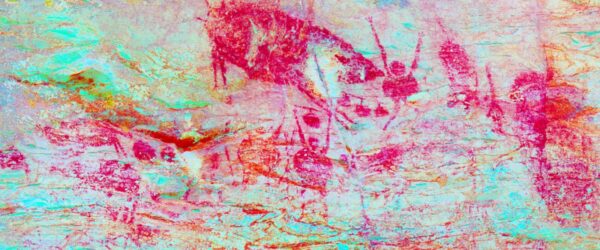
via New Naratif, 24 May 2019: An article about the Gua Tambun rock paintings in Ipoh, which was the subject of my MA research a decade ago. Lots of quotes from me, and the article also delves into issues of public engagement in Malaysia and perspectives from indigenous peoples. Article is also available in Bahasa Malaysia.
Tambun’s rock paintings were first reported in 1959 by John M. Matthews (then-curator of the National Museum in Kuala Lumpur), following an investigation that same year by a team from the museum. A second expedition was undertaken in 1984 by another team from the National Museum. Subsequently, Tan’s fieldwork in 2009 mapped out 640 forms of rock art and contains the most comprehensive and detailed record ever produced. It also provides a baseline archive of the site, as information and understanding on them have been scarce and were mainly based on Matthews’ assumptions made 60 years ago.
Tan’s work involves cataloguing and recording the paintings through digital photography, and carrying out compositional analysis to study samples of pigment and comparisons of Gua Tambun with other rock art in Southeast Asia (particularly in Southern Thailand). Interpretive questions—which allow for more than one possible answer based on available information—were used to determine the date, technology and authorship of the rock art. The creation of the paintings (in purple, red and orange colours) indicate a complex process on a logistical level; the artists would have had to climb up the cliff face to paint, and some sections of the art were fairly large in scale. Interestingly, the largest paintings were made first on the highest parts of the cliff, with the smaller ones occurring closer to the current floor.
Source: Tambun Rock Art: Archaeology as a Public Good – New Naratif
![This week in Southeast Asian Archaeology: Prambanan gets some renewed attention, Phimai Black pottery surfaces at Mun Bon Dam, and I’m taking a short break next week.⠀
⠀
The featured stories look at the new Indonesia–India conservation project at Prambanan, focusing on the temple complex’s ruined perwara shrines, and a striking Late Prehistoric find in northeast Thailand: a remarkably complete Phimai Black vessel discovered as water levels fell at Mun Bon Dam.⠀
⠀
Temples, pottery, reservoirs, and a little scheduled rest. Back again on 27 July.⠀
⠀
Read this week’s newsletter: [link in bio]⠀
⠀
#SoutheastAsianArchaeology #Archaeology #Heritage #Prambanan #Thailand #Indonesia #Cambodia #Vietnam #CulturalHeritage #Substack This week in Southeast Asian Archaeology: Prambanan gets some renewed attention, Phimai Black pottery surfaces at Mun Bon Dam, and I’m taking a short break next week.⠀
⠀
The featured stories look at the new Indonesia–India conservation project at Prambanan, focusing on the temple complex’s ruined perwara shrines, and a striking Late Prehistoric find in northeast Thailand: a remarkably complete Phimai Black vessel discovered as water levels fell at Mun Bon Dam.⠀
⠀
Temples, pottery, reservoirs, and a little scheduled rest. Back again on 27 July.⠀
⠀
Read this week’s newsletter: [link in bio]⠀
⠀
#SoutheastAsianArchaeology #Archaeology #Heritage #Prambanan #Thailand #Indonesia #Cambodia #Vietnam #CulturalHeritage #Substack](https://scontent-sin6-3.cdninstagram.com/v/t51.82787-15/744214042_18361115071209510_2262608560893170251_n.jpg?stp=dst-jpg_e35_tt6&_nc_cat=110&ccb=7-5&_nc_sid=18de74&efg=eyJlZmdfdGFnIjoiRkVFRC5iZXN0X2ltYWdlX3VybGdlbi5DMyJ9&_nc_ohc=efvF5aVfY5EQ7kNvwHCwB5Y&_nc_oc=Adrhygfs4_3OVhjr2Rgbgpm8FmeWkE2yymjBA2vziLdP9JGysLT5sw8HvP0DyoT9ok0&_nc_zt=23&_nc_ht=scontent-sin6-3.cdninstagram.com&edm=ANo9K5cEAAAA&_nc_gid=E2a971KxU5zWh5nw04VahQ&_nc_tpa=Q5bMBQG3isXxBQ6X2iiWSZMjLP-e67HFOBtkU91-gQ-AKbsKRt5f8E-T4V3vusgBi5f3KhWHhujQj78B&oh=00_AQDe-6UC5alsUH9NnC76ElPMhHOuQqr5Md7rQWU22phWgQ&oe=6A65E271)