• This week in Southeast Asian Archaeology:⠀
⠀
💀 What decades of funerary archaeology can tell us about the changing field of bioarchaeology in Indonesia.⠀
⠀
🏛️ Reconstructing the lost palaces of Lý dynasty Đại Việt—and what archaeology at Thăng Long reveals about their architecture.⠀
⠀
🙏 Two devas at Angkor Thom’s Victory Gate get their heads back, complete with an “eye-opening” ceremony.⠀
⠀
🪨 And the Singapore Stone has become Stoney, an absurdly adorable plushie - I want one.⠀
⠀
All that and much more in this week’s Stones, Skeletons and State Rooms.⠀
⠀
#SoutheastAsianArchaeology #Indonesia #Vietnam #Cambodia #Singapore
  • 🏺 CAVES, COMMUNITIES AND CULTURAL MEMORY⠀
⠀
An archaeological site doesn’t stop changing once the excavation ends.⠀
⠀
This week, we look at Ban Chiang through the memories of the people who live there, and at Sri Mahosot, where an ancient landscape remains part of contemporary worship and community identity.⠀
⠀
Also this week:⠀
⠀
🇵🇭 Rescue archaeology at a cave in Romblon⠀
🇮🇩 A possible Kadiri-era site in East Java⠀
🇻🇳 A new forest-and-heritage trail at Mỹ Sơn⠀
🇰🇭 Angkorian Buddhist sculpture⠀
📢 SPAFACON 2027 call for abstracts⠀
💼 New archaeology and heritage jobs⠀
💰 Grants, fellowships and PhD opportunities⠀
⠀
…plus archaeology and heritage stories from across Southeast Asia.⠀
⠀
Caves, Communities and Cultural Memory⠀
Southeast Asian Archaeology Newsletter | 21–27 September 2026⠀
⠀
🔗 Link in bio / southeastasianarchaeology.substack.com⠀
⠀
#Archaeology #SoutheastAsianArchaeology #SoutheastAsia
  • One river in northern Vietnam has yielded a remarkable record of more than 2,000 years of boatbuilding.

From the bed of the Kinh Thầy River at Cầu Bình, researchers documented 23 boat remains, including eight virtually complete logboat hulls and fragments of bows, sterns and planks. Radiocarbon dates place most of them between roughly 700 BCE and 1500 CE. 

Many hulls showed signs of sophisticated work beyond simply hollowing out a tree trunk. The hulls could be widened during manufacture, while wooden thwarts or bulkheads helped maintain their expanded shape. Some boats also carried additional boards along their upper edges, attached through holes with fibre lashings.

Around 2,000 years ago, during the late Đông Sơn and Han periods, several examples reveal another solution: mortise-and-tenon joints locked with wooden dowels. One boat even combined these joints with lashing holes. In later centuries, other Cầu Bình boats were built without this particular system.

This shows that over 2,200 years, boatbuilders used, combined and abandoned different solutions while continuing a long tradition of wooden river craft in the northern Red River Delta.

Reference
Bellwood, Nguyễn, , Lê, Hung, & Calo. 2026. “A 2,200-Year Logboat Sequence (700 BCE–1500 CE) from the Northern Red River Delta, Vietnam.” International Journal of Nautical Archaeology.
DOI: 10.1080/10572414.2026.2717219

#VietnamArchaeology #SoutheastAsianArchaeology #MaritimeArchaeology #NauticalArchaeology #RedRiverDelta
  • 🏺 Palaces, Pots and Porcelain⠀
⠀
Xin Chào! 🇻🇳 It’s a very Vietnam-heavy week in Southeast Asian archaeology: imperial palaces, ceremonial architecture, ancient brick tombs, early tile kilns, Cham heritage and the return of a Đông Sơn bronze drum.⠀
⠀
🔬 New research from Malaysia finds molecular evidence for dairy processing around 3,000 years ago.⠀
⠀
🏺 And in the Philippines, some very unusual earthenware decorated with fragments of Chinese porcelain tells a story about Manila, material culture and the early colonial encounter.⠀
⠀
There’s plenty more from around Southeast Asia in this week’s newsletter.⠀
⠀
Palaces, Pots and Porcelain — read via the link in bio.⠀
⠀
#Archaeology #SoutheastAsianArchaeology #VietnamArchaeology #MalaysiaArchaeology #PhilippineArchaeology
  • A 4.38-metre-long wooden rudder from the west coast of Sumatra is providing a rare glimpse of Southeast Asian seafaring around 1,300 years ago.

The rudder was recovered at the Bongal Site in Central Tapanuli, North Sumatra. Today the site lies inland, but geomorphological research suggests that in the 7th–8th centuries CE it was part of a shallow bay or estuarine environment.

The quarter rudder was carved from a single log and measures 4.38 metres long. Radiocarbon dating of the wood produced a calibrated date of 656–687 CE, making it the earliest securely dated rudder currently known from Southeast Asia.

Researchers also documented hull planks with raised wooden lugs, dowels and surviving palm-fibre ropes. These suggest that parts of these boats were pegged and tied together—a construction method archaeologists call the Southeast Asian lashed-lug tradition. Differences between the surviving planks even suggest that several vessels may have been present. 

Bongal also produced ceramics, glass, beads and coins pointing to connections with much wider exchange networks. The researchers do not argue that the Bongal boats themselves were making long-distance voyages across the Indian Ocean, but propose that locally constructed vessels formed part of a regional maritime network, moving through rivers and along Sumatra’s coast and connecting communities there to broader systems of exchange.

Reference
Mochtar et al. 2026. “Lashed-Lug Boats from the Bongal Site: New Evidence for Early Maritime Networks on the West Coast of Sumatra.” International Journal of Nautical Archaeology.
10.1080/10572414.2026.2714901

#SoutheastAsianArchaeology #Indonesia #Sumatra #MaritimeArchaeology #NauticalArchaeology
  • Betel, Boats and Border Stones is this week’s Southeast Asian Archaeology Newsletter.⠀
⠀
This issue starts with a fascinating new paper on ancient teeth from South Sulawesi, where unusual dental wear may point to the habitual sucking of whole areca nuts by pre-agricultural foragers.⠀
⠀
Then we move from teeth to timbers: lashed-lug boat remains from Bongal on Sumatra’s west coast, including a 7th-century quarter rudder, add new detail to Southeast Asia’s early maritime networks.⠀
⠀
And yes, there are more boats: Phanom Surin in Thailand and the Butuan boat sites in the Philippines both make appearances this week.⠀
⠀
Plus: Preah Vihear, Koh Ker, Prambanan, Đông Sơn drums, repatriation, digital heritage, and more.⠀
⠀
Read the full issue at the link in bio.⠀
⠀
#SoutheastAsianArchaeology #Archaeology #MaritimeArchaeology
  • People in Sulawesi may have been habitually using a neuroactive plant as far back as 25,000–16,000 years ago.

A new study in Science Advances examines two preagricultural foragers from South Sulawesi, Indonesia, separated by thousands of years but sharing an unusual dental pattern: deep, rounded, circumferential wear that does not match ordinary chewing. The researchers argue that the wear formed through repeatedly holding, sucking or gently gnawing a small, hard object in different parts of the mouth. 

Using LC-MS, the team detected arecoline—a characteristic alkaloid of areca, or “betel”, nut—in dental samples from both individuals. One came from Leang Bulu Bettue and dates to 25–16 ka; the other, from Leang Cappalombo 1, is associated with deposits dating to around 7.6–6.3 ka. 

This was probably not betel chewing in the form familiar today. Modern betel quid typically combines processed areca nut with slaked lime and other ingredients. To test whether a simpler practice was plausible, the researchers soaked intact areca nuts and applied the resulting solutions to cells expressing human receptors. The experiments showed that intact nuts could release physiologically active arecoline without slaked lime. Combined with the dental wear, chemical residues and experiments support the authors’ interpretation that these foragers habitually sucked whole areca nuts.

For now, the sample is just two individuals, and psuggestions that the nuts were used for stimulation, pain relief or medicinal purposes remain hypotheses. What the study does show is that habitual neuroactive plant use may reach far deeper into the hunter-gatherer past than the archaeological record had previously demonstrated. 

Reference
Brumm et al. 2026. “Betel nut sucking is the earliest recorded evidence for the habitual use of a neuroactive plant drug.” Science Advances.
10.1126/sciadv.aei1901

#SoutheastAsianArchaeology #Sulawesi #IndonesiaArchaeology #Prehistory #BetelNut
  • Twenty-two small beads can preserve the traces of a much larger world of movement and exchange.

A new archaeometric study examines beads excavated in 2023 at Khok Phithak, within the ancient city of Khu Bua in Ratchaburi, central Thailand. Khu Bua was an important urban centre associated with the Dvaravatī cultural sphere, enclosed by earthen ramparts and moats and situated within the Mae Klong river system. 

The researchers analysed 21 glass beads and one chalcedony/agate bead, combining microscopic observations with VP-SEM-EDS, LA-ICP-MS and micro-Raman spectroscopy. Manufacturing traces—including axial colour streaks and elongated bubbles—indicate that most of the glass beads were made by drawing glass into tubes or canes before cutting them into individual beads. 

Their chemistry indicates that nineteen beads belong to the m-Na-Al-1 glass subgroup, consistent with glassmaking traditions documented in South Asia, particularly the wider technological sphere of southern India and Sri Lanka. Together with their manufacturing technique, the authors associate these beads with the large-scale Indo-Pacific beadmaking tradition. 

However, one blue bead, B014, is made from plant-ash soda–lime glass with a broad western Asian affinity—although the study cannot identify a specific production centre. Another remarkable bead, B007, appears to have been wound from recycled iron-smelting slag, suggesting an entirely different production history.

Rather than evidence for primary glassmaking at Khu Bua itself, the authors interpret the assemblage as reflecting an inland centre of consumption and possibly redistribution, connected through maritime and riverine networks to much wider systems of Indian Ocean exchange. 

Reference
Risteka et al. 2026. “Production Technology and Provenance of Dvaravatī Glass Beads from Khu Bua, Central Thailand: An Archaeometric Study.” Heritage 9, 347.
10.3390/heritage9090347

#SoutheastAsianArchaeology #ThailandArchaeology #Dvaravati #KhuBua #ancienttrade
  • Small finds, big stories this week.⠀
⠀
The latest Southeast Asian Archaeology newsletter focuses on Thailand, with newly reported rock art, worrying news of looting, and two new papers showing what archaeological science can reveal from humble materials.⠀
⠀
One study looks at prehistoric pottery from Don Up Mung in Nong Bua Lamphu, tracing differences in clay composition, firing and production choices. Another follows glass beads from Khu Bua in Ratchaburi into the wider world of South Asian glassmaking and Indian Ocean exchange.⠀
⠀
Also: a LOT of opportunities this week — jobs, scholarships, courses and calls for papers.⠀
⠀
Link in bio⠀
⠀
#SoutheastAsianArchaeology #Archaeology #CulturalHeritage #ArchaeologicalScience
  • Can inscriptions help reconstruct how a kingdom expanded across a landscape?

King Citrasena (Chitrasen, later known as Mahendravarman) ruled Chenla in the late 6th to early 7th centuries, during a period when Chenla’s influence was extending across parts of what are now Cambodia, Laos and northeastern Thailand. His reign is known partly through inscriptions recording religious foundations, royal achievements and other acts of authority. 

Pailoplee and Khatshima map 21 inscriptions from at least 19 locations associated with Citrasena, and asked if people were moving between these places, which routes would they have taken? To explore this, they use Least Cost Path (LCP) modelling in a GIS. LCP calculates routes that minimise the “cost” of movement across terrain.

In archaeology, this can help identify plausible corridors shaped by features such as slopes, river valleys and mountain barriers. These models show how movement could have been structured by the landscape under the assumptions of the model.

Across several scenarios, the reconstructed paths repeatedly concentrate around major river systems—especially the Mun River—and particular passes through the Phnom Dong Rek (Dangrek) mountain range. The authors also compare the modelled network with archaeological sites attributed to Citrasena’s period, many of which fall along these reconstructed corridors.

Where river navigation would have been difficult (such as the Khone Phapheng Falls), the authors propose that Citrasena’s forces may instead have moved overland along riverbanks, using waterways as natural guides through the landscape.

The placement of several inscriptions near river confluences also suggests that these locations may have been important for controlling movement, communication and exchange, not simply access to water.

Reference
Pailoplee, S. & Khatshima, K. 2026. “The role of King Chitrasen (Mahendravarman) in the expansion of the Chenla Kingdom: A study of inscriptions and historical geography.” Social Sciences & Humanities Open 14, 103503.
10.1016/j.ssaho.2026.103503

#SoutheastAsianArchaeology #Cambodia #Thailand #Laos #Chenla
Sunday, October 11, 2026
Southeast Asian Archaeology
  • News
  • Resources
  • Countries
    • Southeast Asia
    • Mainland Southeast Asia
      • Cambodia
      • Laos
      • Malaysia
      • Myanmar
      • Thailand
      • Vietnam
    • Island Southeast Asia
      • Brunei
      • Indonesia
      • Malaysia
      • Philippines
      • Singapore
      • Timor Leste
    • Peripheral Southeast Asia
  • Topics
    • Artifact Type
      • Architecture
      • Bones and Burials
      • Ceramics
      • Intangible Cultural Heritage
      • Lithics
      • Megaliths
      • Rock Art
      • Sculpture
    • Field
      • Anthropology
      • Bioarchaeology
      • Epigraphy
      • General Archaeology
      • Metallurgy and Metalworking
      • Paleontology
      • Underwater Archaeology
      • Visual Art
      • Zooarchaeology
    • Other Themes
      • Animism
      • Buddhism
      • Christianity
      • Disaster Risk Management
      • Hinduism
      • Islam
      • Archaeological Tourism in Southeast Asia
  • Visit
    • Virtual Archaeology
    • Unesco World Heritage
  • Jobs
  • Subscribe
  • About
    • About
    • Supporters
    • Terms of Use
    • Privacy Policy
    • Contact
No Result
View All Result
Southeast Asian Archaeology
  • News
  • Resources
  • Countries
    • Southeast Asia
    • Mainland Southeast Asia
      • Cambodia
      • Laos
      • Malaysia
      • Myanmar
      • Thailand
      • Vietnam
    • Island Southeast Asia
      • Brunei
      • Indonesia
      • Malaysia
      • Philippines
      • Singapore
      • Timor Leste
    • Peripheral Southeast Asia
  • Topics
    • Artifact Type
      • Architecture
      • Bones and Burials
      • Ceramics
      • Intangible Cultural Heritage
      • Lithics
      • Megaliths
      • Rock Art
      • Sculpture
    • Field
      • Anthropology
      • Bioarchaeology
      • Epigraphy
      • General Archaeology
      • Metallurgy and Metalworking
      • Paleontology
      • Underwater Archaeology
      • Visual Art
      • Zooarchaeology
    • Other Themes
      • Animism
      • Buddhism
      • Christianity
      • Disaster Risk Management
      • Hinduism
      • Islam
      • Archaeological Tourism in Southeast Asia
  • Visit
    • Virtual Archaeology
    • Unesco World Heritage
  • Jobs
  • Subscribe
  • About
    • About
    • Supporters
    • Terms of Use
    • Privacy Policy
    • Contact
No Result
View All Result
Southeast Asian Archaeology
No Result
View All Result
ADVERTISEMENT

Related Posts

Source: Bao Hoa Binh 20240725

Preserving the Cultural Heritage of Muong Gongs in Hoa Binh

30 July 2024
0
32

...

Source: The Debrief 20240727

51,200-Year-Old Sulawesi Cave Art: Hominin or Human?

29 July 2024
0
184

...

The Great Cave of Niah in Sarawak

Malaysia’s Niah Caves Added to World Heritage List

28 July 2024 - Updated on 31 July 2024
0
84

...

Source: The Nation 20240727

Phu Prabat Historical Park Joins UNESCO World Heritage List

28 July 2024 - Updated on 29 July 2024
0
138

...

Popular This Week

  • Southeast Asian Archaeology memes that will tickle your funny bone and also make you ponder

    Southeast Asian Archaeology memes that will tickle your funny bone and also make you ponder

    68 shares
    Share 68 Tweet 0
  • Southeast Asian Archaeology from a Rock Art Perspective (with annotations)

    0 shares
    Share 0 Tweet 0
  • The most influential books on Southeast Asian Archaeology (a crowdsourced list)

    0 shares
    Share 0 Tweet 0
  • Negritos or Malays: Who are the original inhabitants of the Philippines?

    2 shares
    Share 2 Tweet 0
  • Explore Southeast Asia through these virtual galleries

    616 shares
    Share 616 Tweet 0
Buy me a coffeeBuy me a coffee

If you found this site useful, you can help support it by buying me a coffee!

Rock art from Merapoh, Pahang

16 October 2013
in Malaysia
Tags: indigenous peoplesMerapoh (town)Mokhtar Saidin (person)Orang Asli (people)Pahang (state)rock art
0
SHARES
523
VIEWS
Rock art from Merapoh, Pahang

In the last year, a group of cavers1 have been exploring the limestone caves near Merapoh, in Pahang, Malaysia. In their survey of about a 100 caves, they have discovered a number with drawings in them and they have asked me to comment on them.
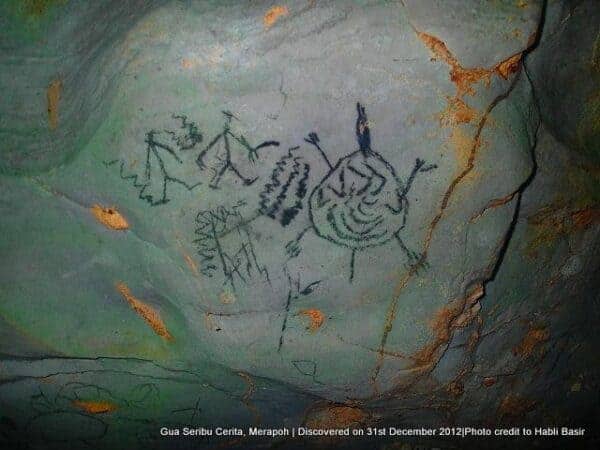
Rock art at Gua Seribu Cerita near Merapoh, Pahang. Photo: Habli Basir.

Six caves with drawings have been identified (Technical note: drawings=applied dry, paintings=applied using wet pigment). They are black in colour, which suggests charcoal, and if so might potentially be carbon dated. That said, black rock art in Southeast Asia tends to be more recent2, and some of the subjects depicted on the rock also suggest a recent time frame (perhaps in the last 200 years). The relative freshness of the rock art also suggests a young age. Of course, I haven’t been to the sites myself and I’m commenting off photographs so I could be wrong.

Black drawings are fairly common in Peninsular Malaysia, and they have been associated with the orang asli (literally, the original peoples) of Malaysia. Evans3, an early ethnographer observed orang asli in Perak creating similar drawings and they were described as drawing items that they saw in their daily lives. Black coloured rock art sites are fairly common in peninsular Malaysia and as far north as Southern Thailand, so the discovery of more sites is not surprising. In Pahang, two previously noted sites are Gua Kechil4 and Gua Luas5.

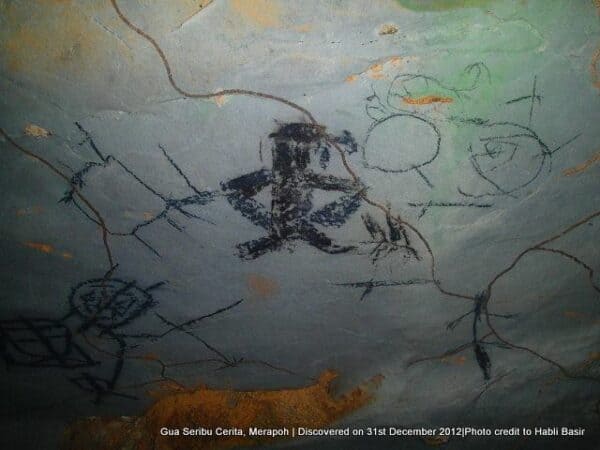
The first of these sites is named Gua Seribu Cerita (Cave of a Thousand Stories, quite poetic!), and is said to contain hundreds of drawings located over a number of panels throughout the cave. This site has quite a number of interesting pictoral elements.
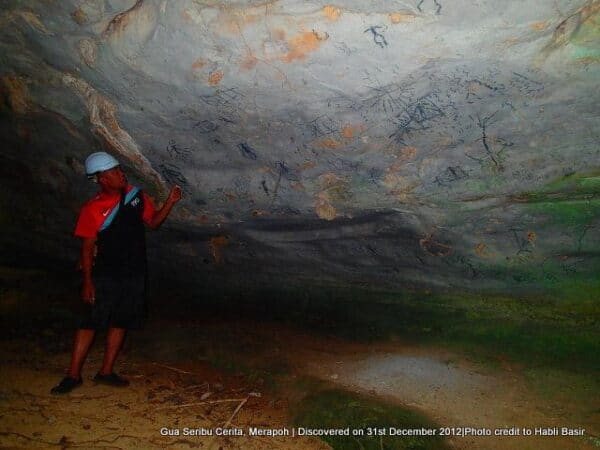
Gua Seribu Cerita. Photo: Habli Basir.

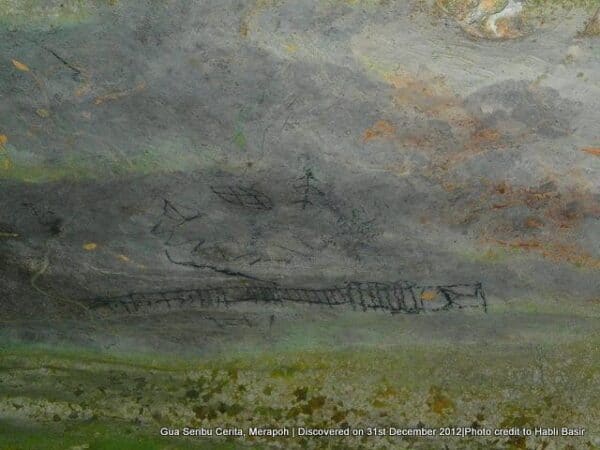
When taken in concert, some of the drawings suggest a fairly recent (maybe the last 100-200 years) creation date. Depictions of an ‘agricultural’ scene where a people are are standing in the middle of fields, which have been demarcated by a square look like farming of some sort. A series of lines at the bottom of another panel look like ‘train tracks’ – interestingly enough, the railway passes within a kilometre of the cave. Although there is no train depicted, there appears to be a person on the right side of the tracks where the tracks are incomplete – this could be a depiction of the track being laid, and hence possibly an event that can be dated! The last interesting element from this site is the depiction of a human figure with the hands-on-hips posture. This particular posture has been associated with colonial Europeans as an arrogant, domineering posture and has been noted in several other rock art sites inside and outside of Malaysia6.
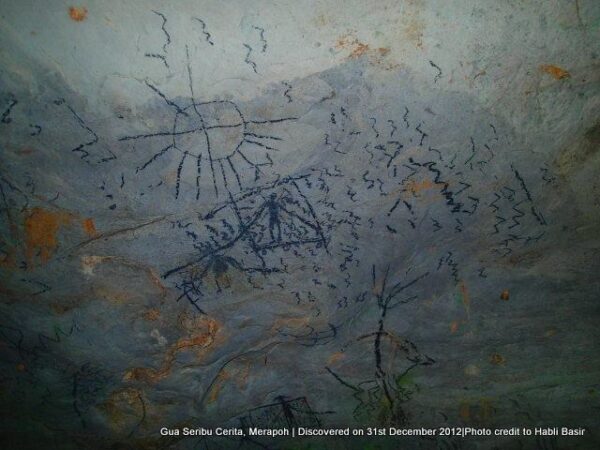
‘Agricultural’ scene at Gua Seribu Cerita. Photo: Habli Basir
‘Train Tracks’ at Gua Seribu Cerita. Photo: Habli Basir.


‘European figure’. Gua Seribu Cerita. Photo: Habli Basir

The ‘train tracks’, ‘European’ figure and to some extent the ‘agricultural scene’ all fit in nicely with a class of rock art called Contact Rock Art, which commonly refers to depictions of European colonialism by indigenous groups. Gua Badak in Perak also fits in with this type of rock art and the underlying idea here is that indigenous populations were drawing the novel. So while Evans noted that the Lenggong Negritos were drawing scenes from everyday life, these new people and technologies that came in where drawn in juxtaposition to the everyday and probably drawn because they were also so disruptive.

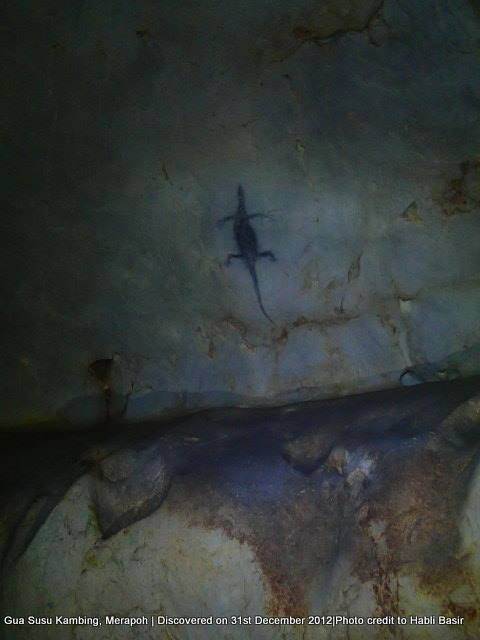
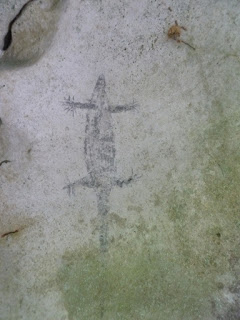
Other caves with rock art discovered in the area include Gua Gajah Gosok (Elephant Rubbing Cave), Gua Jambatan Batu (Stone Bridge Cave), Gua Lima (cave 5), Gua Susu Kambing (Goat’s Milk Cave) and Gua Jinjang Pelamin (Wedding Throne Cave7) the last two of which share the depiction of a ‘lizard’, the symbolism of which is yet to be known – group marker or hunting signal are possible explanations. It is not surprising that the rock art has been discovered as a cluster – it denotes that people have been using, and moving in and out of, these caves and they have a collective significance and function.
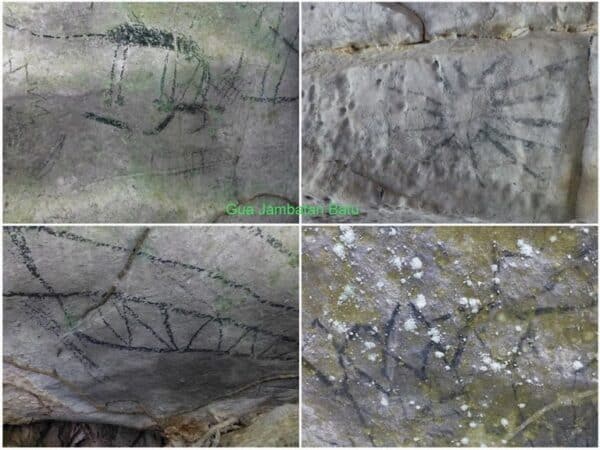
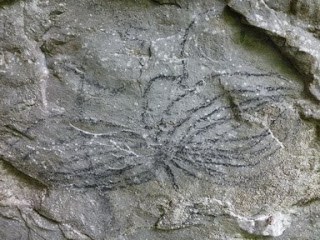
Gua Jambatan Batu. Photo: Liz Price.


Gua Lima. Photo: Liz Price
‘Lizard’ from Gua Susu Kambing. Photo: Habli Basir
Lizard’ figure from Gua Jinjang Pelamin. Photo: Liz Price

In rock art lingo, I’m describing these drawings in single quotes (‘train tracks’) to indicate they are my interpretations. They may not be the right meanings, or what the creators intended to depict, or they may even have multiple meanings! Such is the peril of interpreting rock art, and my role as a rock art researcher is to make sense of these of these drawings and what they tell us about the people who made them. If my interpretations are correct and the art is recent, there is a possibility that the creators of their art or their descendants still exist, and finding them and asking them about the art may shed light on their meaning. For more pictures of the rock art, check out Liz’s posts on her blog here and here.

1. Many thanks to Habli Basir and Liz Price, part of the caving team to the Merapoh Caves who have shared their photos with me for this post.
2. Tan, N. H. 2003. Rock Art Research in Southeast Asia: A Synthesis. (In preparation).
3. Evans, I. H. N. 1927. Negrito Cave Drawings at Lenggong, Upper Perak. Journal of the Federated Malayan States Museums, 12, 105-106.
4. Zulkfli Jaafar 2003. Ancient limestone landscapes of Malaysia: An archaeological insight, Kuala Lumpur, Department of Museums and Antiquities.
5. Abdul Latib Ariffin 1985. Penyelidikan Lukisan Lama di Gua Luas, Batu Luas (Kuala Kenyam), Ulu Tembeling, Pahang. Malayan Naturalist, 38, 38-43.
6. Mokhtar Saidin & Taçon, P. S. C. 2011. The recent rock drawings of the Lenggong Valley, Perak, Malaysia. Antiquity, 85, 459–475.
7. In an earlier translation attempt, Google Translate called it Necromancer’s Throne. Which is a much better name, IMO. Thanks to Nick Gani for the correction.

Subscribe to the weekly Southeast Asian Archaeology news digest

Latest Books

The following are affiliate links for which I may earn a commission if you click and make a purchase. Click here for more books about Southeast Asian archaeology.
Sale Malay Silver and Gold: Courtly Splendour from Indonesia, Malaysia, Singapore, Brunei and Thailand
Malay Silver and Gold: Courtly Splendour from...
Amazon Prime
$38.54
Buy on Amazon
Sale The Oxford Guide to the Malayo-Polynesian Languages of Southeast Asia (Oxford Guides to the World's Languages)
The Oxford Guide to the Malayo-Polynesian...
Amazon Prime
$165.87
Buy on Amazon
Sale Majapahit: Sculptures from a Forgotten Kingdom
Majapahit: Sculptures from a Forgotten Kingdom
$44.08
Buy on Amazon
Sale Majapahit: Intrigue, Betrayal and War in Indonesia’s Greatest Empire
Majapahit: Intrigue, Betrayal and War in...
Amazon Prime
$15.74
Buy on Amazon
Sale The Story of Southeast Asia
The Story of Southeast Asia
$24.11
Buy on Amazon
Buddhist Landscapes: Art and Archaeology of the Khorat Plateau, 7th to 11th Centuries
Buddhist Landscapes: Art and Archaeology of the...
Amazon Prime
$56.00
Buy on Amazon

Leave a Reply

Your email address will not be published. Required fields are marked *

I agree to the Terms & Conditions and Privacy Policy.

This site uses Akismet to reduce spam. Learn how your comment data is processed.

Southeast Asian Archaeology

© 2019

Navigate Site

  • News
  • Resources
  • Countries
  • Topics
  • Visit
  • Jobs
  • Subscribe
  • About

Follow

Never Miss a Discovery
Subscribe for Exclusive Southeast Asian Archaeology News!

Stay connected with the latest breakthroughs, research, and events from across Southeast Asia’s archaeology scene. Sign up today for exclusive weekly updates, trusted by over 2,000 subscribers.

×
No Result
View All Result
  • News
  • Resources
  • Countries
    • Southeast Asia
    • Mainland Southeast Asia
      • Cambodia
      • Laos
      • Malaysia
      • Myanmar
      • Thailand
      • Vietnam
    • Island Southeast Asia
      • Brunei
      • Indonesia
      • Malaysia
      • Philippines
      • Singapore
      • Timor Leste
    • Peripheral Southeast Asia
  • Topics
    • Artifact Type
      • Architecture
      • Bones and Burials
      • Ceramics
      • Intangible Cultural Heritage
      • Lithics
      • Megaliths
      • Rock Art
      • Sculpture
    • Field
      • Anthropology
      • Bioarchaeology
      • Epigraphy
      • General Archaeology
      • Metallurgy and Metalworking
      • Paleontology
      • Underwater Archaeology
      • Visual Art
      • Zooarchaeology
    • Other Themes
      • Animism
      • Buddhism
      • Christianity
      • Disaster Risk Management
      • Hinduism
      • Islam
      • Archaeological Tourism in Southeast Asia
  • Visit
    • Virtual Archaeology
    • Unesco World Heritage
  • Jobs
  • Subscribe
  • About
    • About
    • Supporters
    • Terms of Use
    • Privacy Policy
    • Contact

© 2019

This website uses cookies. By continuing to use this website you are giving consent to cookies being used. Visit our Privacy and Cookie Policy.