

![[Talk] The Ancient Town of Si Thep in Thailand: A Crossroads of Indianization](https://www.southeastasianarchaeology.com/wp-content/uploads/2024/07/the-ancient-town-of-si-thep-in-thailand-a-crossroads-of-indianization-502-120x86.jpg)


Readers may be interested in this talk by Theara Tun happening on 2 December.
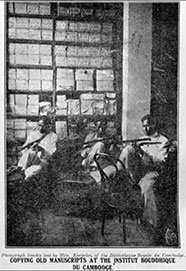
Similar to many other parts of Southeast Asia, ‘history’ in the present-day sense, as a field of analysis of past events related to human activities, including those related to ancient Cambodia, was not practised in Theravada Buddhist societies like Cambodia prior to the arrival of Western colonial rule. Instead, a literary tradition known as the ‘baṅsāvtār’ or ‘chronicle’ writing (called yazawin in Burmese and phoṅsāvdan in Thai and in Lao) was the most popular body of knowledge circulated within educated and religious circles. In Cambodia, the strengthening of French rule from the 1900s onwards allowed French colonial scholars to produce a great amount of scholarship dealing with Cambodia’s collective past, including its ancient Khmer Hindu-Buddhist heritage, which later played a hegemonic role in replacing the more traditional understanding. The colonial regime also initiated the establishment of institutions such as the Bibliothèque Royale (Royal Library) and l’Institut Bouddhique (the Buddhist Institute). These academic institutions played key roles in providing platforms for the emergence of several Cambodian individuals who engaged in the reproduction of French historiography and circulated it among Khmer readers. Given the important role of these Cambodian intellectuals, the main purpose of this presentation is to address the three categories of the epistemological transition in which the perceptions of the past initially shifted from those of the baṅsāvtār tradition to the newer history scholarship published and promoted by the colonial regime. These categories include an early form of local scholars’ engagement with French colonial scholarship, translating colonial versions of Cambodian history into Khmer, and the formulation of a new pravattisātr (a neologism for history) scholarship for Cambodia’s collective past. Capturing the dynamic of the epistemological transition allows us to highlight a broader picture of the interplay between a long-existing body of knowledge and more contemporary scholarship under Western colonisation.