• Angkor’s water system is famous for its scale: enormous reservoirs, long canals, and monumental engineering.⠀
⠀
New research by archaeologist Sarah Klassen highlights how Angkor’s agricultural system also depended on more than 1,000 local temple communities spread across the Greater Angkor Region. These communities helped organise labour, manage local water systems, and coordinate rice production - and suggests that Angkor’s success was built through a combination of top-down and bottom-up management.⠀
⠀
The state created the large hydraulic framework. Local communities adapted to it, expanded around it, and helped make the wider agricultural landscape function.⠀
⠀
Over time, however, this balance changed. Land and resources became increasingly concentrated, the system became more centralised, and some of the flexibility that had helped Angkor cope with earlier environmental stress may have been lost.⠀
⠀
Beyond its temples and kings, Angkor
  • New Evidence from the Southeast Asian Borderlands⠀
⠀
This week in Southeast Asian Archaeology: new dates, new methods, and some wonderfully untidy timelines.⠀
⠀
🪨 Uranium-thorium dating pushes the Mangguan rock paintings in Yunnan back to at least 4,220 years ago⠀
 🥁 AI-assisted restoration takes on damaged imagery on Guangxi bronze drums⠀
 🌾 New work at Angkor asks how infrastructure, local communities and water management shaped resilience⠀
 🗿 Lao-Australian fieldwork maps and excavates the enigmatic Hintang standing stones⠀
⠀
Plus archaeology and heritage news from across Southeast Asia, new research, opportunities, and more.⠀
⠀
I’ve also started experimenting with short visual explainers of new archaeology papers here on Instagram — so follow along if you like your archaeology with fewer footnotes and more pixels.⠀
⠀
Read the latest SEAArch newsletter via the link in bio.⠀
⠀
#Archaeology #SoutheastAsianArchaeology #SoutheastAsia #RockArt #Angkor #Laos #Yunnan #Heritage #ArchaeologicalResearch #DigitalHeritage
  • This week on Southeast Asian Archaeology: fish traps, tidal flats and maritime memory.⠀
⠀
The main story looks at tambek, stone tidal fish weirs on Bawean Island in Indonesia. A new study records 54 of these structures and shows how they reflect local knowledge of tides, fish behaviour, construction, ownership and coastal life.⠀
⠀
Also in the highlights:⠀
⠀
Bronze and Iron Age layers beneath Korat’s historic city wall⠀
Nguyễn-era military posts at Hải Vân Pass⠀
A reminder that coastal archaeology is not always shipwrecks and trade ceramics⠀
Sometimes the quieter story is sitting in the tidal flats, waiting for the water to go out.⠀
⠀
Read the full issue: https://bit.ly/4wkInNI ⠀
⠀
#SoutheastAsianArchaeology #Archaeology #Indonesia #Bawean #MaritimeHeritage #CulturalHeritage #Thailand #Vietnam #HeritageConservation #IslandArchaeology
  • How do you catch fish without a net, hook or boat?⠀
⠀
On Bawean Island in Indonesia’s Java Sea, coastal communities developed tambek: stone walls built across the intertidal zone that use the movement of the tides to trap fish.⠀
⠀
A new study by Dwi Kurnia Sandy and colleagues documents these remarkable structures through archaeological survey, drone photography, interviews, historical sources and mapping. The researchers recorded different forms of tambek, from relatively simple U-shaped structures to more elaborate V-shaped systems directing fish into enclosed spaces. Their locations were carefully chosen around productive coastal environments, particularly extensive intertidal zones and mangroves.⠀
⠀
But tambek were more than fishing equipment. They were also part of Bawean’s social landscape. Individual structures could belong to particular families, with ownership remembered and passed down across generations. Tambek could even be traded, while customary rules governed who could fish around them at different stages of the tide.⠀
⠀
Today, new tambek are no longer being built and many surviving structures are little used or abandoned. The researchers link their decline to modern fishing technologies, damage to reefs and mangroves, and the gradual loss of knowledge about how the structures were used and maintained. Some have even been dismantled, with their stones reused for coastal infrastructure.⠀
⠀
The study highlights how archaeology can document not only things from the distant past, but also traditional technologies and knowledge systems that are disappearing within living memory.⠀
⠀
📖 Sandy, D. K., et al. 2026. “Tambek as Traditional Fish Trapping Techniques: The Role of Stone Tidal Fish Weirs in Bawean Island Indonesia’s Maritime Culture.” Journal of Island and Coastal Archaeology.⠀
 DOI: 10.1080/15564894.2026.2703955⠀
⠀
#Archaeology #SoutheastAsianArchaeology #Indonesia #Bawean #MaritimeArchaeology #UnderwaterArchaeology #FishingHeritage #MaritimeHeritage #TraditionalKnowledge
  • Tiger bones. Blood-bound pigments. Temple walls. Digital museums.⠀
⠀
This week’s newsletter leads with two fascinating studies: evidence for Ice Age tigers living on Palawan, and research into blood-bearing mineral binders used in the Huashan rock art of southern China.⠀
⠀
Also inside: UNESCO decisions, Angkor conservation, Chăm heritage digitisation and the archaeology of wartime railways.⠀
⠀
Read Blood, Big Cats and Buffer Zones at the link in bio.⠀
⠀
#SoutheastAsianArchaeology #Archaeology #RockArt #Palawan #CulturalHeritage #MuseumStudies #AsianArchaeology
  • New issue out now — and it’s a bumper one.⠀
⠀
This week:⠀
Wat Phra Mahathat Woramahawihan becomes Thailand’s newest World Heritage Site; Fort Cornwallis and the Penang State Museum reopen with fresh questions about how colonial and local histories are told; and at Don Yai Thong, archaeologists continue the careful work of lifting fragile burials, gold ornaments and all.⠀
⠀
Also featuring Muna rock art, Angkor conservation, Butuan boats, Cham exhibitions, Bagan finds, and archaeology’s awkward cameo in South China Sea claims.⠀
⠀
Read via the link in bio.⠀
⠀
#SoutheastAsianArchaeology #Archaeology #WorldHeritage #Museum #CulturalHeritage #Thailand #Malaysia #Penang #Indonesia #Cambodia #Vietnam
  • This week in Southeast Asian Archaeology: Prambanan gets some renewed attention, Phimai Black pottery surfaces at Mun Bon Dam, and I’m taking a short break next week.⠀
⠀
The featured stories look at the new Indonesia–India conservation project at Prambanan, focusing on the temple complex’s ruined perwara shrines, and a striking Late Prehistoric find in northeast Thailand: a remarkably complete Phimai Black vessel discovered as water levels fell at Mun Bon Dam.⠀
⠀
Temples, pottery, reservoirs, and a little scheduled rest. Back again on 27 July.⠀
⠀
Read this week’s newsletter: [link in bio]⠀
⠀
#SoutheastAsianArchaeology #Archaeology #Heritage #Prambanan #Thailand #Indonesia #Cambodia #Vietnam #CulturalHeritage #Substack
  • Gold rings, bronze drums, ancient burials, and better ethics in bioarchaeology — this week’s Southeast Asian Archaeology newsletter is a two-week catch-up edition.⠀
⠀
The lead story comes from Don Yai Thong in Phetchaburi, Thailand, where excavations have revealed gold ornaments, bronze drums, burials, beads, pottery and more. One newly reported gold signet ring bears Brahmi script, raising interesting questions about status, ritual and long-distance connections in the region.⠀
⠀
Also featured: a new paper on ethical collaboration when working with human remains in Southeast Asia — a timely reminder that care, respect, training, authorship and local authority are all part of good archaeological practice.⠀
⠀
Read the latest issue through the link in bio.
  • Cobbles, Caves and Committees 🪨⛰️📜⠀
⠀
This week’s Southeast Asian Archaeology newsletter moves from UNESCO heritage diplomacy to synchrotron science in Malaysia’s Nenggiri Valley, and then back into deep time with Early Palaeolithic cobble tools from Cambodia’s Mekong terraces.⠀
⠀
Cover image: Wat Phra Mahathat, Nakhon Si Thammarat — because temple towers do improve most things.⠀
⠀
Read the latest issue at the link in bio.⠀
⠀
#SoutheastAsianArchaeology #Archaeology #Heritage #Cambodia #Malaysia #UNESCO #WatPhraMahathat #NakhonSiThammarat #CulturalHeritage
  • This week in Southeast Asian Archaeology: broken pots, painted hands, and returning relics.⠀
⠀
The main story is a new paper on Angkorian ceramics from Thala Borivat and Sambor, showing how Angkor’s eastern Mekong provinces were connected through roads, rivers, rapids and local choices — not one neat supply chain.⠀
⠀
Also featured: Tham Pha Mue in Laos opens to visitors, a site I studied and helped document; Cambodia welcomes the return of three sculptures from the US; plus updates from Bujang Valley, Mỹ Sơn and Bagan.⠀
⠀
Read this week’s issue: https://bit.ly/3QjsdVO ⠀
⠀
#SoutheastAsianArchaeology #Angkor #Cambodia #Laos #RockArt #Archaeology #Heritage #Mekong
Wednesday, August 19, 2026
Southeast Asian Archaeology
  • News
  • Resources
  • Countries
    • Southeast Asia
    • Mainland Southeast Asia
      • Cambodia
      • Laos
      • Malaysia
      • Myanmar
      • Thailand
      • Vietnam
    • Island Southeast Asia
      • Brunei
      • Indonesia
      • Malaysia
      • Philippines
      • Singapore
      • Timor Leste
    • Peripheral Southeast Asia
  • Topics
    • Artifact Type
      • Architecture
      • Bones and Burials
      • Ceramics
      • Intangible Cultural Heritage
      • Lithics
      • Megaliths
      • Rock Art
      • Sculpture
    • Field
      • Anthropology
      • Bioarchaeology
      • Epigraphy
      • General Archaeology
      • Metallurgy and Metalworking
      • Paleontology
      • Underwater Archaeology
      • Visual Art
      • Zooarchaeology
    • Other Themes
      • Animism
      • Buddhism
      • Christianity
      • Disaster Risk Management
      • Hinduism
      • Islam
      • Archaeological Tourism in Southeast Asia
  • Visit
    • Virtual Archaeology
    • Unesco World Heritage
  • Jobs
  • Subscribe
  • About
    • About
    • Supporters
    • Terms of Use
    • Privacy Policy
    • Contact
No Result
View All Result
Southeast Asian Archaeology
  • News
  • Resources
  • Countries
    • Southeast Asia
    • Mainland Southeast Asia
      • Cambodia
      • Laos
      • Malaysia
      • Myanmar
      • Thailand
      • Vietnam
    • Island Southeast Asia
      • Brunei
      • Indonesia
      • Malaysia
      • Philippines
      • Singapore
      • Timor Leste
    • Peripheral Southeast Asia
  • Topics
    • Artifact Type
      • Architecture
      • Bones and Burials
      • Ceramics
      • Intangible Cultural Heritage
      • Lithics
      • Megaliths
      • Rock Art
      • Sculpture
    • Field
      • Anthropology
      • Bioarchaeology
      • Epigraphy
      • General Archaeology
      • Metallurgy and Metalworking
      • Paleontology
      • Underwater Archaeology
      • Visual Art
      • Zooarchaeology
    • Other Themes
      • Animism
      • Buddhism
      • Christianity
      • Disaster Risk Management
      • Hinduism
      • Islam
      • Archaeological Tourism in Southeast Asia
  • Visit
    • Virtual Archaeology
    • Unesco World Heritage
  • Jobs
  • Subscribe
  • About
    • About
    • Supporters
    • Terms of Use
    • Privacy Policy
    • Contact
No Result
View All Result
Southeast Asian Archaeology
No Result
View All Result
ADVERTISEMENT

Related Posts

Source: Bao Hoa Binh 20240725

Preserving the Cultural Heritage of Muong Gongs in Hoa Binh

30 July 2024
0
25

...

Source: The Debrief 20240727

51,200-Year-Old Sulawesi Cave Art: Hominin or Human?

29 July 2024
0
147

...

The Great Cave of Niah in Sarawak

Malaysia’s Niah Caves Added to World Heritage List

28 July 2024 - Updated on 31 July 2024
0
77

...

Source: The Nation 20240727

Phu Prabat Historical Park Joins UNESCO World Heritage List

28 July 2024 - Updated on 29 July 2024
0
125

...

Popular This Week

  • The most influential books on Southeast Asian Archaeology (a crowdsourced list)

    The most influential books on Southeast Asian Archaeology (a crowdsourced list)

    0 shares
    Share 0 Tweet 0
  • Southeast Asian Archaeology from a Rock Art Perspective (with annotations)

    0 shares
    Share 0 Tweet 0
  • Southeast Asian Archaeology memes that will tickle your funny bone and also make you ponder

    68 shares
    Share 68 Tweet 0
  • Negritos or Malays: Who are the original inhabitants of the Philippines?

    2 shares
    Share 2 Tweet 0
  • An archaeological region older than Angkor Wat

    1 shares
    Share 1 Tweet 0
Buy me a coffeeBuy me a coffee

If you found this site useful, you can help support it by buying me a coffee!

Rock art from Merapoh, Pahang

16 October 2013
in Malaysia
Tags: indigenous peoplesMerapoh (town)Mokhtar Saidin (person)Orang Asli (people)Pahang (state)rock art
0
SHARES
512
VIEWS
Rock art from Merapoh, Pahang

In the last year, a group of cavers1 have been exploring the limestone caves near Merapoh, in Pahang, Malaysia. In their survey of about a 100 caves, they have discovered a number with drawings in them and they have asked me to comment on them.
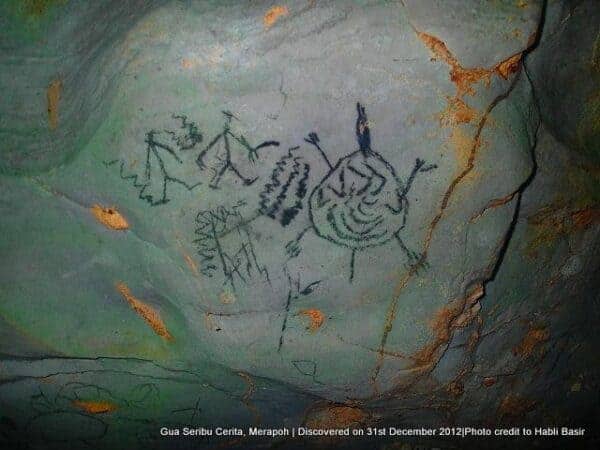
Rock art at Gua Seribu Cerita near Merapoh, Pahang. Photo: Habli Basir.

Six caves with drawings have been identified (Technical note: drawings=applied dry, paintings=applied using wet pigment). They are black in colour, which suggests charcoal, and if so might potentially be carbon dated. That said, black rock art in Southeast Asia tends to be more recent2, and some of the subjects depicted on the rock also suggest a recent time frame (perhaps in the last 200 years). The relative freshness of the rock art also suggests a young age. Of course, I haven’t been to the sites myself and I’m commenting off photographs so I could be wrong.

Black drawings are fairly common in Peninsular Malaysia, and they have been associated with the orang asli (literally, the original peoples) of Malaysia. Evans3, an early ethnographer observed orang asli in Perak creating similar drawings and they were described as drawing items that they saw in their daily lives. Black coloured rock art sites are fairly common in peninsular Malaysia and as far north as Southern Thailand, so the discovery of more sites is not surprising. In Pahang, two previously noted sites are Gua Kechil4 and Gua Luas5.

The first of these sites is named Gua Seribu Cerita (Cave of a Thousand Stories, quite poetic!), and is said to contain hundreds of drawings located over a number of panels throughout the cave. This site has quite a number of interesting pictoral elements.
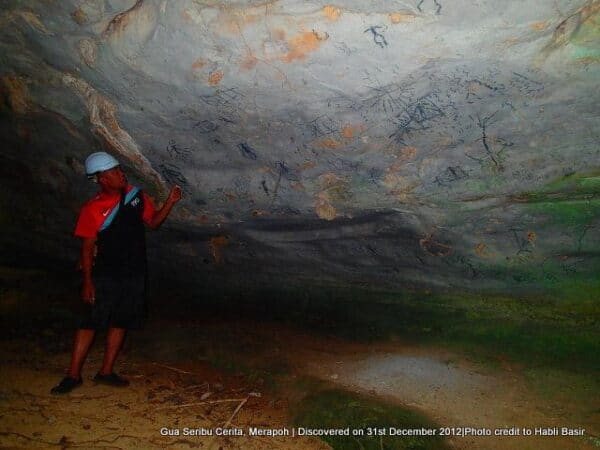
Gua Seribu Cerita. Photo: Habli Basir.

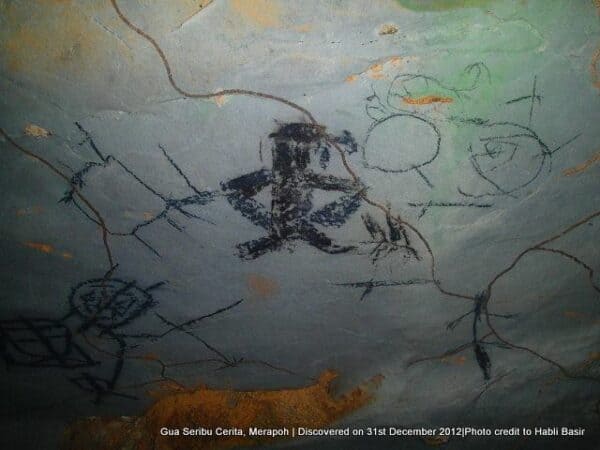
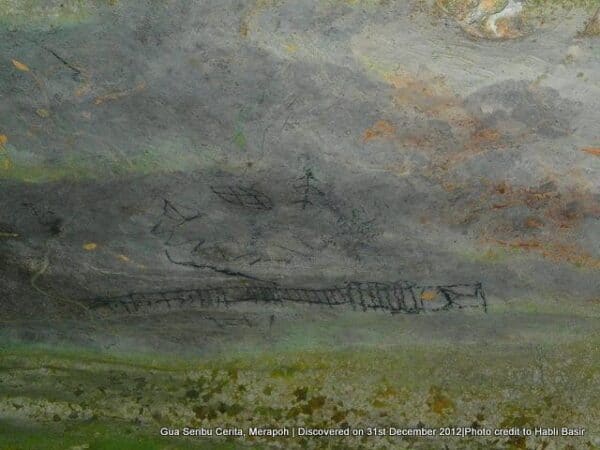
When taken in concert, some of the drawings suggest a fairly recent (maybe the last 100-200 years) creation date. Depictions of an ‘agricultural’ scene where a people are are standing in the middle of fields, which have been demarcated by a square look like farming of some sort. A series of lines at the bottom of another panel look like ‘train tracks’ – interestingly enough, the railway passes within a kilometre of the cave. Although there is no train depicted, there appears to be a person on the right side of the tracks where the tracks are incomplete – this could be a depiction of the track being laid, and hence possibly an event that can be dated! The last interesting element from this site is the depiction of a human figure with the hands-on-hips posture. This particular posture has been associated with colonial Europeans as an arrogant, domineering posture and has been noted in several other rock art sites inside and outside of Malaysia6.
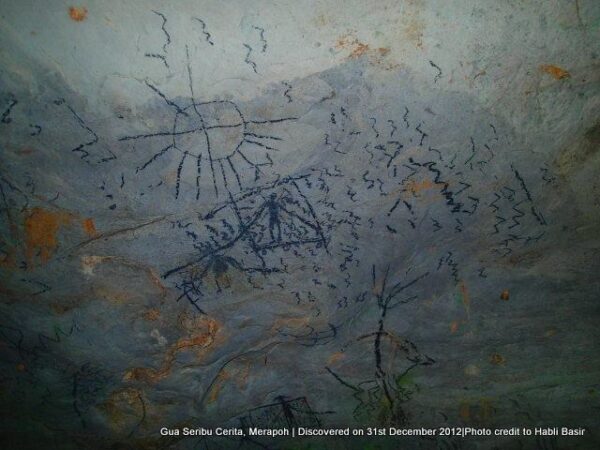
‘Agricultural’ scene at Gua Seribu Cerita. Photo: Habli Basir
‘Train Tracks’ at Gua Seribu Cerita. Photo: Habli Basir.


‘European figure’. Gua Seribu Cerita. Photo: Habli Basir

The ‘train tracks’, ‘European’ figure and to some extent the ‘agricultural scene’ all fit in nicely with a class of rock art called Contact Rock Art, which commonly refers to depictions of European colonialism by indigenous groups. Gua Badak in Perak also fits in with this type of rock art and the underlying idea here is that indigenous populations were drawing the novel. So while Evans noted that the Lenggong Negritos were drawing scenes from everyday life, these new people and technologies that came in where drawn in juxtaposition to the everyday and probably drawn because they were also so disruptive.

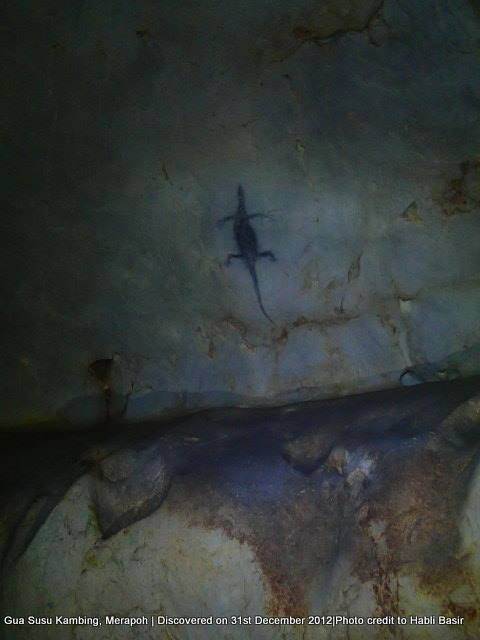
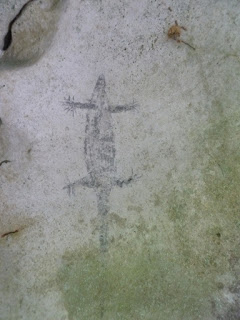
Other caves with rock art discovered in the area include Gua Gajah Gosok (Elephant Rubbing Cave), Gua Jambatan Batu (Stone Bridge Cave), Gua Lima (cave 5), Gua Susu Kambing (Goat’s Milk Cave) and Gua Jinjang Pelamin (Wedding Throne Cave7) the last two of which share the depiction of a ‘lizard’, the symbolism of which is yet to be known – group marker or hunting signal are possible explanations. It is not surprising that the rock art has been discovered as a cluster – it denotes that people have been using, and moving in and out of, these caves and they have a collective significance and function.
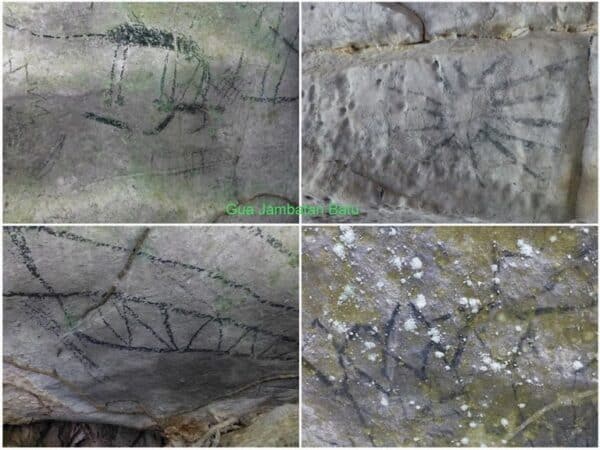
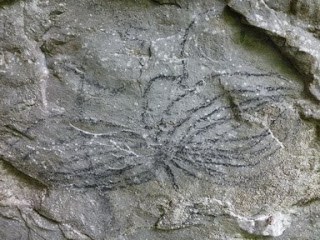
Gua Jambatan Batu. Photo: Liz Price.


Gua Lima. Photo: Liz Price
‘Lizard’ from Gua Susu Kambing. Photo: Habli Basir
Lizard’ figure from Gua Jinjang Pelamin. Photo: Liz Price

In rock art lingo, I’m describing these drawings in single quotes (‘train tracks’) to indicate they are my interpretations. They may not be the right meanings, or what the creators intended to depict, or they may even have multiple meanings! Such is the peril of interpreting rock art, and my role as a rock art researcher is to make sense of these of these drawings and what they tell us about the people who made them. If my interpretations are correct and the art is recent, there is a possibility that the creators of their art or their descendants still exist, and finding them and asking them about the art may shed light on their meaning. For more pictures of the rock art, check out Liz’s posts on her blog here and here.

1. Many thanks to Habli Basir and Liz Price, part of the caving team to the Merapoh Caves who have shared their photos with me for this post.
2. Tan, N. H. 2003. Rock Art Research in Southeast Asia: A Synthesis. (In preparation).
3. Evans, I. H. N. 1927. Negrito Cave Drawings at Lenggong, Upper Perak. Journal of the Federated Malayan States Museums, 12, 105-106.
4. Zulkfli Jaafar 2003. Ancient limestone landscapes of Malaysia: An archaeological insight, Kuala Lumpur, Department of Museums and Antiquities.
5. Abdul Latib Ariffin 1985. Penyelidikan Lukisan Lama di Gua Luas, Batu Luas (Kuala Kenyam), Ulu Tembeling, Pahang. Malayan Naturalist, 38, 38-43.
6. Mokhtar Saidin & Taçon, P. S. C. 2011. The recent rock drawings of the Lenggong Valley, Perak, Malaysia. Antiquity, 85, 459–475.
7. In an earlier translation attempt, Google Translate called it Necromancer’s Throne. Which is a much better name, IMO. Thanks to Nick Gani for the correction.

Subscribe to the weekly Southeast Asian Archaeology news digest

Latest Books

The following are affiliate links for which I may earn a commission if you click and make a purchase. Click here for more books about Southeast Asian archaeology.
Sale Malay Silver and Gold: Courtly Splendour from Indonesia, Malaysia, Singapore, Brunei and Thailand
Malay Silver and Gold: Courtly Splendour from...
Amazon Prime
$38.54
Buy on Amazon
Sale The Oxford Guide to the Malayo-Polynesian Languages of Southeast Asia (Oxford Guides to the World's Languages)
The Oxford Guide to the Malayo-Polynesian...
Amazon Prime
$165.87
Buy on Amazon
Sale Majapahit: Sculptures from a Forgotten Kingdom
Majapahit: Sculptures from a Forgotten Kingdom
$44.08
Buy on Amazon
Sale Majapahit: Intrigue, Betrayal and War in Indonesia’s Greatest Empire
Majapahit: Intrigue, Betrayal and War in...
Amazon Prime
$15.74
Buy on Amazon
Sale The Story of Southeast Asia
The Story of Southeast Asia
$24.11
Buy on Amazon
Buddhist Landscapes: Art and Archaeology of the Khorat Plateau, 7th to 11th Centuries
Buddhist Landscapes: Art and Archaeology of the...
Amazon Prime
$56.00
Buy on Amazon

Leave a Reply

Your email address will not be published. Required fields are marked *

I agree to the Terms & Conditions and Privacy Policy.

This site uses Akismet to reduce spam. Learn how your comment data is processed.

Southeast Asian Archaeology

© 2019

Navigate Site

  • News
  • Resources
  • Countries
  • Topics
  • Visit
  • Jobs
  • Subscribe
  • About

Follow

Never Miss a Discovery
Subscribe for Exclusive Southeast Asian Archaeology News!

Stay connected with the latest breakthroughs, research, and events from across Southeast Asia’s archaeology scene. Sign up today for exclusive weekly updates, trusted by over 2,000 subscribers.

×
No Result
View All Result
  • News
  • Resources
  • Countries
    • Southeast Asia
    • Mainland Southeast Asia
      • Cambodia
      • Laos
      • Malaysia
      • Myanmar
      • Thailand
      • Vietnam
    • Island Southeast Asia
      • Brunei
      • Indonesia
      • Malaysia
      • Philippines
      • Singapore
      • Timor Leste
    • Peripheral Southeast Asia
  • Topics
    • Artifact Type
      • Architecture
      • Bones and Burials
      • Ceramics
      • Intangible Cultural Heritage
      • Lithics
      • Megaliths
      • Rock Art
      • Sculpture
    • Field
      • Anthropology
      • Bioarchaeology
      • Epigraphy
      • General Archaeology
      • Metallurgy and Metalworking
      • Paleontology
      • Underwater Archaeology
      • Visual Art
      • Zooarchaeology
    • Other Themes
      • Animism
      • Buddhism
      • Christianity
      • Disaster Risk Management
      • Hinduism
      • Islam
      • Archaeological Tourism in Southeast Asia
  • Visit
    • Virtual Archaeology
    • Unesco World Heritage
  • Jobs
  • Subscribe
  • About
    • About
    • Supporters
    • Terms of Use
    • Privacy Policy
    • Contact

© 2019

This website uses cookies. By continuing to use this website you are giving consent to cookies being used. Visit our Privacy and Cookie Policy.