
• Boats, pots, and prehistoric know-how this week at Southeast Asian Archaeology.⠀
⠀
In the new newsletter:⠀
🛶 outrigger boat motifs in Sulawesi rock art⠀
🏺 new perspectives on pottery in Timor-Leste⠀
👑 the restored Nguyen Dynasty throne⠀
🎟️ falling ticket sales at Angkor⠀
⚖️ a new book on archaeology and Philippine law⠀
⠀
#Archaeology #SoutheastAsia #Heritage #RockArt #TimorLeste #Indonesia
  • Brunei’s archaeology does not get nearly enough attention.⠀
⠀
For this bonus post, I’m looking at Kota Batu Archaeological Park, the site of Brunei’s old capital. It is not a spectacular ruin in the usual sense — no towering temples, no monumental gateways — but its fragments tell a fascinating story: tombs, ceramics, sandstone pillar bases, river defences, house posts, imported wares, and traces of a working port city.⠀
⠀
Kota Batu shows Brunei not as a quiet corner of Southeast Asian archaeology, but as part of the maritime world that linked Borneo with China, Vietnam, Thailand, the Philippines and beyond.
  • This week’s Southeast Asian Archaeology newsletter is about movement, adaptation, and why archaeology is rarely as tidy as we pretend.⠀
⠀
Inside:⠀
🏹 a new review of bow-and-arrow evidence from India to Oceania⠀
🪙 a study of how Roman materials were filtered and remade in Southeast Asia⠀
🌊 new work on maritime links between Angkor and China during the megadrought period⠀
⠀
Also this week: Angkor palace waterworks, the Cẩm An shipwreck, and the reopening of Phimai National Museum.⠀
⠀
Link in bio / https://bit.ly/4dV88wS ⠀
#SoutheastAsianArchaeology #Archaeology #Heritage #Angkor #Vietnam #Thailand #Cambodia #AncientTrade #MaritimeArchaeology
  • New this week in Southeast Asian Archaeology: the Plain of Jars, trade beads, burial rituals, Philippine obsidian, coastal watchtowers, public archaeology, and a museum rethink of the galleon trade.⠀
⠀
The lead story is a new paper from Laos, where one huge jar at Site 75 contained the remains of at least 37 people and hints at a long, careful mortuary tradition. From there, the issue moves across the region, with a particularly strong run of stories from the Philippines on exchange networks, local histories, and the stories archaeology tells in public.⠀
⠀
Jars, beads, boats, and the occasional inconvenient fact. https://bit.ly/3RqKWyW ⠀
⠀
#SoutheastAsianArchaeology #Archaeology #Heritage #Laos #Philippines #Museums #PublicHistory
  • This week: Đồng Dương, ancient Champa, broken bricks, border temples, Buddhist architecture on the move, and a reminder that archaeology is rarely just about the past.⠀
⠀
Link in bio / read here: https://bit.ly/4ePHSpL ⠀
⠀
#SoutheastAsianArchaeology #DongDuong #Champa #Vietnam #Cambodia #Thailand #Myanmar #Archaeology #Heritage
  • This week in Southeast Asian Archaeology: a remarkable burial find in Phetchaburi, an old perahu under review in Kelantan, and the Po Nagar festival in Vietnam as a case of living heritage in action. ⠀
⠀
https://bit.ly/48PAeI5 ⠀
⠀
#archaeology #southeastAsia #southeastasianarchaeology
  • The Ayala Museum’s Gold of Ancestors exhibition showcases over a thousand gold objects, many originating from Butuan and the Surigao Treasure and generally dated to the 10th–13th centuries CE. These pieces demonstrate the Philippines’ participation in extensive regional trade networks and the high level of craftsmanship achieved before Spanish colonisation.

#southeastasianarchaeology #philippines #ayalamuseum #surigao #butuan
  • A quick visit to the National Museum of the Philippines earlier this week, particularly to the National Museum of Anthropology. Here are my 5 highlights.

Have you been to the National Museum in Manila? What are your favourite pieces?

#manila #philippines #nationalmuseum #archaeology #southeastasianarchaeology
  • From Angkor wall repairs and Óc Eo museum plans to Preah Vihear restoration politics and Sulawesi cliff burials, this week’s newsletter rounds up Southeast Asian archaeology with context. Subscribe for the stories behind the headlines.

https://bit.ly/4w8870M
  • 20 years ago I started Southeast Asian Archaeology with a few blog posts.⠀
It somehow turned into a weekly newsletter read around the world.⠀
Reflections, AMA, and what readers want next: ⠀
https://bit.ly/4cNZVKi⠀
Tuesday, June 9, 2026
Southeast Asian Archaeology
  • News
  • Resources
  • Countries
    • Southeast Asia
    • Mainland Southeast Asia
      • Cambodia
      • Laos
      • Malaysia
      • Myanmar
      • Thailand
      • Vietnam
    • Island Southeast Asia
      • Brunei
      • Indonesia
      • Malaysia
      • Philippines
      • Singapore
      • Timor Leste
    • Peripheral Southeast Asia
  • Topics
    • Artifact Type
      • Architecture
      • Bones and Burials
      • Ceramics
      • Intangible Cultural Heritage
      • Lithics
      • Megaliths
      • Rock Art
      • Sculpture
    • Field
      • Anthropology
      • Bioarchaeology
      • Epigraphy
      • General Archaeology
      • Metallurgy and Metalworking
      • Paleontology
      • Underwater Archaeology
      • Visual Art
      • Zooarchaeology
    • Other Themes
      • Animism
      • Buddhism
      • Christianity
      • Disaster Risk Management
      • Hinduism
      • Islam
      • Archaeological Tourism in Southeast Asia
  • Visit
    • Virtual Archaeology
    • Unesco World Heritage
  • Jobs
  • Subscribe
  • About
    • About
    • Supporters
    • Terms of Use
    • Privacy Policy
    • Contact
No Result
View All Result
Southeast Asian Archaeology
  • News
  • Resources
  • Countries
    • Southeast Asia
    • Mainland Southeast Asia
      • Cambodia
      • Laos
      • Malaysia
      • Myanmar
      • Thailand
      • Vietnam
    • Island Southeast Asia
      • Brunei
      • Indonesia
      • Malaysia
      • Philippines
      • Singapore
      • Timor Leste
    • Peripheral Southeast Asia
  • Topics
    • Artifact Type
      • Architecture
      • Bones and Burials
      • Ceramics
      • Intangible Cultural Heritage
      • Lithics
      • Megaliths
      • Rock Art
      • Sculpture
    • Field
      • Anthropology
      • Bioarchaeology
      • Epigraphy
      • General Archaeology
      • Metallurgy and Metalworking
      • Paleontology
      • Underwater Archaeology
      • Visual Art
      • Zooarchaeology
    • Other Themes
      • Animism
      • Buddhism
      • Christianity
      • Disaster Risk Management
      • Hinduism
      • Islam
      • Archaeological Tourism in Southeast Asia
  • Visit
    • Virtual Archaeology
    • Unesco World Heritage
  • Jobs
  • Subscribe
  • About
    • About
    • Supporters
    • Terms of Use
    • Privacy Policy
    • Contact
No Result
View All Result
Southeast Asian Archaeology
No Result
View All Result
ADVERTISEMENT

Related Posts

Source: Free Malaysia Today 20240725

Kedah’s 1200-Year-Old Buddha Statue Rewrites History

26 July 2024
0
190

...

Source: Vietnam Net 20240715

Mystery of 400-Year-Old Muong Tombs in Vietnam

19 July 2024
0
86

...

Bat Chum Temple. Source: Khmer Times 20240614

APSARA Begins 5th Phase of Bat Chum Temple Restoration

17 June 2024 - Updated on 18 June 2024
0
12

...

Source: The Conversation 20240610

Can AI Crack the Singapore Stone’s Undeciphered Writing?

12 June 2024
0
97

...

Popular This Week

  • Southeast Asian Archaeology from a Rock Art Perspective (with annotations)

    Southeast Asian Archaeology from a Rock Art Perspective (with annotations)

    0 shares
    Share 0 Tweet 0
  • Southeast Asian Archaeology memes that will tickle your funny bone and also make you ponder

    68 shares
    Share 68 Tweet 0
  • The most influential books on Southeast Asian Archaeology (a crowdsourced list)

    0 shares
    Share 0 Tweet 0
  • Yamashita Gold: Myth vs. Archaeological Reality

    0 shares
    Share 0 Tweet 0
  • Negritos or Malays: Who are the original inhabitants of the Philippines?

    2 shares
    Share 2 Tweet 0
Buy me a coffeeBuy me a coffee

If you found this site useful, you can help support it by buying me a coffee!

Karimun Inscription

15 April 2007
in Indonesia
Tags: BuddhismDevanegari scriptepigraphyfootprintinscriptionJohn Miksic (person)Karimun (island)Karimun Inscription (site)Mahayana BuddhismMalay Annals / Sulalatus Salatin (literary work)Pallava Grantha ScriptquarrySrivijaya (kingdom)
0
SHARES
486
VIEWS
Karimun Inscription


Over the weekend, I made a trip to nearby Karimun Island, some 30 km west of Singapore in search of an ancient stone inscription.
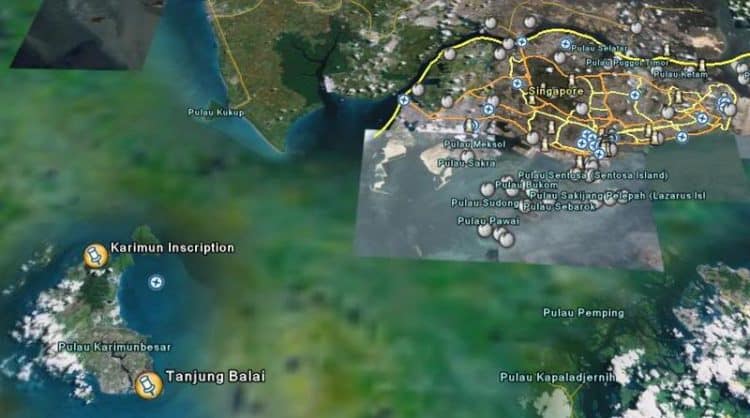
The island of Karimun Besar (Greater Karimun) is a croissant-shaped island resting at the end of the Melaka strait – a great strategic position because from the north shore one can see Sumatra at the left and the Malay Peninsula in the right. In fact, the British once considered setting up base there because of its location – but Raffles opted instead for Singapore with the romantic notion of resurrecting the civilization (Temasek) that was mentioned in the Malay Annals.

I read about the inscription a long time ago, and was recently reminded by it when I attended a short course on the archaeology of Singapore. Dr. John Miksic, the course conductor, mentioned the Karimun inscription and inspired me to take a trip down to look for it. Finding the inscription was the tricky part, however. Dr Miksic mentioned visiting the place almost 20 years ago, so I was working with 20-year-old information. The only lead I had was that it must have laid on the north shore of the island, possibly by a beach. Locating the stone was also compounded by the fact that Karimun of late was mired in some tension over importing granite to Singapore – and that the granite quarry was also in the north side of the island.

So I was rather fortunate to have met with Tres, one of the taxi drivers who aggressively touted visitors to Karimun. For something like S$30, Tres would drive my party of three up to the northern Pasir Panjang beach. When he found out that we were looking for the stone inscription, he told us that he knew where it was and offered to drive us directly there.

It was a good thing he did – as it turns out the inscription was, as feared, inside the grounds of the granite quarry. We had to pass through two security checkpoints, as well as surrender our cameras at the second checkpoint where we continued on foot. Our guide was good to his word when he led us to a shed 100 metres away from the security post – the stone inscription was carved on the side of a large granite hill, in an area of about 3 metres by 3 metres. At a distance, trucks rumbled carrying workers and granite. The area around the inscription was fairly untouched and protected – a small wall, fence and roof were erected over the inscription, and the presence of incense offerings also indicated that the place was venerated as a shrine. There was even a government notice that indicated the inscription was protected.

(Yes, I snuck my phone camera in.) I think the current worshippers at the shrine are Sikhs, judging from the images placed at the shrine. This is quite strange, considering that the inscription was probably written by a Buddhist author:

According to Dr. Miksic, the inscription is written in Devanegari script and dates to the 9th or 10th century AD. It reads, “These are the footsteps of the illustrious Gautama the Mahayana Buddhist who possessed a round instrument.” Which was why I found it strange that it has become a site of Sikh veneration. Dr. Miksic also noted that the characters that formed the word “round instrument” are unique – they are not found in any other Indian inscription anywhere in the world. When I got home, I merged the two photos in photoshop-cleanup for better clarity:

What about the footprints that our illustrious Gautama left behind? At first, I thought it was the rounded depressions on the side of the hill beside the shrine. But Tres our guide came to the rescue again, pointing us to the footprint at the foot of the hill, 20 feet away.

The footprint was carved in the rock, but was partly covered by sand which was also wet. As a result, we couldn’t see if there were carvings at the bottom, but we managed to scoop out enough water to see the outline of the foot. Maybe the task for the next time I visit?

Related Books:
The article on Malaysia in Southeast Asia: From Prehistory to History by I. Glover and P. S. Bellwood (Eds) mentions the Karimun inscription but not much else.

Subscribe to the weekly Southeast Asian Archaeology news digest

Latest Books

The following are affiliate links for which I may earn a commission if you click and make a purchase. Click here for more books about Indonesian archaeology.
Sale Patterned Splendour: Textiles Presented on Javanese Metal and Stone Sculptures; Eighth to Fifteenth Century
Patterned Splendour: Textiles Presented on...
Amazon Prime
$30.54
Buy on Amazon
Sale Majapahit: Sculptures from a Forgotten Kingdom
Majapahit: Sculptures from a Forgotten Kingdom
$44.08
Buy on Amazon
Sale Little Species, Big Mystery: The Story of Homo Floresiensis
Little Species, Big Mystery: The Story of Homo...
Amazon Prime
$26.53
Buy on Amazon
Sale Majapahit: Intrigue, Betrayal and War in Indonesia’s Greatest Empire
Majapahit: Intrigue, Betrayal and War in...
Amazon Prime
$15.74
Buy on Amazon
Seaways and Gatekeepers: Trade and State in the Eastern Archipelagos of Southeast Asia, c.1600–c.1906
Seaways and Gatekeepers: Trade and State in the...
Amazon Prime
$46.00
Buy on Amazon
Heroes, Gods and Guardians: Hilts and Keris of Indonesia, Huntington Miller Collection
Heroes, Gods and Guardians: Hilts and Keris of...
Buy on Amazon

Comments 8

  1. liz says:
    19 years ago

    Glad to read that you found the inscription. Seems that luck was on your side, finding a taxi driver who could take you right to the site. Do you know how old the inscriptions are?
    It’s worrying that the inscriptions are now located inside a quarry. How far away are they blasting? Let’s hope they don’t get destroyed.

  2. noelbynature says:
    19 years ago

    Ah, i forgot to mention the age of the script! According to Dr Miksic, they date to about 9th to 10th century. Yes, I was really lucky to have met up with Tres, the taxi driver. I might employ him again if I visit there again – there are a couple of other sites he pointed out that might be ointerest,one being “Kubor Badang”, or the grave of Badang who I assume is the grace of the legendary strongman named in the Malay Annals. The site itself seems fairly safe – it looks like it’s become a shrine now that is still in use. There is a fair amount of traffic in front of the site – I think the blasting takes place deeper inside from where I was at.

  3. charles says:
    18 years ago

    i am taking a tri[p to karimun today could you please sms or email me directions to the stone please! i am an artist and would like to see the inscriptions.

  4. charles says:
    18 years ago

    apparently the quarry site closed down. just got back from yesterday in karimun

  5. noelbynature says:
    18 years ago

    Hi Charles!

    I was wondering about your expedition. Did you even manage to see the inscription then? It was very near the entrance.

  6. charles says:
    18 years ago

    no i didn’t make it to that quarry . next time!

  7. cinta kumara says:
    18 years ago

    Oh, thanks so much for the information. Actually now Im trying to do research on Buddhist inscriptions in Indonesia.

  8. Peter Jalal says:
    11 years ago

    Hi, I have been bringing Students and Teachers from Singapore to Karimun Island since 1998. Information that I got from the people and the ministry of Tourism is totally different from what is mention about the inscription. There is no issues for bringing in Cameras for photo taking, we just need to ensure the Security Guards that we will only be taking photos of the inscription and not the Granite Quarry. Furthermore, the Sikhs claim that the writings are in Sanskrit and that’s the reason they visit the site often…. !

Leave a Reply

Your email address will not be published. Required fields are marked *

I agree to the Terms & Conditions and Privacy Policy.

This site uses Akismet to reduce spam. Learn how your comment data is processed.

Southeast Asian Archaeology

© 2019

Navigate Site

  • News
  • Resources
  • Countries
  • Topics
  • Visit
  • Jobs
  • Subscribe
  • About

Follow

Never Miss a Discovery
Subscribe for Exclusive Southeast Asian Archaeology News!

Stay connected with the latest breakthroughs, research, and events from across Southeast Asia’s archaeology scene. Sign up today for exclusive weekly updates, trusted by over 2,000 subscribers.

×
No Result
View All Result
  • News
  • Resources
  • Countries
    • Southeast Asia
    • Mainland Southeast Asia
      • Cambodia
      • Laos
      • Malaysia
      • Myanmar
      • Thailand
      • Vietnam
    • Island Southeast Asia
      • Brunei
      • Indonesia
      • Malaysia
      • Philippines
      • Singapore
      • Timor Leste
    • Peripheral Southeast Asia
  • Topics
    • Artifact Type
      • Architecture
      • Bones and Burials
      • Ceramics
      • Intangible Cultural Heritage
      • Lithics
      • Megaliths
      • Rock Art
      • Sculpture
    • Field
      • Anthropology
      • Bioarchaeology
      • Epigraphy
      • General Archaeology
      • Metallurgy and Metalworking
      • Paleontology
      • Underwater Archaeology
      • Visual Art
      • Zooarchaeology
    • Other Themes
      • Animism
      • Buddhism
      • Christianity
      • Disaster Risk Management
      • Hinduism
      • Islam
      • Archaeological Tourism in Southeast Asia
  • Visit
    • Virtual Archaeology
    • Unesco World Heritage
  • Jobs
  • Subscribe
  • About
    • About
    • Supporters
    • Terms of Use
    • Privacy Policy
    • Contact

© 2019

This website uses cookies. By continuing to use this website you are giving consent to cookies being used. Visit our Privacy and Cookie Policy.